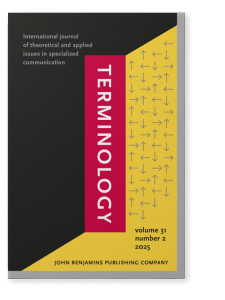
Terminology | International Journal of Theoretical and Applied Issues in Specialized Communication

Editors
ORCiD logo with linkKyo Kageura | University of Tokyo, Japan
ORCiD logo with linkRita Temmerman | Vrije Universiteit Brussel, Belgium

Terminology is an independent journal with a cross-cultural and cross-disciplinary scope. It focuses on the discussion of (systematic) solutions not only of language problems encountered in translation, but also, for example, of (monolingual) problems of ambiguity, reference and developments in multidisciplinary communication. Particular attention will be given to new and developing subject areas such as knowledge representation and transfer, information technology tools, expert systems and terminological databases. Terminology encompasses terminology both in general (theory and practice) and in specialized fields (LSP), such as physics; biomedical sciences; technology; engineering; humanities; management; law; arts; business administration; trade; corporate identity; economics; methodology; and any other area in which terminology is essential to improve communication.

Terminology publishes its articles Online First.

ISSN: 0929-9971 | E-ISSN: 1569‑9994
DOI logo with link
https://doi.org/10.1075/term
Latest articles

23 March 2026

  • Consistency beyond terms: Translating terminological chains
    Rossella Resi
  • 9 March 2026

  • Gender-sensitive language in terminological definitions: A case study on Italian legal concepts
    Elena ChiocchettiNatascia Ralli
  • Domain properties and the representation of terminological relations
    Pius ten Hacken
  • Terms as linguistic and domain specific units: A translation perspective
    Maria Koliopoulou
  • Meaning distinctions in terminology research: A lexicon-driven approach applied to Brazilian Portuguese
    Flávia Lamberti
  • Terminology beyond terms
    Pius ten HackenRossella Resi
  • 4 March 2026

  • Rossella ResiFrieda Steurs (eds). 2025. Terminology planning in Europe
    Reviewed by Margaret Rogers
  • 26 February 2026

  • Evaluating the extraction of Italian institutional terminology: A comparative study between Sketch Engine and ChatGPT-4o
    Helena Ortiz-Garduño
  • Multidimensional analysis of H&SS terminology translation: A case study
    Ying Xu
  • 20 January 2026

  • Wine words, cultural worlds: A systematic review of metaphor and language in global wine communication
    Allison Creed
  • Developing a ship-shore radio communication technical vocabulary list
    Wen ZhaoXiaoyan Wei
  • 1 December 2025

  • Representing multiword expressions in terminology resources: From a traditional to a construction-based approach
    Marie-Claude L’Homme
  • 27 November 2025

  • Kara WarburtonJohn Humbley (eds). 2025. Terminology throughout History: A discipline in the making
    Reviewed by Lynne Bowker
  • 14 October 2025

  • Discovering hyponymic knowledge patterns in English
    Antonio San MartínCatherine Trekker
  • 13 October 2025

  • Terminology in genetic-linguistic studies as a political issue: The case of the South Slavic dialectal continuum
    Igor Ivašković
  • Translation of medical terms from an ethical perspective: A case study of the Chinese translation of Alzheimer’s disease
    Aling Shi
  • 11 July 2025

  • Investigating Western social science terminology in China’s late Qing and early Republican Eras: A case study of Yan Fu’s translations
    Lichun Tao, Yanjun PanZixuan Wang
  • 23 May 2025

  • Designing a termbase in the context of European higher education: The Arqus Termbase
    Esther Castillo-PérezSilvia Montero-Martínez | TERM 31:1 (2025) pp. 136–170
  • LlamATE: Automated terminology extraction using large‑scale generative language models
    Hanh Thi-Hong Tran, Carlos-Emiliano González-Gallardo, Antoine DoucetSenja Pollak | TERM 31:1 (2025) p. 5
  • When LMF and TMF meet: Towards a Unified Markup Framework (UMF)
    Federica Vezzani, Giorgio Maria Di Nunzio, Ana SalgadoRute Costa | TERM 31:1 (2025) p. 72
  • AI as a resource for the clarification of medical terminology: An analysis of its advantages and limitations
    Laia Vidal SabanésIria da Cunha | TERM 31:1 (2025) pp. 37–71
  • Impact of automatic term extraction on terminology work: A qualitative interview study in institutional settings
    Tanja Wissik | TERM 31:1 (2025) pp. 110–135
  • Introduction to the special issue on Computational Terminology
    Ayla Rigouts TerrynPatrick Drouin | TERM 31:1 (2025) pp. 1–4
  • 18 February 2025

  • Pamela FaberMarie-Claude L’Homme (Ed.). 2022. Theoretical Perspectives on Terminology: Explaining terms, concepts and specialized knowledge
    Reviewed by Xiaofang WuRunze Liu | TERM 31:2 (2025) pp. 335–348
  • 14 February 2025

  • Pruning translation of logical and accidental polysemy in traditional Chinese medicine terminology
    Yuehui Hou | TERM 31:2 (2025) pp. 311–334
  • Terminology: Ancient Chinese way
    Xingfeng Liu
  • 10 February 2025

  • A corpus-based cognitive linguistic analysis of taste terms: The case of English Sour and Chinese suan
    Ting Zhang, Hicham LahlouYasir Azam | TERM 31:2 (2025) pp. 267–310
  • IssuesOnline-first articles

    Volume 31 (2025)

    Volume 30 (2024)

    Volume 29 (2023)

    Volume 28 (2022)

    Volume 27 (2021)

    Volume 26 (2020)

    Volume 25 (2019)

    Volume 24 (2018)

    Volume 23 (2017)

    Volume 22 (2016)

    Volume 21 (2015)

    Volume 20 (2014)

    Volume 19 (2013)

    Volume 18 (2012)

    Volume 17 (2011)

    Volume 16 (2010)

    Volume 15 (2009)

    Volume 14 (2008)

    Volume 13 (2007)

    Volume 12 (2006)

    Volume 11 (2005)

    Volume 10 (2004)

    Volume 9 (2003)

    Volume 8 (2002)

    Volume 7 (2001)

    Volume 6 (2000)

    Volume 5 (1998/99)

    Volume 4 (1997)

    Volume 3 (1996)

    Volume 2 (1995)

    Volume 1 (1994)

    Editorial info
    Editors
    ORCiD logo with linkKyo Kageura | University of Tokyo, Japan
    ORCiD logo with linkRita Temmerman | Vrije Universiteit Brussel, Belgium
    Editorial Board
    ORCiD logo with linkBassey E. Antia | University of the Western Cape, South Africa
    ORCiD logo with linkŁucja Biel | University of Warsaw, Poland
    ORCiD logo with linkLynne Bowker | Université Laval, Canada
    ORCiD logo with linkMíriam Buendía Castro | University of Granada, Spain
    ORCiD logo with linkMarc Van Campenhoudt | Institut Supérieur de Traducteurs et Interprètes, Belgium
    Yongjun Dai | Anhui University of Technology, China
    ORCiD logo with linkBéatrice Daille | Université de Nantes, France
    ORCiD logo with linkPatrick Drouin | Université de Montréal, Canada
    ORCiD logo with linkIsabel Durán-Muñoz | Universidad de Córdoba, Spain
    ORCiD logo with linkPascaline Dury | Université Lumière 2 Lyon, France
    ORCiD logo with linkJan Engberg | Aarhus University, Denmark
    ORCiD logo with linkRosa Estopà | Universitat Pompeu Fabra, Spain
    ORCiD logo with linkPamela Faber | University of Granada, Spain
    ORCiD logo with linkSabela Fernández-Silva | Pontificia Universidad Católica de Valparaíso, Chile
    ORCiD logo with linkJohn Humbley | Université Paris-Diderot, France
    Ernie Jiali Du | Guangdong University of Foreign Studies, China
    Koen Kerremans | Vrije Universiteit Brussel, Belgium
    ORCiD logo with linkMarita Kristiansen | NHH, Norwegian School of Economics, Norway
    ORCiD logo with linkMarie-Claude L'Homme | University of Montreal, Canada
    ORCiD logo with linkPilar León-Araúz | University of Granada, Spain
    ORCiD logo with linkElizabeth Marshman | University of Ottawa, Canada
    ORCiD logo with linkMojca Pecman | Université de Paris, France
    ORCiD logo with linkKatia Peruzzo | University of Trieste, Italy
    ORCiD logo with linkAyla Rigouts Terryn | Université de Montréal & Mila, Canada
    ORCiD logo with linkMargaret Rogers | University of Surrey, UK
    Micaela Rossi | University of Genoa, Italy
    Young-Bin Song | Ewha Women's University, Seoul, Korea
    ORCiD logo with linkŠpela Vintar | University of Ljubljana, Slovenia
    ORCiD logo with linkKara Warburton | Université du Québec à Trois-Rivières, Canada
    Xiangqing Wei | Nanjing University, China
    Maria-Cornelia Wermuth | KU Leuven, Belgium
    Subscription Info
    Current issue: 31:2, available as of July 2025

    General information about our electronic journals.

    Subscription rates

    All prices for print + online include postage/handling.

    Online-onlyPrint + online
    Volume 32 (2026): 2 issues; ca. 300 pp.EUR 296.00EUR 410.00

    Individuals may apply for a special online-only subscription rate of EUR 65.00 per volume.
    Private subscriptions are for personal use only, and must be pre-paid and ordered directly from the publisher.

    Available back-volumes

    Online-onlyPrint + online
    Complete backset
    (Vols. 1‒31; 1994‒2025)
    62 issues;
    9,300 pp.
    EUR 7,798.00EUR 8,478.00
    Volume 31 (2025) 2 issues; 300 pp.EUR 287.00EUR 387.00
    Volume 30 (2024) 2 issues; 300 pp.EUR 279.00EUR 352.00
    Volume 29 (2023) 2 issues; 300 pp.EUR 271.00EUR 320.00
    Volumes 26‒28 (2020‒2022) 2 issues; avg. 300 pp.EUR 271.00 per volumeEUR 314.00 per volume
    Volume 25 (2019) 2 issues; 300 pp.EUR 266.00EUR 308.00
    Volume 24 (2018) 2 issues; 300 pp.EUR 258.00EUR 299.00
    Volume 23 (2017) 2 issues; 300 pp.EUR 250.00EUR 290.00
    Volume 22 (2016) 2 issues; 300 pp.EUR 250.00EUR 282.00
    Volume 21 (2015) 2 issues; 300 pp.EUR 250.00EUR 274.00
    Volume 20 (2014) 2 issues; 300 pp.EUR 250.00EUR 266.00
    Volume 19 (2013) 2 issues; 300 pp.EUR 250.00EUR 258.00
    Volumes 1‒18 (1994‒2012) 2 issues; avg. 300 pp.EUR 243.00 per volumeEUR 250.00 per volume
    Author info

    Terminology offers online submission .

    Before submitting, please consult the guidelines and the Short Guide to EM for Authors .

    If you are not able to submit online, or for any other editorial correspondence, please contact the editors via e-mail: kyo at p.u-tokyo.ac.jp and/or Rita.Temmerman at vub.be

    Ethics

    John Benjamins journals are committed to maintaining the highest standards of publication ethics and to supporting ethical research practices.

    Authors and reviewers are kindly requested to read this Ethics Statement.

    Please also note the guidance on (the declaration of) the use of Artificial Intelligence.

    Rights and Permissions

    Authors must ensure that they have permission to use any third-party material in their contribution; the permission should include perpetual (not time-limited) world-wide distribution in print and electronic format.

    For information on authors' rights, please consult the rights information page.

    Open Access

    Articles accepted for this journal can be made Open Access through payment of an Article Publication Charge (APC) of EUR 1800 (excl. tax). To arrange this, please contact openaccess at benjamins.nl as soon as your paper has been accepted for publication. More information can be found on the publisher's Open Access Policy page.

    Corresponding authors from institutions with which John Benjamins has a Read & Publish arrangement can publish Open Access without paying a fee. Please consult this list of institutions for up-to-date information on which articles qualify.

    For information about permission to post a version of your article online or in an institutional repository ('green' open access or self-archiving), please consult the rights information page.

    If the article is not (to be made) Open Access, there is no fee for the author to publish in this journal.

    Archiving

    John Benjamins Publishing Company has an agreement in place with Portico for the archiving of all its online journals and e-books.

    Call for Papers

    Call for Papers

    Call for Papers on Terminology and AI. Special Issue Terminology 33:1 (2027)

    Call for Papers on The Art of Defining: Innovations and Challenges in crafting Terminological and Lexicographic Definitions. Special Issue Terminology 34:1 (2028)

    Mobile Menu Logo with link to supplementary files background Layer 1 prag Twitter_Logo_Blue