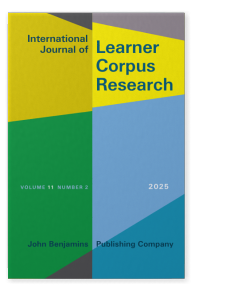
International Journal of Learner Corpus Research
Main information
Journal metrics
Impact Factor: 2.2Journal Citation Indicator: 1.15
CiteScore: 3.3
SNIP: 1.257 SJR: 0.732
This journal is peer reviewed and indexed in: CNKI Scholar ; Dimensions ; ERIH PLUS ; Glottolog ; IBR/IBZ ; Linguistics Abstracts Online ; Scopus ; WoS Emerging Sources Citation Index (ESCI )
The International Journal of Learner Corpus Research (IJLCR) is a forum for researchers who collect, annotate, and analyse computer learner corpora and/or use them to investigate topics in Second Language Acquisition and linguistic theory in general, inform foreign and second language teaching, develop learner-corpus-informed tools (e.g. courseware, proficiency tests, dictionaries and grammars) or conduct natural language processing tasks (e.g. annotation, automatic spell- and grammar-checking, L1 identification). IJLCR aims to highlight the multidisciplinary and broad scope of practice that characterizes the field and publishes original research covering methodological, theoretical and applied work in any area of learner corpus research. IJLCR features research articles, review articles, replication studies, corpus reports, materials & methods reports, software reports, shared task reports, position papers and reviews of books, corpora and software tools. The language of the journal is English. The journal will occasionally publish special issues (for details please contact the general editors). All contributions are peer-reviewed.
IJLCR publishes its articles Online First.

Latest articles
15 January 2026
4 November 2025
7 October 2025
21 August 2025
15 May 2025
1 April 2025
10 March 2025
13 January 2025
10 January 2025
9 January 2025
9 December 2024
Issues
Online-first articlesVolume 11 (2025)
Volume 10 (2024)
Volume 9 (2023)
Volume 8 (2022)
Volume 7 (2021)
Volume 6 (2020)
Volume 5 (2019)
Volume 4 (2018)
Volume 3 (2017)
Volume 2 (2016)
Volume 1 (2015)
Editorial info
Subscription Info
General information about our electronic journals.
Subscription rates
All prices for print + online include postage/handling.
| Online-only | Print + online | ||
|---|---|---|---|
| Volume 12 (2026): 2 issues; ca. 300 pp. | EUR | EUR |
Individuals may apply for a special online-only subscription rate of EUR
Private subscriptions are for personal use only, and must be pre-paid and ordered directly from the publisher.
Available back-volumes
| Online-only | Print + online | ||
|---|---|---|---|
| Complete backset (Vols. 1‒11; 2015‒2025) | 22 issues; 3,300 pp. | EUR 1,677.00 | EUR 1,939.00 |
| Volume 11 (2025) | 2 issues; 300 pp. | EUR | EUR |
| Volume 10 (2024) | 2 issues; 300 pp. | EUR | EUR |
| Volume 9 (2023) | 2 issues; 300 pp. | EUR | EUR |
| Volumes 6‒8 (2020‒2022) | 2 issues; avg. 300 pp. | EUR | EUR |
| Volume 5 (2019) | 2 issues; 300 pp. | EUR | EUR |
| Volume 4 (2018) | 2 issues; 300 pp. | EUR | EUR |
| Volume 3 (2017) | 2 issues; 300 pp. | EUR | EUR |
| Volume 2 (2016) | 2 issues; 300 pp. | EUR | EUR |
| Volume 1 (2015) | 2 issues; 300 pp. | EUR | EUR |
Author info
Manuscripts can be submitted through the journal's online submission and manuscript tracking site. Please consult the guidelines section, the IJLCR stylesheet and the Short Guide to EM for Authors before you submit your paper.
If you are not able to submit online, or for any other editorial correspondence, please contact the editors by e-mail: ijlcrbenjamins.nl
IJLCR invites original submissions in the following categories:
Research articles
Research articles are original research papers presenting research findings based on the analysis of learner corpora. Research findings should move the field forward, either by proposing theoretical developments, methodological advances, and/or pedagogical applications.
Replication studies
Replication studies are empirical studies motivated by a previously published study (not necessarily published in the IJLCR). They reproduce and/or extend the methodology proposed in an initial study of significant impact and of credible methodological rigour within its domain of research. They aim to verify findings and/or examine the generalizability of the insights obtained in earlier learner corpus studies.
The background and motivation sections may be shorter compared to research articles but should clarify why there is a need for replicating the selected study.
Review articles
Review articles are systematic state-of-the-art analyses of research published in the field. They offer a summary of findings and make critical observations on published research to date. Manuscripts submitted under this category can be of two kinds: (1) reviews of study quality in LCR and (2) meta-analyses in a particular domain of LCR.
Corpus reports
Corpus reports present a detailed description of new learner corpora (i.e. corpus design, collection, transcription, annotation and distribution). Such reports should focus on learner corpora that are original in their design and/or construction, available (stored online or available via a data repository) and with high potential for reuse by the research community.
Materials & methods reports
Materials and methods reports provide details of the methods and protocols developed and materials used during a research cycle (e.g. corpus annotation schemes, learner questionnaires). Researchers can co-submit their report to IJLCR together with the original research article.
Software reports
Software reports present a detailed description of a new software tool or code and how it can be used to compile, annotate and/or analyze learner corpus data. Software reports should focus on tools that offer researchers new ways to compile, annotate or analyse a learner corpus and are available to the research community.
Shared task reports
Shared task reports present the cumulative results of shared tasks organized to promote research advancement by solving a problem of general interest to the community (e.g. error identification and correction, native language identification) on the basis of learner corpus data.
Position papers
Position papers are shorter essays (i.e., papers not based on original empirical research) motivated by current theoretical, methodological and/or pedagogical issues that are of general interest to the community. We also welcome responses to position papers.
Articles under consideration are double-blind peer-reviewed and decisions on all published content are made by the editors.
Open Science
This journal encourages Open Science practices and participates in the Centre for Open Science badges. If you want your submission to qualify for any COS badges, read this information before submitting.
Ethics
John Benjamins journals are committed to maintaining the highest standards of publication ethics and to supporting ethical research practices.
Authors and reviewers are kindly requested to read this Ethics Statement.
Please also note the guidance on (the declaration of) the use of Artificial Intelligence.
Rights and Permissions
Authors must ensure that they have permission to use any third-party material in their contribution; the permission should include perpetual (not time-limited) world-wide distribution in print and electronic format.
For information on authors' rights, please consult the rights information page.
Open Access
Articles accepted for this journal can be made Open Access through payment of an Article Publication Charge (APC) of EUR 1800 (excl. tax). To arrange this, please contact openaccessbenjamins.nl as soon as your paper has been accepted for publication. More information can be found on the publisher's Open Access Policy page.
Corresponding authors from institutions with which John Benjamins has a Read & Publish arrangement can publish Open Access without paying a fee. Please consult this list of institutions for up-to-date information on which articles qualify.
For information about permission to post a version of your article online or in an institutional repository ('green' open access or self-archiving), please consult the rights information page.
If the article is not (to be made) Open Access, there is no fee for the author to publish in this journal.
Archiving
John Benjamins Publishing Company has an agreement in place with Portico for the archiving of all its online journals and e-books.