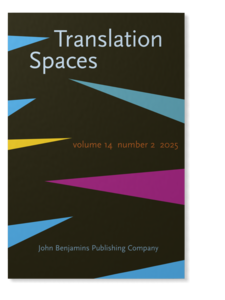
Translation Spaces | A multidisciplinary, multimedia, and multilingual journal of translation

Editors
ORCiD logo with linkDorothy Kenny | Dublin City University, Ireland | dorothy.kenny at dcu.ie
ORCiD logo with linkJoss Moorkens | Dublin City University, Ireland | joss.moorkens at dcu.ie
Consulting Editors
ORCiD logo with linkYves Gambier | University of Turku & Kaunas University of Technology (KTU), Lithuania
ORCiD logo with linkAnthony Pym | Rovira i Virgili University, Spain
Editorial Assistant
Kristien Temperville | Ghent University
Founding Editors
ORCiD logo with linkDeborah A. Folaron | Concordia University, Canada
ORCiD logo with linkGregory M. Shreve | Kent State University, USA
Associate Editors
ORCiD logo with linkSalah Basalamah | University of Ottawa, Canada
ORCiD logo with linkRenée Desjardins | Université de Saint-Boniface, Canada
ORCiD logo with linkDavid Orrego-Carmona | University of Warwick, UK
ORCiD logo with linkFernando Prieto Ramos | Université de Genève, Switzerland
ORCiD logo with linkAkiko Sakamoto | Kansai University, Japan

Journal metrics

Impact Factor: 1.5 (5-year: 1.7)
Journal Citation Indicator: 1.21
CiteScore: 3.5
SNIP: 2.001 SJR: 0.764

This journal is peer reviewed and indexed in: ANVUR Riviste scientifiche (ANVUR ) ; CNKI Scholar ; Dimensions ; ERIH PLUS ; Glottolog ; IBR/IBZ ; Linguistic Bibliography/Bibliographie Linguistique ; Linguistics Abstracts Online ; Linguistics and Language Behavior Abstracts (LLBA ) ; MLA International Bibliography ; Scopus ; Translation Studies Bibliography (TSB ) ; WoS Emerging Sources Citation Index (ESCI )

Translation Spaces is a biannual, peer-reviewed, indexed journal that recognizes the global impact of translation. It envisions translation as multi-dimensional phenomena productively studied (from) within complex spaces of encounter between knowledge, values, beliefs, and practices. These translation spaces -virtual and physical- are multidisciplinary, multimedia, and multilingual. They are the frontiers being explored by scholars investigating where and how translation practice and theory interact most dramatically with the evolving landscape of contemporary globalization.
The journal actively encourages researchers from diverse domains such as communication studies, technology, economics, commerce, law, politics, news, entertainment, and the sciences to engage in translation scholarship. It explicitly aims to stimulate an ongoing interdisciplinary and inter-professional dialogue among diverse communities of research and practice.
Translation Spaces publishes two issues per year. The first issue (1) is open for thematic proposals from potential guest editors. The second issue (2) welcomes submissions that consider translation in terms of global dynamics impacted by the technologies used in diverse social, cultural, political, and legal settings, and by which they are transformed.

Translation Spaces publishes its articles Online First.

Social media presence:
https://bsky.app/profile/transpaces.bsky.social
https://www.facebook.com/TranslationSpaces/

ISSN: 2211-3711 | E-ISSN: 2211‑372X
DOI logo with link
https://doi.org/10.1075/ts
Latest articles

26 February 2026

  • Network of passion: Actor-network in the domain of video game localization in Thailand
    Koraya Techawongstien
  • 20 February 2026

  • The practice of retranslation in subtitling
    Jorge Díaz Cintas
  • 2 February 2026

  • Activist translators as citizen journalists on social media
    Nina Havumetsä
  • Worldbuilding, narrative, and agency in the intersemiotic translations of ‘The Witcher’
    Zoran PoposkiMarija Todorova
  • Visual attention, perception, and performance of international students in EMI lectures with automatic live intralingual subtitles
    Yanou Van Gauwbergen, Isabelle S. RobertIris Schrijver
  • 27 January 2026

  • Ergonomics, well-being and sustainability in translator training environments: Issues, concerns and potential solutions
    Julián Zapata
  • 15 December 2025

  • Creativity in audio description: Culture-specific references in I leoni di Sicilia
    Alessandra Rizzo
  • 2 December 2025

  • Smurfing beyond translation: A relevance-theoretical analysis of Arabic localization in The Smurfs
    Raja Lahiani
  • 24 November 2025

  • Linguistic issues in the localization of English video games into Arabic: A descriptive study
    Ekrema ShehabSaqir Odeh
  • Missing the human touch? A computational stylometric analysis of GPT-4 translations of online Chinese literature
    Xiaofang Yao, Yong-Bin KangAnthony McCosker | TS 14:2 (2025) pp. 303–330
  • 11 November 2025

  • Conceptualisations of ‘translation’ in machine translation research and development
    Michael Tieber
  • 28 October 2025

  • The use of machine translation as a multilingual communication strategy: The case of Ukrainian war refugees in Czechia
    Anna AgapovaStanislava Špačková | TS 14:2 (2025) pp. 331–354
  • In pursuit of the cinematic experience: Film translation in the late silent era
    Serenella Zanotti
  • 6 October 2025

  • The effects of corpus-focused instruction on the development of stylistic translation revision competence in future translators
    Ella Diels, Jim J. J. Ureel, Isabelle S. RobertCarola Strobl | TS 14:2 (2025) pp. 221–252
  • The machine translator’s visibility: A postphenomenological analysis of machine translation
    Joss Moorkens
  • Translation and queer audiovisual culture: Embodiment in the music video of “Es una pasiva”
    Iván Villanueva-Jordán
  • 25 September 2025

  • RETRACTION OF: Tracing the temporal dynamics of emotion and cognition in behavioral translation data
  • 11 September 2025

  • Rethinking creativity in dubbing: Potential impact of AI dubbing technologies on creative practices, roles and viewer perceptions
    Giselle Spiteri Miggiani
  • Creativity in didactic audiovisual translation: Possibilities and preliminary findings
    Noa TalavánJennifer Lertola
  • 11 July 2025

  • Rethinking censorship in translation: A Bourdieusian field approach
    Behrouz Karoubi | TS 14:2 (2025) pp. 171–194
  • 7 July 2025

  • Self-Determined Participation (SDP): A theoretical framework for explaining unpaid human participation in translation (and beyond?)
    Boyi Huang | TS 14:2 (2025) pp. 195–220
  • 30 June 2025

  • Exploring creative audiovisual translation in the age of AI
    Serenella Massidda
  • 5 June 2025

  • Is machine translation gisting translation?
    Mary Nurminen
  • 3 June 2025

  • LGBTQ+ terminology in Irish and other Celtic languages: Promoting pride in domain gain
    Jamie MurphyCiarán Mac Murchaidh | TS 14:1 (2025) p. 99
  • 13 May 2025

  • Audio accessibility in Arabic game localization: A multimodal study of nonverbal subtitles for players who are d/Deaf and hard of hearing
    Mohammed Al-Batineh | TS 14:2 (2025) pp. 277–302
  • 4 April 2025

  • Translated from English or created in Spanish? The reception of audio description for video games: An experimental pilot study
    Carme MangironXiaochun Zhang | TS 14:1 (2025) pp. 146–169
  • “Google Translate is our best friend here”: A vignette-based interview study on machine translation use for health communication
    Susana ValdezAna Guerberof-Arenas | TS 14:2 (2025) pp. 253–276
  • 11 March 2025

  • Faster, but not less demanding: Comparing gender-fair post-editing with translation
    Manuel Lardelli | TS 14:1 (2025) pp. 120–145
  • Exploring the ethical perspectives of translation students and professional translators on translation technology: A Q-methodological study
    Yizhu Li | TS 14:1 (2025) pp. 74–98
  • 6 February 2025

  • Narratives in film title translation: A study of films by Zhang Yimou and Jia Zhangke
    Qi ZhangCaitríona Osborne | TS 14:1 (2025) pp. 25–49
  • 21 November 2024

  • An eye-tracking study on the cognitive processing, reception, and perception of swearword translation in films
    Qihang JiangStephen Doherty | TS 13:2 (2024) pp. 293–329
  • Point of view and narrative in Wikipedia translation: Towards a common research framework
    Mark Shuttleworth | TS 13:2 (2024) pp. 330–353
  • Volumes and issuesOnline-first articles

    Volume 14 (2025)

    Volume 13 (2024)

    Volume 12 (2023)

    Volume 11 (2022)

    Volume 10 (2021)

    Volume 9 (2020)

    Volume 8 (2019)

    Volume 7 (2018)

    Volume 6 (2017)

    Volume 5 (2016)

    Volume 4 (2015)

    Volume 3 (2014)

    Volume 2 (2013)

    Volume 1 (2012)

    Editorial info
    Editors
    ORCiD logo with linkDorothy Kenny | Dublin City University, Ireland | dorothy.kenny at dcu.ie
    ORCiD logo with linkJoss Moorkens | Dublin City University, Ireland | joss.moorkens at dcu.ie
    Consulting Editors
    ORCiD logo with linkYves Gambier | University of Turku & Kaunas University of Technology (KTU), Lithuania
    ORCiD logo with linkAnthony Pym | Rovira i Virgili University, Spain
    Editorial Assistant
    Kristien Temperville | Ghent University
    Founding Editors
    ORCiD logo with linkDeborah A. Folaron | Concordia University, Canada
    ORCiD logo with linkGregory M. Shreve | Kent State University, USA
    Associate Editors
    ORCiD logo with linkSalah Basalamah | University of Ottawa, Canada
    ORCiD logo with linkRenée Desjardins | Université de Saint-Boniface, Canada
    ORCiD logo with linkDavid Orrego-Carmona | University of Warwick, UK
    ORCiD logo with linkFernando Prieto Ramos | Université de Genève, Switzerland
    ORCiD logo with linkAkiko Sakamoto | Kansai University, Japan
    Subscription Info
    Current issue: 14:2, available as of December 2025

    General information about our electronic journals.

    Subscription rates

    All prices for print + online include postage/handling.

    Online-onlyPrint + online
    Volume 15 (2026): 2 issues; ca. 320 pp.EUR 231.00EUR 322.00

    Individuals may apply for a special online-only subscription rate of EUR 55.00 per volume.
    Private subscriptions are for personal use only, and must be pre-paid and ordered directly from the publisher.

    Available back-volumes

    Online-onlyPrint + online
    Complete backset
    (Vols. 1‒14; 2012‒2025)
    25 issues;
    4,120 pp.
    EUR 2,723.00EUR 3,170.00
    Volume 14 (2025) 2 issues; 320 pp.EUR 224.00EUR 304.00
    Volume 13 (2024) 2 issues; 320 pp.EUR 217.00EUR 276.00
    Volume 12 (2023) 2 issues; 320 pp.EUR 211.00EUR 251.00
    Volumes 9‒11 (2020‒2022) 2 issues; avg. 320 pp.EUR 211.00 per volumeEUR 246.00 per volume
    Volume 8 (2019) 2 issues; 320 pp.EUR 207.00EUR 241.00
    Volume 7 (2018) 2 issues; 320 pp.EUR 201.00EUR 234.00
    Volume 6 (2017) 2 issues; 320 pp.EUR 195.00EUR 227.00
    Volume 5 (2016) 2 issues; 320 pp.EUR 195.00EUR 220.00
    Volume 4 (2015) 2 issues; 320 pp.EUR 195.00EUR 214.00
    Volume 3 (2014) 1 issue; 200 pp.EUR 150.00EUR 160.00
    Volume 2 (2013) 1 issue; 200 pp.EUR 150.00EUR 155.00
    Volume 1 (2012) 1 issue; 200 pp.EUR 145.00EUR 150.00
    Author info

    Please consult the Translation Spaces journal guidelines before you submit your article.

    Please submit articles through the John Benjamins Publishing Editorial Manager system.

    For any other editorial correspondence, please contact the general editors by e-mail:

    Dorothy Kenny
    Dublin City University
    dorothy.kenny at dcu.ie

    Joss Moorkens
    Dublin City University
    joss.moorkens at dcu.ie

    Ethics

    John Benjamins journals are committed to maintaining the highest standards of publication ethics and to supporting ethical research practices.

    Authors and reviewers are kindly requested to read this Ethics Statement.

    Please also note the guidance on (the declaration of) the use of Artificial Intelligence.

    Rights and Permissions

    Authors must ensure that they have permission to use any third-party material in their contribution; the permission should include perpetual (not time-limited) world-wide distribution in print and electronic format.

    For information on authors' rights, please consult the rights information page.

    Open Access

    Articles accepted for this journal can be made Open Access through payment of an Article Publication Charge (APC) of EUR 1800 (excl. tax). To arrange this, please contact openaccess at benjamins.nl as soon as your paper has been accepted for publication. More information can be found on the publisher's Open Access Policy page.

    Corresponding authors from institutions with which John Benjamins has a Read & Publish arrangement can publish Open Access without paying a fee. Please consult this list of institutions for up-to-date information on which articles qualify.

    For information about permission to post a version of your article online or in an institutional repository ('green' open access or self-archiving), please consult the rights information page.

    If the article is not (to be made) Open Access, there is no fee for the author to publish in this journal.

    Archiving

    John Benjamins Publishing Company has an agreement in place with Portico for the archiving of all its online journals and e-books.

    Mobile Menu Logo with link to supplementary files background Layer 1 prag Twitter_Logo_Blue