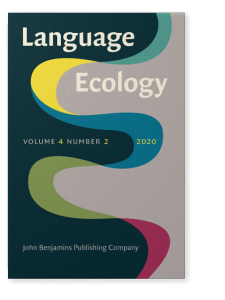
Language Ecology
General Editors
This journal is peer reviewed and indexed in: CNKI Scholar ; Glottolog
Publishing status: Discontinued
The ecology of language is a framework for the study of language as conceptualised primarily in Einar Haugen’s 1971/72 work, where he defines language ecology as “the study of interactions between any given language and its environment”. It was a reaction to the abstract notion of language – as a monolithic, decontextualised, static entity – propagated by Chomsky, and it was conceived as a broad and interdisciplinary framework. In his use of ‘ecology’ as a metaphor from biology in linguistics, Haugen formulated ten questions which together comprehensively address factors pertaining to the positioning of languages in their environment. Each of these relates to a traditional sub-field of the study of language – encompassing historical linguistics, linguistic demography, sociolinguistics, contact, variation, philology, planning and policy, politics of language, ethnolinguistics, and typology – and each of them intersects with one or more of the other sub-fields. Taken together, answering some or all of these questions is part of the enterprise of the ecology of language. Since then the notion of ecology in linguistics has evolved to address matters of social, educational, historical and developmental nature. With the development of ecology as a special branch of biology, and issues of the 20th and 21st centuries such as migration, hybridity and marginalisation coming to the fore, the notion of language ecology plays an important part in addressing broad issues of language and societal change, endangerment, human rights, as well as more theoretical questions of classification and perceptions of languages, as envisaged in Haugen’s work.

Issues
Volume 4 (2020)
Volume 3 (2019)
Volume 2 (2018)
Volume 1 (2017)
Editorial info
General Editors
Editorial Board
Subscription Info
Current issue: 4:2, available as of May 2023
General information about our electronic journals.
Subscription rates
All prices for print + online include postage/handling.
| Online-only | Print + online |
|---|
Available back-volumes
| Online-only | Print + online | ||
|---|---|---|---|
| Complete backset (Vols. 1‒4; 2017‒2020) | 8 issues; 1,000 pp. | EUR 676.00 | EUR 751.00 |
| Volume 4 (2020) | 2 issues; 250 pp. | EUR | EUR |
| Volume 3 (2019) | 2 issues; 250 pp. | EUR | EUR |
| Volume 2 (2018) | 2 issues; 250 pp. | EUR | EUR |
| Volume 1 (2017) | 2 issues; 250 pp. | EUR | EUR |