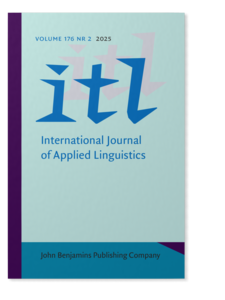
ITL - International Journal of Applied Linguistics
Journal metrics
Impact Factor: 1.5 (5-year: 2.3)Journal Citation Indicator: 1.70
CiteScore: 4.0
SNIP: 1.298 SJR: 0.901
This journal is peer reviewed and indexed in: CNKI Scholar ; Dimensions ; ERIH PLUS ; Glottolog ; IBR/IBZ ; Linguistic Bibliography/Bibliographie Linguistique ; Linguistics Abstracts Online ; Scopus ; WoS Emerging Sources Citation Index (ESCI )
ITL - International Journal of Applied Linguistics is a refereed journal devoted to studies in the field of language acquisition in a multilingual society. It is particularly interested in manuscripts reporting on studies that apply a multidisciplinary approach to research on second/foreign language acquisition of any language, mother tongue education, educational linguistics, computer-assisted language learning, classroom-based research, language policy, and language assessment. ITL welcomes manuscripts that critically discuss the pedagogical or policy implications of research results. The journal publishes reports of empirical studies, critical position papers and ground-breaking theoretical articles. Each volume also contains book reviews.
ITL was previously published by Peeters Publishers. John Benjamins Publishing Company is the official publisher as of Volume 165 (2013/2014).
ITL publishes its articles Online First.

Latest articles
24 March 2026
23 March 2026
17 March 2026
2 March 2026
20 January 2026
15 January 2026
13 January 2026
9 January 2026
8 January 2026
30 October 2025
16 September 2025
16 May 2025
6 May 2025
17 February 2025
14 February 2025
Volumes and issues
Online-first articlesVolume 176 (2025)
Volume 175 (2024)
Volume 174 (2023)
Volume 173 (2022)
Volume 172 (2021)
Volume 171 (2020)
Volume 170 (2019)
Volume 169 (2018)
Volume 168 (2017)
Volume 167 (2016)
Volume 166 (2015)
Volume 165 (2013–2014)
Volume 164 (2012)
Volume 163 (2012)
Volume 162 (2011) Language for Specific Purposes
Volume 161 (2011) Languages in Business Education: Introduction
Volume 160 (2010)
Volume 159 (2010)
Volume 158 (2009)
Volume 157 (2009)
Volume 156 (2008) Learning and Teaching L2 Writing
Volume 155 (2008)
Volume 154 (2007) La centration sur l'apprenant en didactique du FLE
Volume 153 (2007)
Volume 152 (2006) Task-Based Language Teaching
Volume 151 (2006)
Volume 149-150 (2005)
Volume 147-148 (2005)
Volume 145-146 (2004)
Volume 143-144 (2004)
Volume 141-142 (2003)
Volume 139-140 (2003)
Volume 137-138 (2002)
Volume 135-136 (2002)
Volume 133-134 (2001)
Volume 131-132 (2001)
Volume 129-130 (2000)
Volume 127-128 (2000)
Volume 125-126 (1999)
Volume 123-124 (1999)
Volume 121-122 (1998)
Volume 119-120 (1998)
Volume 117-118 (1997)
Volume 115-116 (1997)
Volume 113-114 (1996)
Volume 111-112 (1996)
Volume 109-110 (1995)
Volume 107-108 (1995)
Volume 105-106 (1994)
Volume 103-104 (1994)
Volume 101-102 (1993)
Volume 99-100 (1993)
Volume 97-98 (1992) Études offertes à Karel van den EyndeÉtudes offertes à Karel van den Eynde
Volume 95-96 (1992) Études offertes à Karel van den Eynde
Volume 93-94 (1991)
Volume 91-92 (1991)
Volume 89-90 (1990)
Volume 87-88 (1990)
Volume 85-86 (1989)
Volume 83-84 (1989) Dimensions of Language Attrition
Volume 81-82 (1988)
Volume 79-80 (1988)
Volume 77-78 (1987)
Volume 76 (1987)
Volume 75 (1987)
Volume 74 (1986)
Volume 73 (1986)
Volume 72 (1986)
Volume 71 (1986)
Volume 70 (1985)
Volume 69 (1985)
Volume 67-68 (1985)
Volume 66 (1985)
Volume 65 (1984)
Volume 64 (1984)
Volume 63 (1984)
Volume 62 (1983)
Volume 60-61 (1983) Papers of the workshop on Language and Prosody
Volume 59 (1983)
Volume 58 (1982)
Volume 57 (1982)
Volume 56 (1982)
Volume 55 (1982)
Volume 54 (1981)
Volume 53 (1981)
Volume 52 (1981)
Volume 51 (1981)
Volume 49-50 (1980)
Volume 48 (1980)
Volume 47 (1980)
Volume 45-46 (1979)
Volume 44 (1979)
Volume 43 (1979)
Volume 41-42 (1978)
Volume 39-40 (1978)
Volume 38 (1977)
Volume 37 (1977)
Volume 36 (1977)
Volume 35 (1977)
Volume 34 (1976)
Volume 33 (1976)
Volume 32 (1976)
Volume 31 (1976)
Volume 30 (1975)
Volume 29 (1975)
Volume 28 (1975)
Volume 27 (1975)
Volume 25-26 (1974)
Volume 24 (1974)
Volume 23 (1974)
Volume 22 (1973)
Volume 21 (1973)
Volume 20 (1973)
Volume 19 (1973)
Volume 18 (1972)
Volume 17 (1972)
Volume 16 (1972)
Volume 15 (1972)
Volume 14 (1971)
Volume 13 (1971)
Volume 12 (1971)
Volume 11 (1971)
Volume 10 (1970)
Volume 9 (1970)
Volume 8 (1970)
Volume 7 (1970)
Volume 6 (1969)
Volume 5 (1969)
Volume 4 (1969)
Volume 3 (1969)
Volume 2 (1968)
Volume 1 (1968)
Editorial info
Subscription Info
General information about our electronic journals.
Subscription rates
All prices for print + online include postage/handling.
| Online-only | Print + online | ||
|---|---|---|---|
| Volume 177 (2026): 2 issues; ca. 300 pp. | EUR | EUR |
Individuals may apply for a special online-only subscription rate of EUR
Private subscriptions are for personal use only, and must be pre-paid and ordered directly from the publisher.
Available back-volumes
| Online-only | Print + online | ||
|---|---|---|---|
| Complete backset (Vols. 1‒176; 1968‒2025) | 144 issues; 18,600 pp. | EUR 7,852.00 | EUR 8,717.00 |
| Volume 176 (2025) | 2 issues; 300 pp. | EUR | EUR |
| Volume 175 (2024) | 2 issues; 300 pp. | EUR | EUR |
| Volume 174 (2023) | 2 issues; 300 pp. | EUR | EUR |
| Volumes 171‒173 (2020‒2022) | 2 issues; avg. 300 pp. | EUR | EUR |
| Volume 170 (2019) | 2 issues; 300 pp. | EUR | EUR |
| Volume 169 (2018) | 2 issues; 300 pp. | EUR | EUR |
| Volume 168 (2017) | 2 issues; 300 pp. | EUR | EUR |
| Volume 167 (2016) | 2 issues; 300 pp. | EUR | EUR |
| Volume 166 (2015) | 2 issues; 300 pp. | EUR | EUR |
| Volume 165 (2014) | 2 issues; 300 pp. | EUR | EUR |
| Volumes 2‒164 (1968‒2012) | 1 issue; avg. 125 pp. | EUR | EUR |
Author info
Manuscripts can be submitted through the journal's online submission and manuscript tracking site. Please consult the guidelines and the Short Guide to EM for Authors before you submit your paper.
If you are not able to submit online, or for any other editorial correspondence, please contact the editors by e-mail: itlkuleuven.be
Articles under consideration are double-blind peer-reviewed and decisions on all published content are made by the editors.
Ethics
John Benjamins journals are committed to maintaining the highest standards of publication ethics and to supporting ethical research practices.
Authors and reviewers are kindly requested to read this Ethics Statement.
Please also note the guidance on (the declaration of) the use of Artificial Intelligence.
Rights and Permissions
Authors must ensure that they have permission to use any third-party material in their contribution; the permission should include perpetual (not time-limited) world-wide distribution in print and electronic format.
For information on authors' rights, please consult the rights information page.
Open Access
Articles accepted for this journal can be made Open Access through payment of an Article Publication Charge (APC) of EUR 1800 (excl. tax). To arrange this, please contact openaccessbenjamins.nl as soon as your paper has been accepted for publication. More information can be found on the publisher's Open Access Policy page.
Corresponding authors from institutions with which John Benjamins has a Read & Publish arrangement can publish Open Access without paying a fee. Please consult this list of institutions for up-to-date information on which articles qualify.
For information about permission to post a version of your article online or in an institutional repository ('green' open access or self-archiving), please consult the rights information page.
If the article is not (to be made) Open Access, there is no fee for the author to publish in this journal.
Archiving
John Benjamins Publishing Company has an agreement in place with Portico for the archiving of all its online journals and e-books.