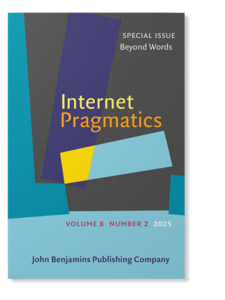
Internet Pragmatics

Main information
Editors
ORCiD logo with linkChaoqun Xie | Zhejiang International Studies University, China | internetpragmatics at foxmail.com
ORCiD logo with linkFrancisco Yus | University of Alicante, Spain
Review Editor
ORCiD logo with linkSanna-Kaisa Tanskanen | University of Helsinki, Finland
Editorial Assistant
Xinru Ding | Zhejiang International Studies University, China

Journal metrics

Impact Factor: 0.7 (5-year: 1.7)
Journal Citation Indicator: 0.97
CiteScore: 4.4
SNIP: 1.287 SJR: 0.822

This journal is peer reviewed and indexed in: Bibliography of Pragmatics Online (BoP ) ; CNKI Scholar ; Dimensions ; ERIH PLUS ; Glottolog ; IBR/IBZ ; Linguistic Bibliography/Bibliographie Linguistique ; Linguistics Abstracts Online ; Linguistics and Language Behavior Abstracts (LLBA ) ; MLA International Bibliography ; Scopus ; WoS Emerging Sources Citation Index (ESCI )

A large proportion of human interaction today takes place online –via social media, instant messaging, and other digitally-mediated platforms – bringing into focus the discursive construction of digital selves, communicative actions in virtual spaces, and evolving codes of interaction. Internet Pragmatics was launched to address the growing need for pragmatic perspectives on technologically mediated interaction. In the age of artificial intelligence and large language models, new forms of human–machine and machine-mediated communication have emerged, reshaping how meaning is produced, negotiated and understood in cyberspace.

The journal provides a fully peer-reviewed forum for cutting-edge research exploring how people – and intelligent systems – use online platforms to meet communicative, social and professional needs, and how these virtual interactions carry pragmatic implications for identity, relationships and collective formation. It also investigates the connections and contrasts between online and offline interaction, the intertwined nature of digital and physical identity, and the influence of algorithmic and automated mediation on language use across contexts.

Internet Pragmatics especially welcomes qualitative studies offering original thought and insight—research that advances understanding through rich context, nuanced interpretation and genuine theoretical contribution. The journal encourages interdisciplinary work bridging pragmatics with sociology, media studies, digital communication, discourse analysis, cognitive science, anthropology, psychology, and philosophy, contributing to deeper insight into language use and interaction in an age of intelligent technology. The journal does not accept unsolicited reviews.

Internet Pragmatics
publishes its articles Online First.

Social media presence:
https://www.facebook.com/ip2018
https://x.com/iPragmatics

ISSN: 2542-3851 | E-ISSN: 2542‑386X
DOI logo with link
https://doi.org/10.1075/ip
Latest articles

17 March 2026

  • “This is so Vine coded”: Genre, nostalgia, and strategies of multimodal intertextuality on TikTok
    Kendra Calhoun
  • Impoliteness in social media: The case of Syrian Arabic Facebook comments
    Christina Hodeib
  • 13 March 2026

  • Animal personas, ambivalent judgements, and affective effects in social media reels
    Agnieszka Piskorska
  • 9 March 2026

  • Emoji as resources for negotiating affiliation and taste in TikTok comments
    Michele Zappavigna
  • 4 March 2026

  • “Your account has been compromised”: Exploring emotional triggers in scam emails
    Mostafa Morady MoghaddamErhan Aslan
  • 23 February 2026

  • The affective dynamics of online discourse
    Anna Piata
  • 7 November 2025

  • Presentism as a digital language ideology in generative AI discourse
    Theresa Heyd
  • 11 September 2025

  • “This looks so good 😭”: Emoji functions in compliments on TikTok and DouYin
    Fang Xie
  • 5 August 2025

  • Lightening the mood with visual humor: The pragmatic functions of GIFs
    Ashley R. Dainas | IP 8:2 (2025) pp. 295–325
  • 29 July 2025

  • Face-work on Chinese social media: Functional interactions between the Doge emoji and verbal text
    Yanmin WuYiqiong Zhang | IP 8:2 (2025) pp. 186–213
  • 17 July 2025

  • “Dump her!”: Stancetaking in multimodal replies to ‘Am I the Asshole?’ Twitter posts
    Elizabeth MarsdenAlba Milà-Garcia | IP 8:2 (2025) pp. 267–294
  • “Should I text or should I shoot?”: Exploring the use and interpretation of screenshots in mobile instant messaging interactions
    Agnese Sampietro | IP 8:2 (2025) pp. 326–353
  • 11 July 2025

  • Kisses and peaches: A pragmatic perspective on how emojis are used by online child sexual groomers
    Andrea García-Montes | IP 8:2 (2025) pp. 214–240
  • Striking the balance between friendliness and professionality: Pragmatic uses and functions of emoji by Spanish MPs on Twitter/X bios
    Carmen Maíz-Arévalo | IP 8:2 (2025) pp. 241–266
  • “Emojis are grown-up stuff”: Analysing graphical elements in digital relational contexts
    Carmen Pérez-Sabater | IP 8:2 (2025) pp. 152–185
  • 3 June 2025

  • On the recontextualization of meme quiddity: A case study of the TikTok meme #аясейчасвампокажу
    Svitlana Shurma, Helmut GruberPetra Bačuvčíková
  • Pragmatic approaches to visual discourses in digital interactions
    Agnese SampietroCarmen Pérez-Sabater | IP 8:2 (2025) pp. 141–151
  • 13 February 2025

  • The conversationality index: A quantitative assessment of conversation in social media interactions
    Louis Cotgrove, Rüdiger ThulKathy Conklin
  • 30 January 2025

  • “Do not approach men. You will be miserable.”: Feminist humor in “misandry” memes on Chinese microblogging
    Yi ZhangLuoxiangyu Zhang | IP 8:1 (2025) pp. 58–85
  • 28 January 2025

  • The pragmatics of critical thinking: The case of adventure games
    Valandis BardzokasLouisa Desilla | IP 8:1 (2025) pp. 113–140
  • 9 January 2025

  • The pragmatics of hashtags in French tweets
    Taoues Hadour | IP 8:1 (2025) p. 86
  • 19 November 2024

  • Emma Betz, Arnulf Deppermann, Lorenza MondadaMarja-Leena Sorjonen (eds). 2021. OKAY across Languages: Toward a Comparative Approach to Its Use in Talk-in-Interaction
    Reviewed by Bingyun Li | IP 7:2 (2024) pp. 331–335
  • Jim O’Driscoll. 2020. Offensive Language: Taboo, Offence and Social Control
    Reviewed by Tianying ZhuoHongying Ying | IP 7:2 (2024) pp. 326–330
  • IssuesOnline-first articles

    Volume 8 (2025)

    Volume 7 (2024)

    Volume 6 (2023)

    Volume 5 (2022)

    Volume 4 (2021)

    Volume 3 (2020)

    Volume 2 (2019)

    Volume 1 (2018)

    Editorial info
    Editors
    ORCiD logo with linkChaoqun Xie | Zhejiang International Studies University, China | internetpragmatics at foxmail.com
    ORCiD logo with linkFrancisco Yus | University of Alicante, Spain
    Review Editor
    ORCiD logo with linkSanna-Kaisa Tanskanen | University of Helsinki, Finland
    Editorial Assistant
    Xinru Ding | Zhejiang International Studies University, China
    Advisory Board
    Jenny Arendholz | University of Munich, Germany
    ORCiD logo with linkBrook Bolander | Monash University, Australia
    ORCiD logo with linkPatricia Bou-Franch | University of Valencia, Spain
    ORCiD logo with linkJan Chovanec | Masaryk University, Czech Republic
    ORCiD logo with linkDaria Dayter | Tampere University, Finland
    ORCiD logo with linkAnita Fetzer | University of Augsburg, Germany
    ORCiD logo with linkPilar Garcés-Conejos Blitvich | University of North Carolina at Charlotte, USA
    Gu Yueguo | Beijing Foreign Studies University, China
    ORCiD logo with linkClaire Hardaker | Lancaster University, UK
    ORCiD logo with linkMichael Haugh | University of Queensland, Australia
    Ziran He | Guangdong University of Foreign Studies, China
    ORCiD logo with linkTheresa Heyd | Heidelberg University, Germany
    Christian R. Hoffmann | University of Augsburg, Germany
    Gang Hong | Zhejiang International Studies University, China
    ORCiD logo with linkAndreas H. Jucker | University of Zurich, Switzerland
    ORCiD logo with linkMiriam A. Locher | University of Basel, Switzerland
    Nuria Lorenzo-Dus | Swansea University, UK & Universitat Politècnica de València, Spain
    ORCiD logo with linkRuth Page | University of Birmingham, UK
    ORCiD logo with linkCaroline Tagg | The Open University, UK
    ORCiD logo with linkElda Weizman | Bar Ilan University, Israel
    ORCiD logo with linkMichele Zappavigna | The University of New South Wales, Australia
    Subscription Info
    Current issue: 8:2, available as of September 2025

    General information about our electronic journals.

    Subscription rates

    All prices for print + online include postage/handling.

    Online-onlyPrint + online
    Volume 9 (2026): 2 issues; ca. 320 pp.EUR 169.00EUR 226.00

    Individuals may apply for a special online-only subscription rate of EUR 55.00 per volume.
    Private subscriptions are for personal use only, and must be pre-paid and ordered directly from the publisher.

    Available back-volumes

    Online-onlyPrint + online
    Complete backset
    (Vols. 1‒8; 2018‒2025)
    16 issues;
    2,560 pp.
    EUR 1,237.00EUR 1,437.00
    Volume 8 (2025) 2 issues; 320 pp.EUR 164.00EUR 213.00
    Volume 7 (2024) 2 issues; 320 pp.EUR 159.00EUR 194.00
    Volume 6 (2023) 2 issues; 320 pp.EUR 154.00EUR 176.00
    Volumes 3‒5 (2020‒2022) 2 issues; avg. 320 pp.EUR 154.00 per volumeEUR 173.00 per volume
    Volume 2 (2019) 2 issues; 320 pp.EUR 151.00EUR 170.00
    Volume 1 (2018) 2 issues; 320 pp.EUR 147.00EUR 165.00
    Author info

    Internet Pragmatics offers online submission. Before submitting please consult the guidelines and the Short Guide to EM for Authors.

    If you are not able to submit online, or for any other editorial correspondence, please contact the editors by e-mail: internetpragmatics at foxmail.com

    Ethics

    John Benjamins journals are committed to maintaining the highest standards of publication ethics and to supporting ethical research practices.

    Authors and reviewers are kindly requested to read this Ethics Statement.

    Please also note the guidance on (the declaration of) the use of Artificial Intelligence.

    Rights and Permissions

    Authors must ensure that they have permission to use any third-party material in their contribution; the permission should include perpetual (not time-limited) world-wide distribution in print and electronic format.

    For information on authors' rights, please consult the rights information page.

    Open Access

    Articles accepted for this journal can be made Open Access through payment of an Article Publication Charge (APC) of EUR 1800 (excl. tax). To arrange this, please contact openaccess at benjamins.nl as soon as your paper has been accepted for publication. More information can be found on the publisher's Open Access Policy page.

    Corresponding authors from institutions with which John Benjamins has a Read & Publish arrangement can publish Open Access without paying a fee. Please consult this list of institutions for up-to-date information on which articles qualify.

    For information about permission to post a version of your article online or in an institutional repository ('green' open access or self-archiving), please consult the rights information page.

    If the article is not (to be made) Open Access, there is no fee for the author to publish in this journal.

    Archiving

    John Benjamins Publishing Company has an agreement in place with Portico for the archiving of all its online journals and e-books.

    Mobile Menu Logo with link to supplementary files background Layer 1 prag Twitter_Logo_Blue