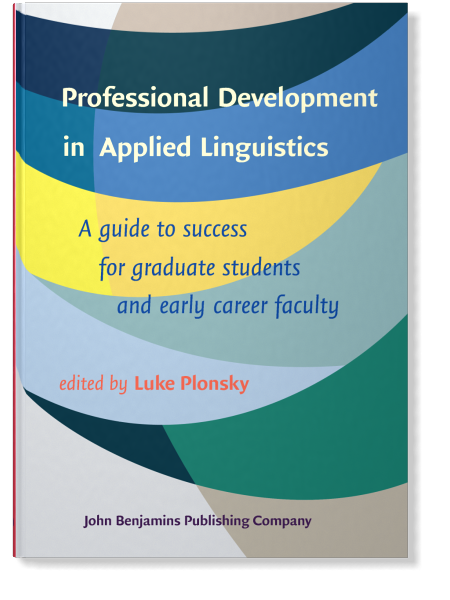
In:Professional Development in Applied Linguistics: A guide to success for graduate students and early career faculty
Edited by Luke Plonsky
[Not in series 229] 2020
► pp. 165–180
Chapter 12Crossing over
Writing (and talking) for general (as compared to academic) audiences
Published online: 30 July 2020
https://doi.org/10.1075/z.229.12tan
https://doi.org/10.1075/z.229.12tan
Abstract
Drawing on my own experience, I address some of the
challenges and benefits of writing for both academic and general audiences.
I note, for example, that when I write for general audiences, I can’t say
much of what I know because it would take too long to explain. In my
academic writing, I can’t say much of what I know because I can’t prove it.
Among the challenges are the scorn for and misconceptions about each world
that are held by denizens of the other. Perhaps the most challenging aspect
of moving from academic to trade publishing is not the writing itself but
getting published. To illustrate, I recount the tortuous sagas behind the
publication of my first two general-audience books. I conclude by observing
that understanding the vicissitudes of writing for these two audiences sheds
light on how language works.
Article outline
- Two audiences, two voices
- Mutual suspicion, mutual misunderstanding
- A bumpy road
- Moving between two worlds
References

References (3)
Jefferson, G. (1988). On
the sequential organization of troubles-talk in ordinary
conversation. Social
Problems, 35(4), 418–441.
Tannen, D. (1986). Introducing
constructed dialogue in Greek and American conversational and
literary
narratives. In F. Coulmas (Ed.), Direct
and indirect
speech (pp. 311–322). Berlin: Mouton de Gruyter.
. (1990). Gender
differences in conversational coherence: Physical alignment and
topical
cohesion. In B. Dorval (Ed.), Conversational
coherence and its
development (pp. 167–206). Norwood, NJ: Ablex. Reprinted
in Tannen, D. (1994). Gender and discourse (pp.
85–136). New York, NY: Oxford University
Press.
Cited by (1)
Cited by one other publication
Ergasheva, Mokhira & Ulugbek Nurmukhamedov
2024. Review of Kohls & Casanave (2023): Perspectives on good writing in applied linguistics and TESOL. Journal of English for Research Publication Purposes 5:1-2 ► pp. 118 ff.
This list is based on CrossRef data as of 24 november 2025. Please note that it may not be complete. Sources presented here have been supplied by the respective publishers. Any errors therein should be reported to them.