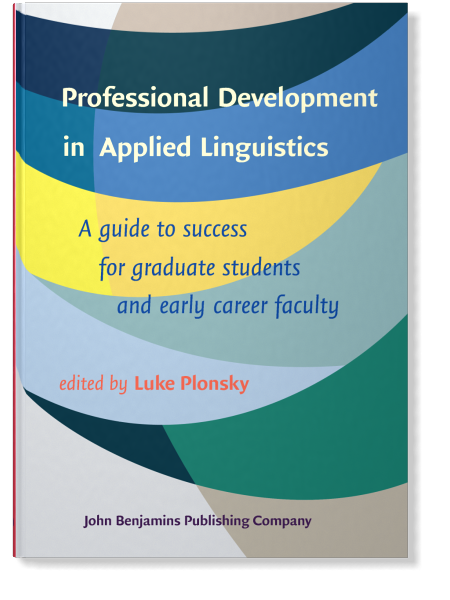
In:Professional Development in Applied Linguistics: A guide to success for graduate students and early career faculty
Edited by Luke Plonsky
[Not in series 229] 2020
► pp. 139–152
Chapter 10Engaging with professional organizations
Published online: 30 July 2020
https://doi.org/10.1075/z.229.10byr
https://doi.org/10.1075/z.229.10byr
Abstract
In this article I argue that contributing to professional
organizations is a particularly beneficial way of finding personal and
professional enrichment and opportunities for creative and meaningful
engagement toward addressing language-related societal issues. Such an
engagement can continue to shape, often in unexpected but deeply rewarding
ways, one’s identity in applied linguistics over an entire professional
career. I exemplify this position by tracing my own involvement with five
professional organizations, in each case asking three interwoven questions:
What were the language-focused societal – the ‘real world’ – issues as I
perceived them at the time when I was most deeply involved with them? What
focused projects and opportunities for enlarging my understanding of the
field presented themselves? And what were the long-term lessons that I took
away from the experience?
Article outline
- Making the case
- Charting the course
- The American Council on the Teaching of Foreign Languages (ACTFL) and the
American Association of Teachers of German (AATG)
- What were the real world issues?
- ACTFL, AATG, and the proficiency and Standards movements
- What did I learn?
- The Northeast Conference On The Teaching Of Foreign Languages
(NECTFL)
- What were the real-world issues?
- What did I learn?
- The Modern Language Association (MLA)
- What were – and are – the real-world issues?
- What did I learn?
- The College Board
- The American Association For Applied Linguistics (AAAL) – and concluding
reflections
- What were the real-world issues?
- What might we yet learn?
References

References (7)
ACTFL. (2014). ACTFL
global competence position
statement. Retrieved
from <[URL]> (22 July,
2017).
ACTFL
Proficiency Guidelines
2012. (2012). Retrieved
from <[URL]> (22 July,
2017).
Bygate, M. (2004). Some
trends in applied linguistics: Toward a generic
view. AILA
Review, 17, 6–22.
Halliday, M. A. K. (2002). Applied
linguistics as an evolving
theme. In J. J. Webster (Ed.), Language
and
education (pp. 1–19). London: Continuum.
MLA Ad Hoc
Committee on Foreign
Languages. (2007). Foreign
languages and higher education: New structures for a changed
world. Profession 2007, 234–245.
Cited by (1)
Cited by one other publication
This list is based on CrossRef data as of 24 november 2025. Please note that it may not be complete. Sources presented here have been supplied by the respective publishers. Any errors therein should be reported to them.