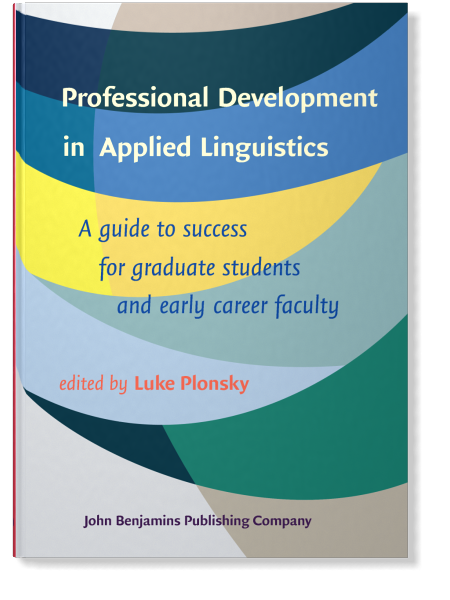
In:Professional Development in Applied Linguistics: A guide to success for graduate students and early career faculty
Edited by Luke Plonsky
[Not in series 229] 2020
► pp. 113–138
Chapter 9Reviewing manuscripts for academic journals
Published online: 30 July 2020
https://doi.org/10.1075/z.229.09sac
https://doi.org/10.1075/z.229.09sac
Abstract
Reviewing manuscripts for academic journals not only
contributes to the advancement of knowledge and the development of fellow
researchers, but also holds numerous advantages for the reviewers
themselves. After a brief explanation of what reviewing is and how it works,
this chapter describes some of the benefits of reviewing; provides guidance
regarding how to write fair, reasonable, meaningful, systematic, specific,
improvement-oriented reviews; raises factors to consider in decision-making;
offers advice for balancing reviewing against other professional priorities
and obligations; and seeks to answer a variety of practical “how-to” and
“what-if” questions that might arise in the process. Approached with a
constructive and strategic mindset, reviewing offers valuable opportunities
for graduate students and new faculty to grow intellectually and
professionally, influence and promote progress in the field, enhance their
reputations, and establish themselves as engaged members of a research
community in ways that will stand them in good stead throughout their
careers.
Article outline
- What to expect
- Benefits
- Access
- Intellectual and professional development
- Intrinsic rewards
- Influence
- Considerations
- Other priorities and obligations
- Personal impact
- Contribution: Effort ratio
- Approaches
- Fair and constructive criticism
- Specificity
- Clarity and organization
- Hows and what ifs
- How long should a review be, and how long should it take?
- How soon should you prioritize writing a review?
- What tends to work as a general approach?
- How do you decide on an overall recommendation?
- What if you think you know the identity of the author?
- Some final thoughts
Acknowledgment Notes References

References (43)
Amsen, E. (2014, January 22). The
Twitter view on peer
review. F1000Research. Retrieved
from <[URL]> (28 January,
2020)
Brown, A. M. L. (2015, November 10). How
not to be Reviewer #2. Retrieved
from <[URL]> (28 January,
2020)
Cohen, P. (2010, August 23). Scholars
test web alternative to peer
review. The New York
Times. Retrieved
from <[URL]> (28 January,
2020).
Digital
Pedagogy
Lab. (n.d.). Hybrid
pedagogy: A digital journal of learning, teaching, and
technology. Retrieved
from <[URL]> (21 February,
2017).
Elsevier. (2017). Scopus®. Retrieved
from <[URL]> (4 January,
2017).
Ferguson, C., Marcus, A., & Oransky, I. (2014, November 26). Publishing:
The peer-review
scam. Nature, 515(7528). Retrieved
from <[URL]> (28 January,
2020).
Hames, I. (2013, March). COPE
Ethical Guidelines for Peer
Reviewers. Committee on Publication
Ethics. Retrieved
from <[URL]> (28 January,
2020).
(2015, June 22). Re:
The problem(s) with credit for peer review [Blog
comment]. The Scholarly
Kitchen. Society for Scholarly
Publishing. Retrieved
from <[URL]> (28 January,
2020).
Hartshorn, K. J. (2016). The
status of peer review in applied linguistics
research. Journal of Linguistics and
Language
Teaching, 7(2), 155–181.
Larivière, V., Haustein, S., & Mongeon, P. (2015). The
oligopoly of academic publishers in the digital
era. PLoS
ONE, 10(6). Retrieved
from <[URL]> (28 January,
2020).
Lucey, B. (2013, September 27). Peer
review: How to get it right – 10
tips. The
Guardian. Retrieved
from <[URL]> (28 January,
2020).
McDermott, J. [@redpenblackpen]. (2014, February 10). What
peer review feels like. The Mad
Scientist Confectioner’s
Club. [Blog]. Retrieved
from <[URL]> (28 January,
2020).
. (2014, September 5). The
dawn of peer review. The Mad
Scientist Confectioner’s
Club. [Blog]. Retrieved
from <[URL]> (28 January,
2020).
. (2015, April 22). Your
manuscript on peer review. The Mad
Scientist Confectioner’s
Club. [Blog]. Retrieved
from <[URL]> (28 January,
2020).
. (2016, January 21). Making a super
villain. The Mad Scientist
Confectioner’s
Club. [Blog]. Retrieved
from <[URL]> (28 January,
2020).
Mehmani, B. (2016, September 22). Is open peer review
the way
forward? Elsevier. Retrieved
from <[URL]> (28 January,
2020).
Milstein, S. (2002, August 12). New
Economy; Web-based peer-review programs are reducing turnaround
time, postage bills and workload at many scholarly
journals. The New York
Times. Retrieved
from <[URL]> (28 January,
2020).
Movie-Moments. (2016, May 2). My
life is good, really good – Nacho Libre, Jack Black.
[Fair use movie
clip]. From J. Black, D. Klawans, J. Pistor, & M. White (Producers) & J. Hess (Director), Nacho
Libre [Motion Picture,
2006]. Hollywood, CA: Paramount Pictures. Retrieved
from <[URL]> (14 February,
2017).
Moylan, E. (2015, March 26). Inappropriate
manipulation of peer review. BioMed
Central Blog. Retrieved
from <[URL]> (28 January,
2020).
Publons. (n.d.). Track
more of your research
impact. Retrieved
from <[URL]> (28 January,
2020).
Research
Wahlberg
[@ResearchMark]. (n.d.). Media
tweets by Research
Wahlberg. Retrieved
from <[URL]> (28 January,
2020). Also available
at <[URL]> (28 January,
2020).
Retraction
Watch. (2017). Archive
for the ‘self peer review’
category. Retrieved
from <[URL]> (4 January,
2017).
Reviewer 2
Must Be
Stopped! (n.d.) In Facebook [Public
Group]. Retrieved
from <[URL]> (4 January,
2017).
Romano, A. (2015, August 21). Academic
journals are facing a battle to weed out fake peer
reviews. The Daily
Dot. Retrieved
from <[URL]> (28 January,
2020).
Ross-Hellauer, T. (2016, October 30). Defining
open peer review: Part one – competing
definitions. [Blog]. OpenAIRE
blog. Retrieved
from <[URL]> (28 January,
2020).
Schmidt, R., & Frota, S. N. (1986). Developing
basic conversational ability in a second language: A case study of
an adult learner of
Portuguese. In R. R. Day (Ed.), Talking
to learn: Conversation in second language
acquisition (pp. 237–326). Rowley, MA: Newbury House.
SciRev. (2013–2017). All
reviews received by
SciRev. Retrieved
from <[URL]> (2 February,
2017).
Shaw, C. (2013, October 4). Hundreds
of open access journals accept fake science
paper. The
Guardian. Retrieved
from <[URL] (28 January,
2020).
Shema, H. (2014, June 28). An
introduction to open peer
review. [Blog]. Scientific
American. Retrieved
from <[URL]> (28 January,
2020).
Swain, M. (1995). Three
functions of output in second language
learning. In G. Cook & B. Seidlhofer (Eds.), Principle
and practice in applied linguistics: Studies in honor of H. G.
Widdowson (pp. 125–144). Oxford: Oxford University Press.
(1998). Focus
on form through conscious
reflection. In C. Doughty & J. Williams (Eds.), Focus
on form in classroom second language
acquisition (pp.
64–81). Cambridge: Cambridge University Press.
Tennant, J. (2017, February 1). Who
isn’t profiting off the backs of
researchers? Discover
Magazine. Retrieved
from <[URL]> (28 January,
2020).
TESOL. (2015). How
to get published in TESOL and applied linguistics serials. Retrieved
from <[URL]> (28 January,
2020).
Vines, T. (2015, June 17). The
problem(s) with credit for peer review [Blog
comment]. Retrieved
from <[URL]> (28 January,
2020).
Wiley Author
Services. (2000–2016). Recognition
for reviewers. Retrieved
from <[URL]> (14 February,
2017).
@yourpapersucks. (n.d.). Shit
my reviewers say: Collecting the finest real specimens of reviewer
comments since
1456. Tumblr. Retrieved January 4, 2017, from <[URL]> (14 February,
2017).
Additional resources
Beall, J. (2017). List
of standalone journals: Potential, possible, or probable
scholarly open-access
journals. Scholarly Open Access:
Critical analysis of scholarly open-access
publishing. Retrieved
from <[URL]> (4 January,
2017).
Committee
on Publication
Ethics. (2017). Resources. Retrieved
from <[URL]> (4 January,
2017).
Guardian News and
Media. (2017). Publishing. The
Guardian. Retrieved
from <[URL]> (4 January,
2017).
Springer
Nature. (2017). Specials:
The future of
publishing. Nature. Retrieved January 4, 2017, from <[URL]> (4 January,
2017).
Wager, E., Simera, I., Kowalczuk, M., & Boughton, S. (Eds.). (2017). Research
integrity and peer review. BioMed
Central. Retrieved January 4, 2017, from <[URL]> (4 January,
2017).
Ware, M. (2016). Peer
review survey 2015. Publishing Research
Consortium. Retrieved
from <[URL]> (28 January,
2020).
Wiley
Author
Services. (2000–2016). Journal
reviewers. Retrieved
from <[URL]> (14 February,
2017).