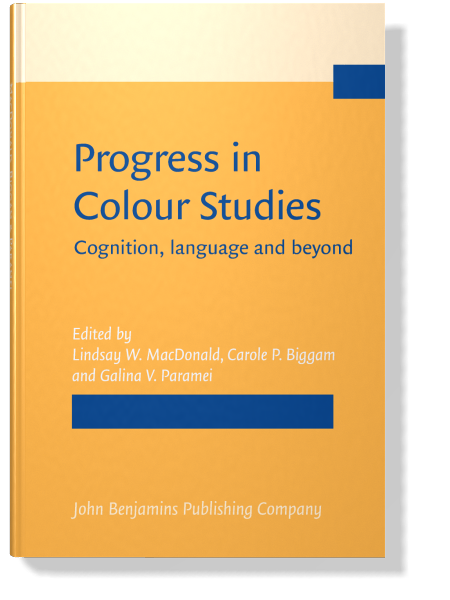
In:Progress in Colour Studies: Cognition, language and beyond
Edited by Lindsay W. MacDonald, Carole P. Biggam and Galina V. Paramei
[Not in series 217] 2018
► pp. 380–396
Chapter 12Divergence and shared conceptual organization
A Points-of-View analysis of colour listing data from fourteen European languages
Published online: 26 November 2018
https://doi.org/10.1075/z.217.12bim
https://doi.org/10.1075/z.217.12bim
Abstract
To study associations among colour terms, we asked speakers of fourteen European languages to list terms in the order that they came to mind and converted each list into an array of “adjacencies”. Analysis of these pointed to possible differences among languages in the cognitive organization of colour concepts. Based on adjacency arrays, we defined an index of similarity between pairs of lists, within and between languages. Factor analysis identified a shared cognitive framework structuring the colour domain across languages. There is also enough heterogeneity that one can consider two alternative structures or “Points-of-View”, with individuals weighting these extremes in different proportions to yield their personal lists. Moreover, languages differ in the mean weights of their speakers.
Keywords: list task, linguistic diversity, semantic maps
Article outline
- 1.Introduction
- 2.Method
- 2.1Generalization to combined languages
- 3.Results
- 4.Interpretation
Note References

References (23)
Aitchison, Jean. 2012. Words in the Mind: An Introduction to the Mental Lexicon. 4th ed. Chichester: Wiley-Blackwell.
Bimler, David L., John Kirkland, and Mari Uusküla. 2015. “Applying Points-of-View Analysis to Individual Variations in Colour Sorting Data.” Journal of Cognition and Culture 15: 87–108.
Bimler, David L., and Mari Uusküla. 2014. ““Clothed in Triple Blues”: Sorting out the Italian Blues.” Journal of the Optical Society of America A 31: A332–A340.
Bimler, David, and Mari Uusküla. 2017. “A Similarity-Based Cross-Language Comparison of Basicness and Demarcation of “Blue” Terms.” Color Research & Application, 42: 362–377.
. 2018. “Individual variations in color-concept space replicate across languages.” Journal of the Optical Society of America A 35: B184–B191. .
Corbett, Greville G., and G. Morgan. 1988. “Colour Terms in Russian: Reflections of Typological Constraints in a Single Language.” Journal of Linguistics 24: 31–64.
Davies, Ian, and Greville Corbett. 1994. “The Basic Colour Terms of Russian.” Linguistics 32: 65–89.
Handwerker, W. Penn. 2002. “The Construct Validity of Cultures: Cultural Diversity, Culture Theory, and a Method for Ethnography.” American Anthropologist 104: 106–122.
Henley, Nancy M. 1969. “A Psychological Study of the Semantics of Animal Terms.” Journal of Verbal Learning and Verbal Behavior 8: 176–184.
Lillo, Julio, Lilia Prado-León, Fernando González, Anna Melnikova, Leticia Álvaro, José Collado, and Humberto Moreira. 2018. “Spanish Basic Color Categories are 11 or 12 Depending on the Dialect.” In Progress in Colour Studies: Cognition, Language and Beyond, ed. by Lindsay W. MacDonald, Carole P. Biggam, and Galina V. Paramei, 59–82. Amsterdam & Philadelphia: John Benjamins.
MacDonald, Lindsay W., Carole P. Biggam, and Galina V. Paramei (eds). 2018. Progress in Colour Studies: Cognition, Language and Beyond. Amsterdam & Philadelphia: John Benjamins.
Mohr, Christine, Domicele Jonauskaite, Elise S. Dan-Glauser, Mari Uusküla, and Nele Dael. 2018]. “Unifying Research on Colour and Emotion: Time for a Cross-Cultural Survey on Emotion Associations to Colour Terms.” In Progress in Colour Studies: Cognition, Language and Beyond, ed. by Lindsay W. MacDonald, Carole P. Biggam, and Galina V. Paramei, 209–221. Amsterdam & Philadelphia: John Benjamins.
Paggetti, Giulia, Gloria Menegaz, and Galina V. Paramei. 2016. “Color Naming in Italian Language.” Color Research & Application 41: 402–415.
Paramei, Galina V. 2005. “Singing the Russian Blues: An Argument for Culturally Basic Color Terms.” Cross-Cultural Research 39: 10–38.
Paramei, Galina V., Mauro D’Orsi, and Gloria Menegaz. 2018. “Diatopic Variation in Referential Meaning of “Italian blues.” In Progress in Colour Studies: Cognition, Language and Beyond, ed. by Lindsay W. MacDonald, Carole P. Biggam, and Galina V. Paramei, 83–105. Amsterdam & Philadelphia: John Benjamins.
Paramei, Galina V., Yulia A. Griber, and Dimitris Mylonas. 2018. “An Online Color Naming Experiment in Russian Using Munsell Color Samples.” Color Research & Application 43: 358–374. .
Smith, J. Jerome, Louanna Furbee, Kelly Maynard, Sarah Quick, and Larry Ross. 1995. “Salience Counts: A Domain Analysis of English Color Terms.” Journal of Linguistic Anthropology 5: 203–216.
Uusküla, Mari, and David Bimler. 2016. “From Listing Data to Semantic Maps: Cross-Linguistic Commonalities in Cognitive Representation of Colour.” Folklore: Electronic Journal of Folklore 64: 57–90.
Uusküla, Mari, Liivi Hollman, and Urmas Sutrop. 2012. “Basic Colour Terms in Five Finno-Ugric Languages and Estonian Sign Language: A Comparative Study.” Eesti ja Soome-Ugri Keeleteaduse Ajakiri 3: 47–86.
Cited by (1)
Cited by one other publication
Lillo, Julio, Lilia Prado-León, Fernando Gonzalez Perilli, Anna Melnikova, Leticia Álvaro, José Collado & Humberto Moreira
2018. Spanish basic colour categories are 11 or 12 depending on the dialect. In Progress in colour studies, ► pp. 59 ff.
This list is based on CrossRef data as of 24 november 2025. Please note that it may not be complete. Sources presented here have been supplied by the respective publishers. Any errors therein should be reported to them.