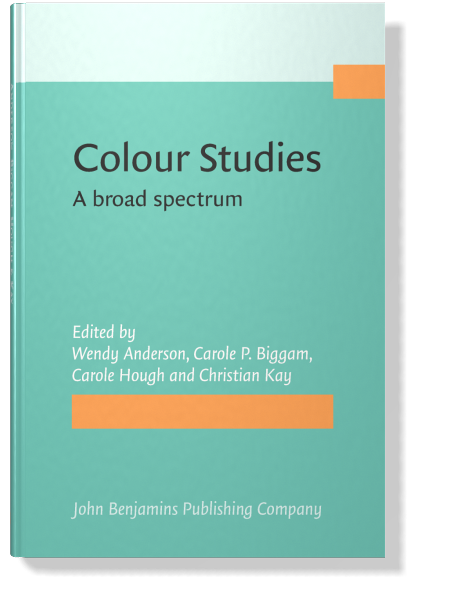
In:Colour Studies: A broad spectrum
Edited by Wendy Anderson, Carole P. Biggam, Carole Hough and Christian Kay
[Not in series 191] 2014
► pp. 258–272
Axiological aspects of Polish colour vocabulary
A study of associations
Published online: 26 November 2014
https://doi.org/10.1075/z.191.17sta
https://doi.org/10.1075/z.191.17sta
The aim of this paper is to investigate axiological attributes of Polish colour terms. We pose the following questions: Which colours are evaluated mostly positively, negatively and neutrally? Are there objects which are provided as both positive and negative associations of a single colour? Are the same associations evoked by different colours? We carried out a questionnaire among fifty Polish speakers. The results point to colours which are perceived most positively (green, blue and orange), negatively (grey and black), neutrally (brown), and ambivalently (red). Moreover, an association may be classified as positive, neutral or negative (e.g. blood associated with red). One association may also be provided for two colours, e.g. death as a negative association with black and white.

References (34)
Ampel-Rudolf, Mirosława. 1994. Kolory: Z badań leksykalnych i semantyczno-składniowych języka polskiego [Colours: Lexical and Semanto-syntactic Investigations]. Rzeszów: Wydawnictwo Wyższej Szkoły Pedagogicznej.
Berlin, Brent, and Paul Kay. 1969. Basic Color Terms: Their Universality and Evolution. Berkeley: University of California Press.
Bjelajeva, Inna. 2005. Niepodstawowe nazwy barw w języku polskim, czeskim, rosyjskim i ukraińskim [Non-basic Colour Terms in Polish, Czech, Russian and Ukrainian]. Warszawa: Wydział Polonistyki Uniwersytetu Warszawskiego.
Corbett, Greville G., and Ian R.L. Davies. 1997. “Establishing Basic Color Terms: Measures and Techniques.” In Hardin and Maffi, 197–223.
Duczmal, Stanisław. 1979. “A Contrastive Semantic Analysis of Colour Adjectives in Polish and English.” Papers and Studies in Contrastive Linguistics 9: 181–191.
Hardin, Clyde L., and Luisa Maffi (eds). 1997. Color Categories in Thought and Language. Cambridge: Cambridge University Press.
Kay, Paul, Brent Berlin, Luisa Maffi, and William Merrifield. 1997. “Color Naming across Languages.” In Hardin and Maffi, 21–56.
Kay, Paul, Brent Berlin, and William Merrifield. 1991. “Biocultural Implications of Systems of Color Naming.” Journal of Linguistic Anthropology 1/1: 12–25.
Kay, Paul, and Luisa Maffi. 1999. “Color Appearance and the Emergence and Evolution of Basic Color Lexicons.” American Anthropologist 101 (4): 743–760.
Kay, Paul, and Chad K. McDaniel. 1978. “The Linguistic Significance of the Meanings of Basic Color Terms.” Language 54 (3): 610–646.
Komorowska, Ewa. 2010. Barwa w języku polskim i rosyjskim: Rozważania semantyczne [Colour in Polish and Russian: Semantic Considerations]. Szczecin: Wydawnictwo Naukowe Uniwersytetu Szczecińskiego.
Komorowska, Ewa, and Danuta Stanulewicz. 2010. “Psychologiczne znaczenie polskich i ukraińskich nazw barw – porównanie wyników badań testowych [Psychological Salience of Polish and Ukrainian Colour Terms – a Comparison of Test Results].” In Język, tożsamość i komunikacja międzykulturowa. Księga Pamiątkowa ofiarowana Doktor Bożenie Zinkiewicz-Tomanek, ed. by Ewa Komorowska, and Danuta Stanulewicz, 138–154. Szczecin: Volumina.pl Daniel Krzanowski.
Kopaliński, Władysław. 2007 [1990]. Słownik symboli [A Dictionary of Symbols]. Warszawa: HPS, Rzeczpospolita.
Krzeszowski, Tomasz P. 1997. Angels and Devils in Hell: Elements of Axiology in Semantics. Warszawa: Wydawnictwo Energeia.
Molchanova, Olga (ed.). 2003. Linguistics across Culture. Szczecin: Wydawnictwo Naukowe Uniwersytetu Szczecińskiego.
Morita, Koji. 2010. “Nazwy barw w języku japońskim i polskim [Colour Terms in Japanese and Polish].” In Relatywizm w języku i kulturze, ed. by Anna Pajdzińska, and Ryszard Tokarski, 157–164. Lublin: Wydawnictwo Uniwersytetu Marii Curie-Skłodowskiej.
Mozolewska, Anna. 2010. “Colour Terms and Emotions in English and Polish”.Beyond Philology 7: 77–102.
Nilsson, Barbro, and Ewa Teodorowicz-Hellman (eds). 1997. Nazwy barw i wymiarów. Colour Terms and Measure Terms: Swedish-Polish Linguistic Conference on the Semantics of Colour and Measure Expression. Stockholm, 1996.04. Stockholm: Stockholm University, Slavic Institute.
Pawłowski, Adam. 2006. “Quantitative Linguistics in the Study of Colour Terminology: A Research Report.” In Progress in Colour Studies I: Language and Culture, ed. by Carole P. Biggam, and Christian J. Kay, 37–55. Amsterdam & Philadelphia: John Benjamins.
Płomińska, Małgorzata. 2003. Farben und Sprache: Deutsche und polnische Farbbezeichnungen aus kontrastiver Sicht [Colours and Language: German and Polish Colour Terms in a Contrastive Perspective]. Frankfurt am Main: Peter Lang.
Siekierska, Krystyna. 1992. “Barwy staropolskiej przyrody [Colours of Nature in Old Polish].” In Studia historyczno-językowe i dialektologiczne, ed. by Marian Kucała, and Jerzy Reichan, 19–42. Kraków: Polska Akademia Nauk, Instytut Języka Polskiego.
Simmons, David R. 2011. “Colour and Emotion.” In New Directions in Colour Studies, ed. by Carole P. Biggam, Carole A. Hough, Christian J. Kay, and David R. Simmons, 395–412. Amsterdam & Philadelphia: John Benjamins.
Stanulewicz, Danuta. 2003. “Blue in English and Polish.” In Europa der Sprachen: Sprachkompetenz – Mehrsprachigkeit – Translation. Akten des 35. Linguistischen Kolloquiums in Innsbruck 2000. Teil I: Sprache und Gesellschaft, ed. by Lew N. Zybatow, 213–222. Frankfurt am Main: Peter Lang.
. 2007. “Polish Colour Terms referring to Blue: A Corpus View.” In Further Insights into Semantics and Lexicography, ed. by Ulf Magnusson, Henryk Kardela, and Adam Głaz, 87–99. Lublin: Wydawnictwo Uniwersytetu Marii Curie-Skłodowskiej.
. 2010a. “Grey in English and Polish.” In Wschód–Zachód. Literature and Linguistics: Theory and Practice, ed. by Adriana Biedroń, and Dorota Werbińska, 43–52. Słupsk: Wydawnictwo Naukowe Akademii Pomorskiej w Słupsku.
. 2010b. “Płeć a psychologiczne znaczenie nazw barw występujących w polszczyźnie (badania wstępne) [Gender and Psychological Salience of Polish Colour Terms (Preliminary Investigations)].” In Barwa w języku, kulturze i literaturze I, ed. by Ewa Komorowska, and Danuta Stanulewicz, 107–122. Szczecin: Volumina.pl Daniel Krzanowski.
Szczęk, Joanna. 2010. “O symbolicznej funkcji barw w języku i kulturze – niemiecko-polskie studium porównawcze [On the Symbolic Function of Colours in Language and Culture – a German-Polish Contrastive Study].” In Barwa w języku, kulturze i literaturze I, ed. by Ewa Komorowska, and Danuta Stanulewicz, 93–106. Szczecin: Volumina.pl Daniel Krzanowski.
Szczygłowska, Tatiana. 2003. “A short English-Polish Contrastive Analysis of the Relationship between the Continuum of Colours and the Continuum of Emotions.” Linguistica Silesiana 24: 89–107.
Teodorowicz-Hellman, Ewa. 1998. “Teoria prototypów a nazwy barw w języku polskim i szwedzkim: Obrazy konceptualne nazw barw a ich eksplikacje językowe [The Prototype Theory and Colour Terms in Polish and Swedish: Conceptualizations of Colours and their Linguistic Explications]”. Polonica 19: 75–91.
. 2000. “Zielony i niebieski w języku polskim w porównaniu z grön i blå w szwedzkim [Green and Blue in Polish in comparison with grön and blå in Swedish]”. In Studia z semantyki porównawczej: Nazwy barw, nazwy wymiarów, predykaty mentalne. Part I, ed. by Renata Grzegorczykowa, and Krystyna Waszakowa, 73–92. Warszawa: Wydawnictwa Uniwersytetu Warszawskiego.
Tokarski, Ryszard. 2004 [1995]. Semantyka barw we współczesnej polszczyźnie [The Semantics of Colours in Contemporary Polish]. Lublin: Wydawnictwo Uniwersytetu Marii Curie-Skłodowskiej.
Waszakowa, Krystyna. 2000. “Podstawowe nazwy barw i ich prototypowe odniesienia: Metodologia opisu porównawczego [Basic Colour Terms and their Prototypical References: The Methodology of Comparative Description].” In Studia z semantyki porównawczej: Nazwy barw, nazwy wymiarów, predykaty mentalne. Part I, ed. by Renata Grzegorczykowa, and Krystyna Waszakowa, 17–28. Warszawa: Wydawnictwa Uniwersytetu Warszawskiego.
Cited by (1)
Cited by one other publication
Stanulewicz, Danuta & Adam Pawłowski
This list is based on CrossRef data as of 24 november 2025. Please note that it may not be complete. Sources presented here have been supplied by the respective publishers. Any errors therein should be reported to them.