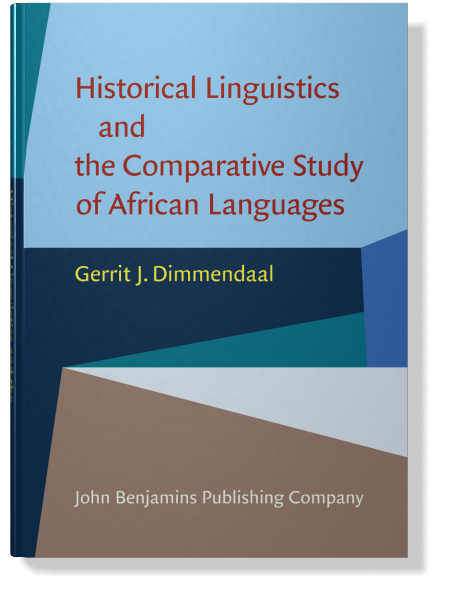
In:Historical Linguistics and the Comparative Study of African Languages
Gerrit J. Dimmendaal
[Not in series 161] 2011
► pp. 307–332
14. Remote relationships and genetic diversity on the African continent
Published online: 8 June 2011
https://doi.org/10.1075/z.161.17ch14
https://doi.org/10.1075/z.161.17ch14
The comparative method takes languages which are assumed to be genetically related as a basis for a more systematic search for lexical and grammatical cognates. It is important to bear in mind that the standard classification of African languages by Greenberg (1963) is based, not on the comparative method, but rather on mass comparison. Of course, the comparative method can only be applied once a hypothesis on possible relatedness has been forwarded through an initial determination of “look alikes” in the lexical and grammatical domain. Once such a hypothesis has been formulated, one may begin to apply the comparative method by retrieving historical sound changes (or “sound laws”) on the basis of a systematic comparison of cognates, and aim at a reconstruction of earlier stages. Below, we discuss the results of mass comparison as a method in an African context. More specifically, the degree of genetic diversity on the African continent and stable versus unstable genetic features are central to this chapter.

Cited by (1)
Cited by one other publication
Otero, Manuel A.
2020. Associated motion, direction and (exchoative) aspect in Ethiopian Komo. Studies in Language 44:4 ► pp. 737 ff.
This list is based on CrossRef data as of 1 december 2025. Please note that it may not be complete. Sources presented here have been supplied by the respective publishers. Any errors therein should be reported to them.