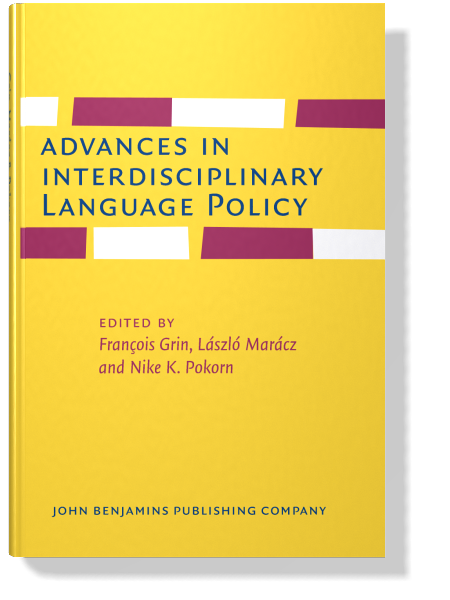
In:Advances in Interdisciplinary Language Policy
Edited by François Grin, László Marácz and Nike K. Pokorn
[Studies in World Language Problems 9] 2022
► pp. 531–554
Chapter 26Does global English influence the perception of professional ethical dilemmas?
Published online: 21 January 2022
https://doi.org/10.1075/wlp.9.26dem
https://doi.org/10.1075/wlp.9.26dem
Abstract
For many multilinguals, the use of a given language is specific to certain areas of life, such as family, social or professional life. This may mean that, for a given person, lexical precision does not imply fluency, and vice-versa. Therefore, having a certain type of skills in a second language does not guarantee a successful use of this second language in all circumstances. This may be especially true with respect to emotional versus factual communication and contents. When a language normally only employed for factual communication is used to express emotional content, the level of precision or understanding may suffer. This research asks the following question: does the use of Global English in the workplace affects the alertness of non-native English speakers in perceiving ethical dilemmas? The hypothesis we explore is that non-native English-speaking employees of organisations in which Global English is the main communication tool, or one of them, may suffer from such communicational, or linguistic, asymmetry, as defined in the paper. In doing so, this study contributes to the ‘Global English’ research agenda and examines the consequences of the use of English. Our statistical results suggest that the importance of linguistic asymmetry becomes acute in situations where ethical issues – with their blend of emotional and technical aspects – emerge in contexts in which otherwise only professional, i.e. factual and technical, contents prevail. The linguistic asymmetry may impair the level of ethical alertness of non-native English-speakers working in organisations where English dominates.
Article outline
- 1.Introduction: Global English – an interdisciplinary conundrum
- 2.The database
- 3.Preference and skills in English
- 4.The linguistic dimension of work environments
- 5.Ethical dilemmas in professional context
- 6.Linguistic asymmetry in ethical matters
- 7.Conclusion: Beyond ‘Wall Street English’
Acknowledgements References

References (42)
Anglemark, Linnea & John, Andrew. (2018). The Use of English-Language Business and Finance Terms in European Language. International Journal of Business Communication 55(3), 406–440.
Badaracco, Joseph. (1997). Defining Moments: When Managers Must Choose between Right and Right. Boston: Harvard Business School Press.
Charles, M. (2007). Language Matters in Global Communication. The Journal of Business Communication, 44(3), 260–282.
Chesney, Marc. (2009). Enjeux et conséquences de l’utilisation de l’anglais pour les études d’économie et de gestion à l’université. Observatoire du Plurilinguisme, Geneva.
Costa, Albert, Foucart, Alice, Arnon, Inbal, Aparici, Melina & Apesteguia, Jose. (2014). ‘Piensa’ twice: on the foreign language effect in decision making. Cognition 130(2), 236–254.
Costa, Albert, Foucart, Alice, Hayakawa, Sayuri, Aparici, Melina, Apesteguia, Jose, Heafner, Joy & Keysar, Boaz. (2014). Your Morals Depend on Language. PLOS one, 9.
Council of Europe. Retrieved from: [URL]
Dembinski, Paul H. (2009). Finance Servant or Deceiver? Financialisation at the Crossroads. UK: Palgrave Macmillan.
Deneire, Marc. (2008). English in the French workplace: realism and anxieties. World Englishes 27(2), 181–195.
De Swaan, Abram. (2002). The World Language System: A Political Sociology and Political Economy of Language. Cambridge: Polity.
. (2010). ‘Language systems’, in N. Coupland (Ed.), The Handbook of Language and Globalization (pp. 56–76). Malden, MA: Blackwell.
García, Ofelia & Schiffman, Harold. (2006). ‘Fishmanian Sociolinguistics (1949 to the present)’, in O. García, P. Rakhmiel & S. Harold (Eds.), Language Loyalty, Continuity and Change, Joshua A. Fishman’s Contributions to International Sociolinguistics and Multilingual Matters. Tonawanda, NY.
Geipel, Janet, Hadjichristidis, Constantinos & Surian, Luca. (2015). How foreign language shapes moral judgment. Journal of Experimental Social Psychology 59, 8–17.
. (2016). Foreign language affects the contribution of intentions and outcomes to moral judgments. Cognition 154, 34–39.
Graddol, David. (2007). English Next: Why Global English May Mean the End of ‘English as a Foreign Language’. London: British Council.
Grin, François, Sfreddo, Claudio & Vaillancourt, François. (2013). The Economics of the Multilingual Workplace. Routledge.
Gunnarsson, Britt-Louise. (2013). Multilingualism in the Workplace. Annual Review of Applied Linguistics 33, 162–189.
Gural, Svetlana & Smokotin, Vladimir. (2014). The language of worldwide communication and linguistic and cultural globalization. Language and Culture 1, 4–13.
Hadjichristidis, Constantinos, Geipel, Janet & Savadori, Lucia. (2015). The Effect of Foreign Language in Judgments or Risk and Benefit: The Role of Affect. Journal of Experimental Psychology: Applied 21, 117–129.
Kankaanranta, Anne, Karhunen, Päivi & Louhiala-Salminen, Leena. (2018). ‘English as corporate language’ in the multilingual reality of multinational companies. Multilingua 37(10), 331–351.
Lauring, Jakob & Tange, Hanne. (2010). International language management: contained or dilute communication. European Journal of International Management 4(4), 317–322.
Lind, Georg. (1989). Essay review – the measurement of moral judgment. Human development 32, 388–397.
Louhiala-Salminen, Leena, Charles, Mirjaliisa & Kankaanranta, Anne. (2005). English as a lingua franca in Nordic corporate mergers: two case companies. English for Specific Purposes 24(4), 401–421.
Maurais, Jacques. (2003). ‘Toward a new global linguistic order?’, in J. Maurais & M. A. Morris (Eds.), Languages in a Globalizing World (pp. 13–36). Cambridge: Cambridge University Press.
Morgenson, Gretchen. (2011). Reckless endangerment: how outsized ambition, greed, and corruption led to economic Armageddon. New York: Henry Holt and Company.
Piekkari, Rebecca, Welch, Denice E. & Welch, Lawrence. S. (2014). Language in international business: the multilingual reality of global business expansion. Cheltenham: Edward Elgar.
Polonioli, Andrea. (2018). A blind spot in research on foreign language effects in judgement and decision-making. Frontiers in Psychology 9(1), 1–5.
Rest, James, Navarez, Darcia, Thoma, Stephen J. & Bebeau, Muriel J. (2000). A Neo-Kohlbergian Approach to morality research. Journal of moral education 29(4), 382–395.
Reszat, Beate. (2000). Culture and Finance in a Globalized World – An Uneasy Relation. HWWA Discussion Paper 101, Hamburg Institute of International Economics.
Sedivy, Julie. (2016). How morality changes in a foreign language. Scientific American, 14 September 2016. Retrieved from: [URL]
Titus, Craig S. (2008). Le développement moral dans la psychologie morale de Lawrence Kohlberg et de Martin Seligman. Revue d’éthique et de théologie morale HS 251, 31–50.
(2013). ‘The use of developmental psychology in ethics: beyond Kohlberg and Seligman’, in F. Doridot, P. Duquenoy, P. Goujon, A. Kurt, S. Lavelle, N. Patrignani, S. Rainey & A. Santuccio (Eds.), Ethical Governance of Emerging Technologies Development (pp. 266–285). Retrieved from: [URL].
Volk, Stefan, Köhler, Tine & Pudelko, Markus. (2014). Brain drain: The cognitive neuroscience of foreign language processing in multinational corporations. Journal of International Business Studies 45(5), 862–885.
Wickelmaier, Florian. (2015). On not testing the foreign-language effect: A comment on Costa, Foucart, Arnon, Aparici, and Apesteguia (2014). arXiv: Applications. available at [URL]
Cited by (1)
Cited by one other publication
This list is based on CrossRef data as of 24 november 2025. Please note that it may not be complete. Sources presented here have been supplied by the respective publishers. Any errors therein should be reported to them.