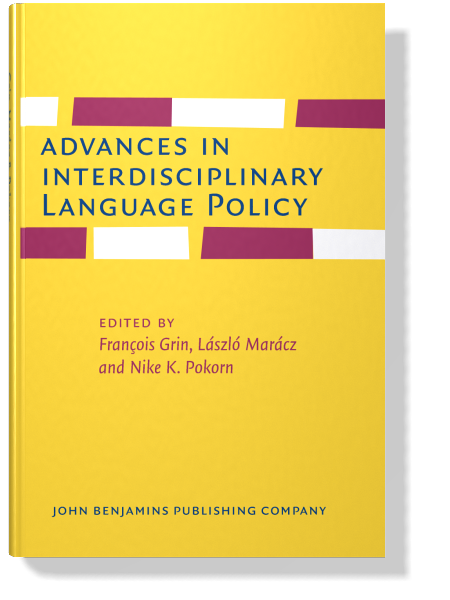
In:Advances in Interdisciplinary Language Policy
Edited by François Grin, László Marácz and Nike K. Pokorn
[Studies in World Language Problems 9] 2022
► pp. 151–170
Chapter 8Urban multilingualism
Place-making, mobility and sense of belonging in European cities
Published online: 21 January 2022
https://doi.org/10.1075/wlp.9.08mam
https://doi.org/10.1075/wlp.9.08mam
Abstract
This chapter deals with urban multilingualism from a geographical perspective considering the trade-off between mobility, inclusion, and place-making. Place-making in multilingual cities is influenced by the linguistic diversity among their inhabitants, and the sense of place and sense of belonging fostered at the level of the city as a whole and/or in specific neighbourhoods and public spaces shape the individual’s perceptions of linguistic diversity and multilingualism. The chapter introduces key geographical concepts and approaches before examining the new forms of linguistic diversity in European cities fostered by globalisation, Europeanisation, transnational migration and digitalisation. It presents diverse geographical approaches and methodologies relevant to the study of multilingualism and place-making and focuses on two perspectives. First a humanistic geography of urban multilingualism foregrounds the perceptions and representations of languages in relation to a sense of place and a sense of belonging. One empirical study examines linguistic practices and ideologies in Madrid and Amsterdam among residents with a French or German background, another focused on walks through the linguistic landscape and soundscape of the inner-city of Amsterdam. Second a political geography of urban multilingualism explores local policies and city networks regarding the management of linguistic diversity and the trade-off between mobility and inclusion. It examines in turn local policies focusing on mobility and migration, on social cohesion and on multilingualism. Based on both types of geographical research the chapter underlines the importance of raising awareness of the specificity of the local diversity of linguistic trajectories and repertoires and of the coordination between policies articulated and implemented at different scale levels (European, national, local).
Article outline
- 1.Introduction
- 2.The trade-off between mobility and inclusion, and place-making
- 3.Geographical concepts and urban multilingualism
- 4.Geographies of multilingualism and place-making
- 4.1Geographical approaches
- 4.2Methods
- 4.3Illustration 1: Individual strategies to cope with linguistic diversity in the city
- 4.4Illustration 2: Local authorities and the management of linguistic diversity
- Local policies regarding mobility and migration, and linguistic aspects
- Local policies regarding cohesion, and linguistic aspects
- Local policies regarding multilingualism, and mobility and inclusion
- 5.Discussion
- Awareness and knowledge
- Coordination between levels
- 6.Conclusion
Notes References

References (53)
Aitken, Stuart & Valentine, Gill (Eds.) (2015). Approaches to Human Geography: Philosophies, Theories, People, Practices (2nd ed.). London: Sage.
Barber, Benjamin. (2013). If mayors ruled the world: dysfunctional nations, rising cities. New Haven: Yale University Press.
Blanc, Maurice & Beaumont, Justin. (2005). Local democracy within European urban development programmes. Tijdschrift voor Economische en Sociale Geografie 96(4), 409–420.
Boix-Fuster, Emili (Ed.) (2015). Urban diversities and language policies in medium-sized linguistic communities. Bristol: Multilingual Matters.
Bolt, Gideon & Van Kempen, Ronald. (2013). Introduction Special Issue: Mixing Neighbourhoods: Success or Failure? Cities 35, 391–396.
Cianetti, Licia. (2019). Governing the multicultural city: Europe’s ‘great urban expectations’ facing austerity and resurgent nativism. Urban Studies 57(13), 2697–2714.
Clifford, Nicholas, Cope, Meghan, Gillespie, Thomas W. & French, Shaun (Eds.) (2016). Key Methods in Geography (3rd ed.). London: Sage.
Duyvendak, Jan Willem & Wekker, Fenneke. (2016). ‘At home in the city? The difference between friendship and amicability’, in V. Mamadouh & A. van Wageningen (Eds.), Urban Europe: Fifty Tales of the City (pp. 23–29). Amsterdam: Amsterdam University Press.
El Ayadi, Nesrin. (2021). Linguistic sound walks: setting out possible ways to explore the relationship between linguistic soundscapes and individual experiences of social diversity. Social and Cultural Geography.
European Migrant Advisory Board (EMAB). (2019). Ask the People. A consultation of migrants and refugees.
Faist, Thomas. (2000). Transnationalization in international migration: implications for the study of citizenship and culture. Ethnic and Racial Studies 23(2), 189–222.
Ferreira, Aantónio, Batey, Peter, Te Brömmelstroet, Marco & Bertolini, Luca. (2012). Beyond the Dilemma of Mobility: Exploring New Ways of Matching Intellectual and Physical Mobility. Environment and Planning A 44(3), 688–704.
Gal, Susan. (2006). Contradictions of standard language in Europe: implications for the study of practices and publics. Social Anthropology 14(2), 163–181.
Guma, Taulant. & Dafydd Jones, Rhys. (2019). ‘Where are we going to go now?’, European Union migrants’ experiences of hostility, anxiety, and (non-)belonging during Brexit. Population, Space and Place 25(1), e2198.
Harrison, Malcolm, Phillips, Deborah, Chahal, Kusminder, Hunt, Lisa & Perry, John. (2005). Housing, ‘race’ and community cohesion. Coventry: Chartered Institute of Housing.
Hoekstra, Myrte. (2015). Diverse cities and good citizenship: how local governments in the Netherlands recast national integration discourse. Ethnic and Racial Studies 38(10), 1798–1814.
Jessop, Bob. (2016). Territory, politics, governance and multispatial metagovernance. Territory Politics Governance 4(1), 8–12.
Jessop, Bob, Brenner, Neil & Jones, Martin. (2008). Theorizing sociospatial relations. Environment & Planning D: Society & Space 26(3), 389–401.
Jones, Rhys & Lewis, Huw. (2019). New Geographies of Language: Language, Culture and Politics in Wales. London: Palgrave Macmillan.
Kearns, Ade & Forrest, Ray. (2000). Social cohesion and multi-level urban governance. Urban Studies 37, 995–1017.
King, Lid & Carson, Lorna (Eds.) (2016). The multilingual city: Vitality, conflict and change. Bristol: Multilingual Matters.
Lapina, Linda. (2016). Besides conviviality; paradoxes in being ‘at ease’ with diversity in a Copenhagen district. Nordic journal of migration research 6, 33–41.
Mamadouh, Virginie. (2018). The city, the (Member) state, and the European Union. Urban Geography 39(9), 1435–1439.
Matos Wunderlich, Filipa (2008). Walking and Rhythmicity: Sensing Urban Space. Journal of Urban Design 13(1), 125–139.
McDowell, Linda. (1999). Gender, Identity & Place. Understanding feminist geographies. Cambridge: Polity Press.
Middleton, Jennie. (2010). Sense and the city: exploring the embodied geographies of urban walking. Social & Cultural Geography 11(6), 575–596.
Murphy, Alexander B. (1988). The regional dynamics of language differentiation in Belgium: a study in cultural-political geography. Chicago: University of Chicago Press.
Musterd, Sako & Murie, Alan. (2010). ‘The idea of the creative or knowledge-based city’, in S. Musterd & A. Murie (Eds.), Making competitive cities (pp. 17–33). Oxford: Wiley-Blackwell.
Noble, Greg. (2009). ‘Everyday cosmopolitanism and the labour of intercultural community’, in A. Wise & S. Velayutham (Eds.), Everyday multiculturalism (pp. 46–64). Basingstoke: Palgrave Macmillan.
Paasi, Anssi. (1996). Territories, Boundaries and Consciousness: the Changing Geographies of the Finnish-Russian Border. Chichester: John Wiley.
Pahl, Ray E. (1991). The search for social cohesion: from Durkheim to the European Commission. European Journal of Sociology 32(2), 345–360.
Pérez del Pulgar Frowein, Carmen. (2016). Porosity of multilingual spaces. Master’s thesis, University of Amsterdam. Retrieved from: [URL]
Pinkster, Fenne & Boterman, Willem. (2017). When the spell is broken: gentrification, urban tourism and privileged discontent in the Amsterdam canal district. Cultural Geographies 24(3), 457–472.
Pred, Allan. (1984). Place as historically contingent process: structuration and the time-geography of becoming places. Annals of the AAG 74(2), 276–297.
. (1990). Lost words and lost worlds : modernity and the language of everyday life in late nineteenth-century Stockholm. Cambridge: Cambridge University Press.
Qian, Junxi, Qian, Lyun & Zhu, Hung. (2012). Representing the imagined city: place and the politics of difference during Guangzhou’s 2010 language conflict. Geoforum 43, 905–915.
Raffestin, Claude. (1978). La langue comme ressource: pour une analyse économique des langues vernaculaires et véhiculaires, Cahiers de géographie du Québec 22(56), 279–286.
. (1995). ‘Langue et territoire. Autour de la géographie culturelle’, in S. Walty & B. Werlen (Eds.), Kulturen und Raum: theoretische Ansätze und empirische Kulturforschung in Indonesien: Festschrift für Professor Albert Leemann. Zurich: Rüegger.
Schultze, Claus J. (2003). Cities and EU governance: policy-takers or policy-makers? Regional & Federal Studies 13(1), 121–147.
Te Brömmelstroet, Marco, Nikolaeva, Anna, Glaser, Meredith, Nicolaisen, Morten S. & Chan, Carmen. (2017). Travelling together alone and alone together: mobility and potential exposure to diversity. Applied Mobilities 2(1), 1–15.
Tuan, Yi-Fu. (1974). Topophilia: A study of environmental perceptions, attitudes, and values. Englewood Cliffs: Prentice Hall.
. (1991). Language and the making of place: a narrative-descriptive approach. Annals of the Association of American Geographers 81(4), 684–696.
Uitermark, Justus & Duyvendak, Jan Willem. (2008). Civilising the City: Populism and Revanchist Urbanism in Rotterdam. Urban Studies 45(7): 1485–1504.
Valentine, Gill, Sporton, Deborah & Bang Nielsen, Katrine. (2008). Language use on the move: sites of encounter, identities and belonging. Transactions of the Institute of British Geographers 33, 376–387.
Wessendorf, Susanne. (2013). Commonplace diversity and the ‘ethos of mixing’: perceptions of difference in a London neighbourhood. Identities 20(4), 407–422.
Cited by (2)
Cited by two other publications
Santos Rovira, José María
This list is based on CrossRef data as of 24 november 2025. Please note that it may not be complete. Sources presented here have been supplied by the respective publishers. Any errors therein should be reported to them.