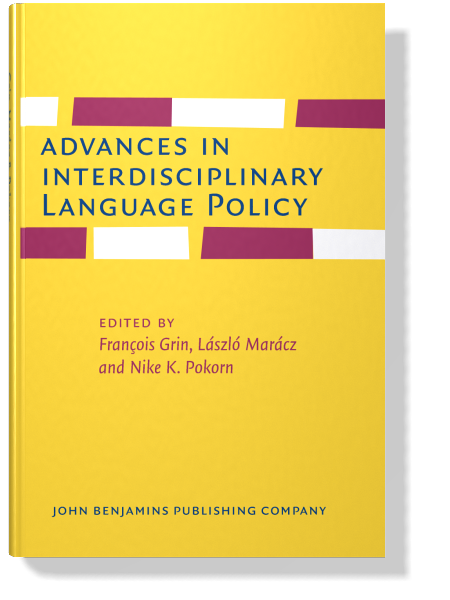
In:Advances in Interdisciplinary Language Policy
Edited by François Grin, László Marácz and Nike K. Pokorn
[Studies in World Language Problems 9] 2022
► pp. 23–42
Chapter 2Principles of integrated language policy
Published online: 21 January 2022
https://doi.org/10.1075/wlp.9.02gri
https://doi.org/10.1075/wlp.9.02gri
Abstract
This chapter proposes a novel perspective on language policy as a form of public policy, highlighting some of the epistemological implications of this approach and discussing its linkages with more standard approaches originating in applied linguistics. After introducing the relevance of interdisciplinarity and complexity as defining features of this enterprise, it focuses on the connections between principles of public policy on the one hand, and the specificities of language policy on the other hand. To this end, this chapter develops an entirely novel typology of the main dimensions of language policy (type, domain, sphere, tier, welfare, target, causation and instrument), with which the latter may be extensively described and characterised. These dimensions bring to the fore the importance of jointly considering the micro, meso and macro levels at which language policies necessarily unfold. Given the extreme complexity of practically any language policy, and the associated difficulty of establishing the full range of effects (including both advantages and drawbacks) of alternative policy choices, analysts often need to fall back on pragmatic solutions in the selection and design process. Accordingly, this chapter emphasizes the role of plausibility as a valid criterion for evaluating such effects.
Article outline
- 1.Introduction
- 2.Integrated language policy in MIME
- 3.Key concepts and tools
- Interdisciplinarity
- Complexity
- Policy relevance
- 4.From theoretical principles to application
- 5.Discussion: Adding plausibility
- 6.Concluding remarks
Acknowledgements Notes References

References (44)
Bar-Yam, Yaneer. (2005). Making Things Work: Solving Complex Problems in a Complex World. Cambridge: Knowledge Press (NECSI).
Becker, Gary. (1976). The Economic Approach to Human Behavior. Chicago: University of Chicago Press. .
Berthoud, Anne-Claude, Grin, François & Lüdi, Georges. (2013). Exploring the Dynamics of Multilingualism. The DYLAN Project. Amsterdam: John Benjamins. .
Cardinal, Linda & Sonntag, Selma (Eds.) (2015). State Traditions and Language Regimes. Kingston: McGill-Queen’s University Press.
Civico, Marco. (2018). ‘Why are computer-based simulations useful in the selection and design of complex language policies?’, in F. Grin et al. (Eds.), The MIME Vademecum (pp. 52–53). Retrieved from: [URL]
. (2019). The Dynamics of Language Minorities: Evidence from an Agent-Based Model of Language Contact, Journal of Artificial Societies and Social Simulation (JASSS) 22(4), 3. .
Coenen-Huther, Jacques. (1989). ‘Sociologie et interdisciplinarité : modalités, problèmes, perspectives’, Revue suisse de sociologie 15 (1), 1–13.
Dell’Aquila, Vittorio & Iannàccaro, Gabriele. (2002). Modelli europei di pianificazione linguistica. Vigo di Fassa: Istitut Cultural Ladin.
Fishman, Joshua. (1991). Reversing language shift: theoretical and empirical foundations of assistance to threatened languages. Clevedon: Multilingual Matters.
Gazzola, Michele. (2013). The Evaluation of Language Regimes: Theory and Application to Multilingual Patent Organisations. Amsterdam & Philadelphia: John Benjamins. .
Gazzola, Michele, Grin, François & Vaillancourt, François. (2020). ‘The Economic Evaluation of Language Policy and Planning: An Introduction to Existing Work’, in S. Mufwene and C. Vigouroux (Eds.), Bridging Linguistics and Economics (pp. 109–139). Cambridge: Cambridge University Press. .
Georgeault, Pierre & Pagé, Michel (Eds.) (2006). Le français, langue de la diversité québécoise. Une réflexion pluridisciplinaire. Montreal: Québec-Amérique.
Grin, François. (2003a). ‘Diversity as paradigm, analytical device, and policy goal’, in W. Kymlicka, & A. Patten (Eds.), Language Rights and Political Theory (pp. 169–188). Oxford: Oxford University Press.
. (2003c). Language Policy Evaluation and the European Charter for Regional and Minority Languages. London: Palgrave Macmillan. .
. (2018). ‘The MIME Vademecum: an Introduction’, in F. Grin et al. (Eds.), The MIME Vademecum (pp. 14–25). Retrieved from: [URL]
. (2020). ‘Operationalizing “diversity” for language policy: meeting sociolinguistic and ethical challenges’, in Y. Peled and D. Weinstock (Eds.), Language Ethics (pp. 117–145). Kingston: McGill-Queens University. .
. (2021a). ‘Internationalisation et anglicisation des universités: diagnostic et éléments de stratégie’, in C. Tremblay (Ed.), Gouvernance linguistique des universités et établissements d’enseignement supérieur. Paris: Presses de l’École Polytechnique, in press.
. (2021b). ‘Sociolinguistics and economics: reassessing an ongoing dialogue’, in L. McEntee-Atalianis and H. Tonkin (Eds.), Language and Sustainability. Berlin: Mouton de Gruyter, in press.
Grin, François & Fürst, Guillaume. (2018). Multilingualism and Creativity: A Multivariate Approach, Journal of Multilingual and Multicultural Development, 39(4), 341–355. .
Hult, Francis M. & Johnson, David C. (Eds.) (2015). Research Methods in Language Policy and Planning: A Practical Guide. Malden: Wiley-Blackwell.
Janssens, Rudi. (2018). ‘Can EU policy improve social inclusion in local urban contexts?’, in F. Grin et al. (Eds.), The MIME Vademecum (pp. 108–109). Retrieved from: [URL].
Kaplan, Robert & Baldauf, Richard. (1997). Language planning. From practice to theory. Clevedon: Multilingual Matters.
Kloss, Heinz. (1969). Research possibilities on group bilingualism: a report. Québec: Centre international de recherche sur le bilinguisme (CIRB).
Knoepfel, Peter, Larrue, Corinne, Varone, Frédéric & Savard, Jean-François. (2015). Analyse et pilotage des politiques publiques. Montréal: Presses de l’Université du Québec. .
Mamadouh, Virginie & El Ayadi, Nesrin. (2018). ‘Should municipalities regulate language use in public space?’, in F. Grin et al. (Eds.), The MIME Vademecum (pp. 112–113). Retrieved from: [URL].
Nelde, Peter. (1992). ‘Multilingualism and contact linguistics’, in H. Pütz (Ed.), Thirty Years of Linguistics Evolution (pp. 379–397). Amsterdam: John Benjamins. .
Pluckrose, Helen & Lindsay, James. (2020). Cynical Theories. How Universities Made Everything about Race, Gender, and Identity – and Why This Harms Everybody. Durham, NC: Pitchstone Publishing.
Pym, Anthony. (2018). ‘Should machine translation be used when providing public services?’, in F. Grin et al. (Eds.), The MIME Vademecum (pp. 152–153). Retrieved from: [URL].
Ricento, Thomas (Ed.) (2006). An Introduction to Language Policy. Theory and Method. Malden: Blackwell.
Room, Graham. (2011). Complexity, Institutions and Public Policy. Agile Decision-Making in a Turbulent World. Cheltenham: Edward Elgar. .
Rossi, Peter H., Lipsey, Mark W. & Freeman, Howard E. (2019). Evaluation: A Systematic Approach (8th ed.). Thousand Oaks & London: Sage.
Spolsky, Bernard (Ed.) (2012). The Cambridge Handbook of Language Policy. Cambridge: Cambridge University Press. .
Tollefson, James & Pérez-Milans, Miguel. (2018). The Oxford Handbook of Language Policy and Planning. Oxford: Oxford University Press. .
Weimer, David L. & Vining, Aidan R. (2017). Policy Analysis: Concepts and Practice (6th ed.). New York: Routledge.
Wickström, Bengt-Arne, Templin, Torsten, & Gazzola, Michele. (2018). ‘An economics approach to language policy and linguistic justice’, in M. Gazzola, B.-A. Wickström & T. Templin (Eds.) Language Policy and Linguistic Justice: Economic, Philosophical and Sociolinguistic Approaches (pp. 3–64). New York & Berlin: Springer. .