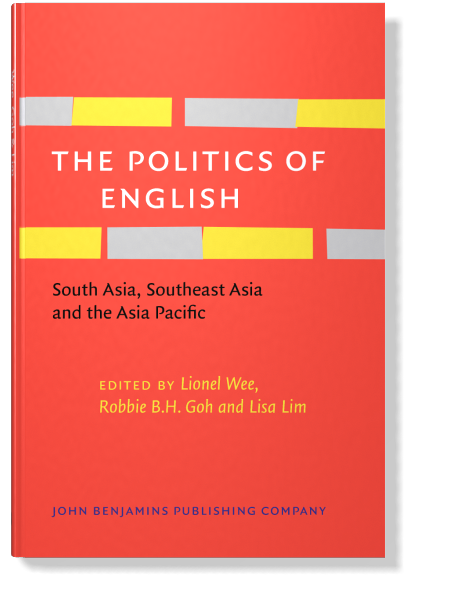
In:The Politics of English: South Asia, Southeast Asia and the Asia Pacific
Edited by Lionel Wee, Robbie B.H. Goh and Lisa Lim
[Studies in World Language Problems 4] 2013
► pp. 167–186
9. “They think speaking in English isn’t good, you know”
Negotiating bilingual identities in the Malay community
Published online: 28 March 2013
https://doi.org/10.1075/wlp.4.12raj
https://doi.org/10.1075/wlp.4.12raj
If language policies offer insights into a country’s national and cultural identity, Malaysia portrays a conflicted self. While the official stand is that English competence is highly valued and encouraged, this public discourse does not always accord with or prevail against deep-seated suspicions and hostilities that the language arouses in certain segments of the community. In an examination of the complex politics of English in Malaysia, this essay focuses on the schisms between state ideology, community practices and daily experiences of learners who seek to live and function in contested spaces. Bringing together micro and macro perspectives, it examines the reflective journal writings of Malay students engaged in the linguistic practice of English. By drawing on constructivism to theorize and examine the data, the analysis shows how the use of English in what is deemed ‘Malay spaces’ problematizes English, unwittingly positions it as the ‘linguistic other’ and implicates political, ideological and identity struggles.

Cited by (5)
Cited by five other publications
Ng, Jia Chi & Chloé Diskin‐Holdaway
Samudro, Ahmad Arif & Muhammad Amin
Lee, Sarah & Thilagavathi Shanmuganathan
Lage-Otero, Eduardo
This list is based on CrossRef data as of 24 november 2025. Please note that it may not be complete. Sources presented here have been supplied by the respective publishers. Any errors therein should be reported to them.