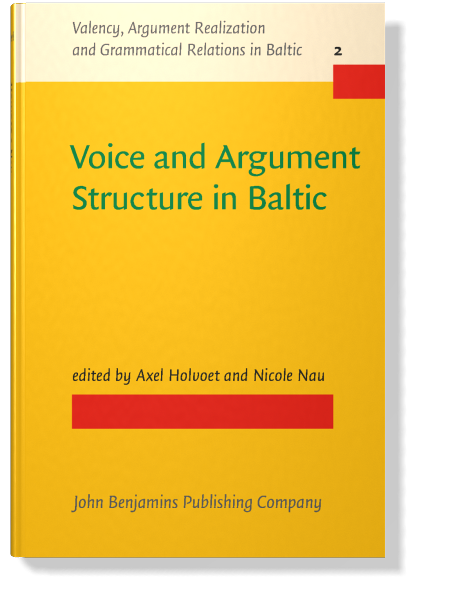
In:Voice and Argument Structure in Baltic
Edited by Axel Holvoet and Nicole Nau
[Valency, Argument Realization and Grammatical Relations in Baltic 2] 2015
► pp. 1–36
Voice in Baltic
An overview
Published online: 5 August 2015
https://doi.org/10.1075/vargreb.2.002int
https://doi.org/10.1075/vargreb.2.002int

References (51)
Ackema, Peter & Schoorlemmer, Maaike. 2006. Middles. In The Blackwell Companion to Syntax vol. 3, Martin Everaert & Henk van Riemsdijk (eds), 131–203. Malden: Blackwell.
Aikhenvald, Alexandra Yu. 2011. Causatives which do not cause: Non-valency-increasing effects of a valency-increasing derivation. In Language at Large. Essays on Syntax and Semantics, Alexandra Yu. Aikhenvald & Robert M.W. Dixon, 86–142. Leiden: Brill.
Alexiadou, Artemis & Schäfer, Florian, eds. 2013. Non-Canonical Passives [Linguistik Aktuell / Linguistics Today, 205]. Amsterdam-Philadelphia: John Benjamins.
Ambrazas, Vytautas. 1990. Sravnitel’nyj sintaksis pričastij baltijskix jazykov [A Comparative Syntax of Participles in Baltic]. Vilnius: Mokslas.
Andronov, Aleksej. 2000. Some remarks on the system of Lithuanian and Latvian conjugation. Linguistica Baltica 8: 35–47.
Arkadiev, Peter M. 2013. From transitivity to aspect: Causative-inchoative alternation and its extensions in Lithuanian. Baltic Linguistics 4: 39–77.
Arumaa, Peeter. 1957. Von der Eigenart des Ablauts und der Diathese im Baltischen. Zeitschrift für Slavische Philologie 26: 118–149.
Cibuļs, Jurs & Leikuma, Lidija. 2003. Vasals! Latgaliešu valodas mācība [Manual of Latgalian]. [Rīga:] n.i.m.s.
Dixon, R.M.W. 2000. A typology of causatives: Form, syntax, and meaning. In Changing Valency: Case Studies in Transitivity, R.M.W. Dixon & Alexandra Aikhenvald (eds), 30–83. Cambridge: Cambridge University Press.
Dixon, R.M.W. & Aikhenvald, Alexandra. 2000. Introduction. In Changing Valency: Case Studies in Transitivity, R.M.W. Dixon & Alexandra Aikhenvald (eds), 1–29. Cambridge: Cambridge University Press.
. 2006. Passives in Lithuanian (in comparison with Russian). In Passivization and Typology: Form and Function [Typological Studies in Language, 68], Werner Abraham & Larisa Leisiö (eds), 29–61. Amsterdam-Philadelphia: John Benjamins.
Haspelmath, Martin. 1993. More on the typology of inchoative / causative verb alternations. In Causatives and Transitivity [Studies in Language Companion Series, 23], Bernard Comrie & Maria Polinsky (eds), 87–120. Amsterdam-Philadelphia: John Benjamins.
Haspelmath, Martin & Calude, Andreea & Spagnol, Michael & Narrog, Heiko & Bamyacı, Elif. 2014. Coding causal-noncausal verb alternations: a form-frequency correspondence explanation. Journal of Linguistics 50 (3): 587–625.
Holvoet, Axel. 2000. Reflexiva typu słowiańskiego w pewnej gwarze górnołotewskiej [Reflexives of the Slavonic type in a High Latvian dialect]. In Kontakty językowe polszczyzny na pograniczu wschodnim. Prace ofiarowane Profesorowi Januszowi Riegerowi, Ewa Wolnicz-Pawłowska & Wanda Szulowska (eds), 97–102. Warsaw: Semper.
. 2001b. Impersonals and passives in Baltic and Finnic. In The Circum-Baltic Languages. Typology and Contact. Vol. 2: Grammar and Typology [Studies in Languages Companion Series, 55], Östen Dahl & Maria Koptjevskaja-Tamm (eds), 363–389. Amsterdam-Philadelphia: John Benjamins.
Holvoet, Axel & Nau, Nicole. 2014. Argument marking and grammatical relations in Baltic: An overview. In Grammatical Relations and their Non-Canonical Encoding in Baltic [Valency, Argument Realization and Grammatical Relations in Baltic, 1], Axel Holvoet & Nicole Nau (eds), 1–41. Amsterdam-Philadelphia: John Benjamins.
Kalnača, Andra & Lokmane, Ilze. 2012. The semantics and distribution of Latvian reflexive verbs. In Multiple Perspectives in Linguistic Research on Baltic languages, Aurelija Usonienė, Nicole Nau & Ineta Dabašinskienė (eds.), 229–256. Newcastle: Cambridge Scholars.
Keenan, Edward L. & Dryer, Matthew S. 2007. Passive in the world’s languages. In Language Typology and Syntactic Description vol. 1, Clause Structure, 2nd edn., Timothy Shopen (ed), 325–361. Cambridge: Cambridge University Press.
Kehayov, Petar & Vihman, Virve. 2014. The lure of lability: a synchronic and diachronic investigation of the labile pattern in Estonian. Linguistics 52 (4): 1061–1105.
Kemmer, Suzan. 1993. The Middle Voice [Typological Studies in Language, 23]. Amsterdam-Philadelphia: John Benjamins.
Kittillä, Seppo. 2011. Transitivity typology. In The Oxford Handbook of Linguistic Typology, Song, Jae Jung (ed.), 346–367. Oxford: Oxford University Press.
Kulikov, Leonid I. 2011. Voice typology. In The Oxford Handbook of Linguistic Typology, Song, Jae Jung (ed.), 368–398. Oxford: Oxford University Press.
Kulikov, Leonid & Lavidas, Nikolaos. 2014. Introduction [to the special issue on labile verbs]. Linguistics 52(4): 871–877.
Lavine, James E. 2006. Is there a passive evidential strategy in Lithuanian? In
Papers from the 42nd Meeting of the Chicago Linguistic Society
, Jacqueline Bunting et al. (eds), 41–55.
Letuchiy, Alexander. 2009. Towards a typology of labile verbs: Lability vs. derivation. In New Challenges in Typology. Transcending the Borders and Refining the Distinctions, Alexandre Arkhipov & Patience Epps (eds.), 223–244. Berlin: Mouton de Gruyter.
Lyngfelt, Benjamin & Solstad, Torgrim, eds. 2006. Demoting the Agent. Passive, Middle and Other Voice Phenomena [Linguistik Aktuell / Linguistics Today, 96]. Amsterdam: John Benjamins.
Mel’čuk, Igor. 1993. The inflectional category of voice: towards a more rigorous definition. In Causatives and Transitivity [Studies in Language Companion Series, 23], Bernard Comrie & Maria Polinsky (eds), 1–46. Amsterdam-Philadelphia: John Benjamins.
Mithun, Marianne. 2000. Valency-changing derivation in Central Alaskan Yup’ik. In Changing Valency: Case Studies in Transitivity, R.M.W. Dixon & Alexandra Aikhenvald (eds), 84–114. Cambridge: Cambridge University Press.
Nedjalkov, Vladimir P. 1969. Nekotorye verojatnostnye universalii v glagol’nom slovoobrazovanii [Some likely universals in verbal word formation]. In Jazykovye universalii i lingvističeskaja tipologija, Igor’ F. Vardul’ (ed.), 106–114. Moskva: Nauka.
Nedyalkov, V.P. & G.G. Silnitsky. 1973. The typology of morphological and lexical causatives. In Trends in Soviet Theoretical Linguistics, Ferenc Kiefer (ed), 1–32. Dordrecht: Reidel.
Nichols, Johanna. 1993. Transitive and causative in the Slavic lexicon: Evidence from Russian. In Causatives and Transitivity [Studies in Language Companion Series, 23], Bernard Comrie & Maria Polinsky (eds), 69–86. Amsterdam-Philadelphia: John Benjamins.
Nichols, Johanna, David A. Peterson & Jonathan Barnes. 2004. Transitivizing and detransitivizing languages. Linguistic Typology 8: 149–211.
Ostrowski, Norbert. 2006. Studia z historii czasownika litewskiego. Iteratiwa, denominatiwa [Studies in the History of the Lithuanian Verb. Iteratives, Denominatives]. Poznań: Wydawnictwo Naukowe UAM.
Pakerys, Jurgis. 2012. On the typology of recent verbal borrowings in Baltic. Paper read at the 45th Annual Meeting of the SLE, Stockholm, August 2012.
Shibatani, Masayoshi. 1985. Passives and related constructions: a prototype analysis. Language 61 (4): 821–848.
. 1998. Voice parameters. In Typology of Verbal Categories. Papers Presented to Vladimir Nedjalkov on the Occasion of his 70th Birthday, Leonid Kulikov & Heinz Vater (eds), 117–138. Tübingen: Niemeyer.
Stang, Christian S. 1942. Das slavische und baltische Verbum. Skriften utgitt av Det Norske Videnskaps Akademi i Oslo. II. Historisk-Filosofisk Klasse. 1942, I. Oslo: Dybwad.
Timberlake, Alan. 1982. The impersonal passive in Lithuanian.
Proceedings of the 8th Annual Meeting of the Berkeley Linguistics Society
, 508–524.
Veidemane, Ruta. 2002. Darbības vārds [The verb]. In Latviešu literārās valodas morfoloģiskās sistēmas attīstība: Lokāmās vārdšķiras, Kornēlija Pokrotniece (ed.), 409–509. Rīga: LU Latviešu valodas institūts.
Wiemer, Björn. 2006. Relations between actor-demoting devices in Lithuanian. In Passivization and Typology: Form and Function [Typological Studies in Language, 68], Werner Abraham & Larisa Leisiö (eds), 274–309. Amsterdam-Philadelphia: John Benjamins.
The World Atlas of Transitivity Pairs. 2014. Tokyo: National Institute for Japanese Language and Linguistics. (Available online at: [URL])
Cited by (2)
Cited by two other publications
Kehayov, Petar, Liina Lindström & Miina Norvik
Holvoet, Axel & Nicole Nau
2016. Introduction. In Argument Realization in Baltic [Valency, Argument Realization and Grammatical Relations in Baltic, 3], ► pp. 1 ff.
This list is based on CrossRef data as of 21 november 2025. Please note that it may not be complete. Sources presented here have been supplied by the respective publishers. Any errors therein should be reported to them.