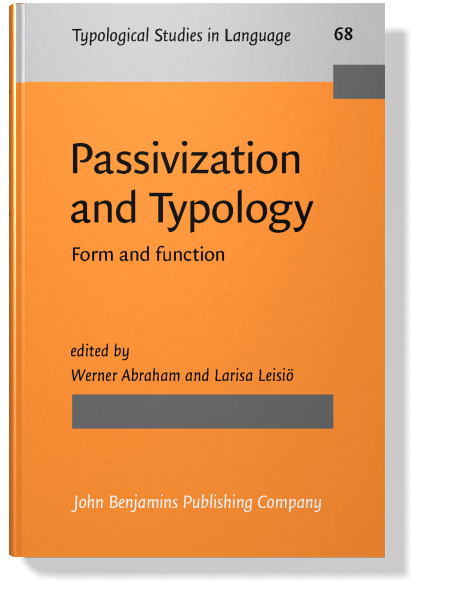
In:Passivization and Typology: Form and function
Edited by Werner Abraham and Larisa Leisiö
[Typological Studies in Language 68] 2006
► pp. 442–460
Passive as a feature-suppression operation
Published online: 20 September 2006
https://doi.org/10.1075/tsl.68.26kal
https://doi.org/10.1075/tsl.68.26kal
The major goal of this article is to examine some properties of the passive crosslinguistically and the ensuing ramifications for a universal theory of the passive. Building on my previous work (Kallulli 2006a, b), this article argues for a uniform derivation of the passive and the anticausative construction. The main claim is that passives and anticausatives differ only with respect to the respective building blocks that enter syntactic computation but both arise through the same operation, namely suppression of a feature in v. Passive constructions across languages can be made compatible by relegating the differences to simple combinatorial properties of verb and prepositional types and their interactions with other event functors/aspectual operators, which are in turn encoded differently morphologically across languages.

Cited by (13)
Cited by 13 other publications
Luraghi, Silvia, Guglielmo Inglese & Daniel Kölligan
Alexiadou, Artemis, Elena Anagnostopoulou & Florian Schäfer
Alexiadou, Artemis, Elena Anagnostopoulou & Florian Schäfer
Alexiadou, Artemis, Elena Anagnostopoulou & Florian Schäfer
Alexiadou, Artemis, Elena Anagnostopoulou & Florian Schäfer
Alexiadou, Artemis, Elena Anagnostopoulou & Florian Schäfer
Alexiadou, Artemis, Elena Anagnostopoulou & Florian Schäfer
Alexiadou, Artemis, Elena Anagnostopoulou & Florian Schäfer
ALEXIADOU, ARTEMIS & EDIT DORON
[no author supplied]
[no author supplied]
This list is based on CrossRef data as of 10 december 2025. Please note that it may not be complete. Sources presented here have been supplied by the respective publishers. Any errors therein should be reported to them.