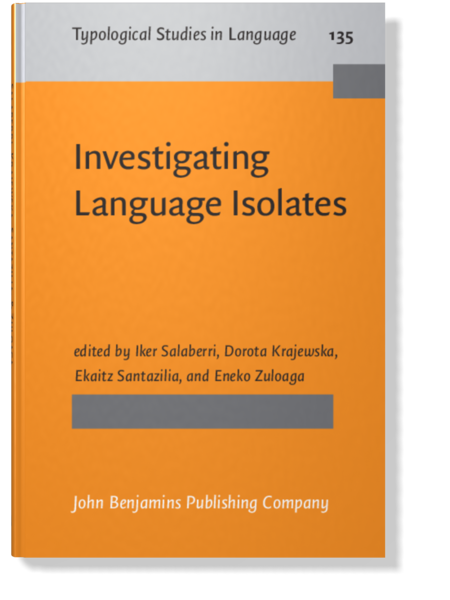
In:Investigating Language Isolates: Typological and diachronic perspectives
Edited by Iker Salaberri, Dorota Krajewska, Ekaitz Santazilia and Eneko Zuloaga
[Typological Studies in Language 135] 2025
► pp. v–vi
Published online: 16 January 2025
https://doi.org/10.1075/tsl.135.toc
https://doi.org/10.1075/tsl.135.toc
Table of contents
AcknowledgementsVII
Part I.Setting the stage
Introduction: State of the art of research on language isolates2
Iker Salaberri
Dorota Krajewska
Ekaitz Santazilia
Eneko Zuloaga
Part II.Typological features of isolates vs. non-isolates
Is there a typological profile of isolates?22
Marine Vuillermet
David Inman
Natalia Chousou-Polydouri
Kellen Parker van Dam
Shelece Easterday
Françoise Rose
The Amuric language family: Why so exotic?48
Ekaterina Gruzdeva
Juha Janhunen
An Austronesian-type voice system in an Amazonian isolate71
Katharina Haude
Part III.Recovering the histories of isolates
Etymologies in a language isolate: Methodological aspects and a proposal to evaluate their quality104
Julen Manterola
The Small Bang: A pilot study investigating the origins of a language and population isolate through loan words142
Abbie Hantgan
Combining disparate lines of evidence in the study of the history of language isolates, exemplified with Mochica from
Northern Peru176
Matthias Urban
The Múra doculects and Múra-Pirahã historical linguistics208
Fernando O. de Carvalho
Part IV.Isolates and language contact
Baroque accretions and isolation: A case study of grammatical complexity in complex social situations in Solomon Islands248
Angela Terrill
California isolates: Language contact and genetic classification270
Carmen Dagostino
Part V.Isolates and language documentation and classification
One language or two? The arbitrariness of isolate classifications in New Guinea306
Antoinette Schapper
Subject index
Language index
Name index
