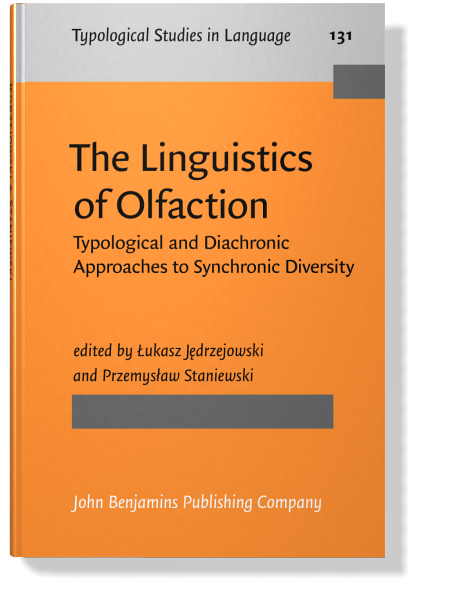
In:The Linguistics of Olfaction: Typological and Diachronic Approaches to Synchronic Diversity
Edited by Łukasz Jędrzejowski and Przemysław Staniewski
[Typological Studies in Language 131] 2021
► pp. 35–72
Why is smell special?
A case study of a European language: Swedish
Published online: 26 April 2021
https://doi.org/10.1075/tsl.131.02vib
https://doi.org/10.1075/tsl.131.02vib
Recent typological studies have described a number of languages with a rich inventory of abstract odor terms, which stand in stark contrast to Swedish and other European languages that are considered to have poor systems of such terms. However, there have been few thorough descriptions of the odor terms of any European language. This chapter presents a detailed corpus-based description of the noun lukt ‘smell’ and the verbs lukta ‘to smell’, stinka ‘to stink’, dofta ‘to smell good’ and osa ‘to smell of burnt fat’. In addition to the description of the lexico-grammatical structure, there is a detailed discussion of the way odor is talked about in Swedish based on word sketches. Unlike colors, which are treated as objective properties of physical objects, odors are often talked about as sensations that evoke affective reactions in humans. Odors are also often talked about as characteristic features of whole situations. The chapter ends with a discussion of what it is that makes smell special with respect to the other senses.
Keywords: lexical semantics, lexical typology, perception verbs, olfaction, Swedish
Article outline
- 1.Introduction
- 1.1Verbs of perception
- 1.2Phenomenon-based sensory words
- 2.The neurophysiology and psychology of smell
- 3.Olfaction and language: State of the art
- 4.The semantic field of smell in Swedish
- 4.1The basic structure
- 4.2Conceptualization of smell as a moving entity
- 4.3Towards a formalized model
- 5.Quantitative overview
- 6.Metaphorical and other extended uses
- 7.Talking about odors in Swedish
- 7.1What odors are talked about
- 7.2What situations are commented on by using an odor verb?
- 7.3The noun lukt ‘odor’
- 8.Why then is smell special?
Abbreviations Notes Electronic sources References

References (60)
ESPC: The English Swedish Parallel Corpus <[URL]> (1 July 2016).
KORP: <[URL]> (15 May 2017).
OED: Oxford English Dictionary. <[URL]> (15 May 2017).
FrameNet: <[URL]> (15 May 2017).
Aikhenvald, Alexandra Y. & Storch, Anne (eds). 2013. Perception and Cognition in Language and Culture [Brill’s Studies in Language, Cognition and Culture 3]. Leiden: Brill.
Altenberg, Bengt & Aijmer, Karin. 2000. The English-Swedish Parallel Corpus: A resource for contrastive research and translation studies. In Corpus Linguistics and Linguistic Theory: Papers from the Twentieth International Conference on English Language Research on Computerized Corpora (ICAME 20), Freiburg im Breisgau [Language and Computers 33],Christian Mair & Marianne Hundt (eds), 15–23. Amsterdam: Rodopi.
Berlin, Brent. 1978. Ethnobiological classification. In Cognition and Categorization, Eleanor Rosch & Barbara B. Lloyd (eds), 9–26. Hillsdale NJ: Lawrence Erlbaum Associates.
Bjorvand, Harald & Lindeman, Fredrik Otto. 2000. Våre arveord. Etymologisk ordbok (Our Inherited Words. Etymological Dictionary). Oslo: Novus forlag.
Boisson, Claude. 1997. La dénomination des odeurs: Variations et régularités linguistiques. Intellectica 24(1): 29–49.
Borin, Lars, Forsberg, Magnus & Roxendal, Johan. 2012. Korp – The corpus infrastructure of Språkbanken. <[URL]> (9 April 2018).
Brown, Cecil. 1985. Mode of subsistence and folk biological taxonomy. Current Anthropology 6(1): 43–64.
Classen, Constance. 1993. Worlds of Sense: Exploring the Senses in History and Across Cultures. London: Routledge.
. 2005. McLuhan in the rainforest. The sensory worlds of oral cultures. In Empire of the Senses: The Sensual Culture Reader, David Howes (ed.), 147–163. Oxford: Berg.
Classen, Constance, Howes, David & Synnott, Anthony. 1994. Aroma. The Cultural History of Smell. London: Routledge.
Delon-Martin, Chantal, Plailly, Jane, Fonlupt, Pierre, Veyrac, Alexandra & Royet, Jean-Pierre. 2013. Perfumers’ expertise induces structural reorganization in olfactory brain regions. NeuroImage 68(1): 55–62.
Demolin, Didier, Traill, Anthony, Sicard, Gilles, & Hombert, Jean-Marie. 2016. Odour terminology in !Xóõ. In Lone Tree – Scholarship in the Service of the Koon. Essays in Memory of Anthony T Traill, Rainer Voßen & Wilfrid H.G. Haacke (eds), 107–118. Cologne: Rüdiger Köppe.
Dubois, Danièle. 2000. Categories as acts of meaning: The case of categories in olfaction and audition. Cognitive Science Quarterly 1: 35–68.
Evans, Nicholas M. & Wilkins, David. 2000. In the mind’s ear: The semantic extension of perception verbs in Australian languages. Language 76(3): 546–592.
Floyd, Simeon, San Roque, Lila & Majid, Asifa. 2018. Smell is coded in grammar and frequent in discourse: Cha’palaa olfactory language in cross-linguistic perspective. Journal of Linguistic Anthropology 28(2): 175–196.
Hammarberg, Björn & Viberg, Åke. 1977. The place-holder constraint, language typology, and the teaching of Swedish to immigrants. Studia Linguistica XXXI: 106–163.
Huumo, Tuomas. 2010. Is perception a directional relationship? On directionality and its motivation in Finnish expressions of sensory perception. Linguistics 48(1): 49–97.
Ibarretxe-Antuñano, Iraide. 1999. Metaphorical mappings in the sense of smell. In Metaphor in Cognitive Linguistics [Current Issues in Linguistic Theory 175], Raymond W. Gibbs Jr. & Gerard J. Steen (eds), 29–45. Amsterdam: John Benjamins.
Kay, Paul, Berlin, Brent, Maffi, Louisa, Merrifield, William R. & Cook, Richard. 2009. The World Color Survey. Stanford CA: CSLI.
Koptjevskaja-Tamm, Maria. 2015. Introducing “The linguistics of temperature”. In The Linguistics of Temparature [Typological Studies in Language 107], Maria Koptevskaja-Tamm (ed.), 1–40.Amsterdam: John Benjamins.
(ed.). 2015. The Linguistics of Temperature [Typological Studies in Language 107]. Amsterdam: John Benjamins.
Lee, Amy Pei-Jung. 2015. Lexical categories and conceptualization of olfaction in Amis. Language and Cognition 7(3): 321–350.
Majid, Asifa & Burenhult, Niclas. 2014. Odors are expressible in language as long as you speak the right language. Cognition 130(2): 266–270.
Majid, Asifa & Kruspe, Nicole. 2018. Hunter-gatherer olfaction is special. Current Biology 28: 409–413.
Maslova, Elena. 2004. A universal constraint on the sensory lexicon, or when hear can mean ‘see’? In Tipologiceskie obosnovanija v grammatike: k 70-letiju professora Xrakovskogo V.S., Alexandr P. Volodin (ed.), 300–312. Moscow: Znak. <[URL]> (9 April 2018).
Miller, George A. & Johnson-Laird, Philip N. 1976. Language and Perception. Cambridge MA: Harvard University Press.
Nakagawa, Hirosi. 2012. The importance of TASTE verbs in some Khoe languages. Linguistics 50(3): 395–420.
O’Meara, Carolyn & Majid, Asifa. 2016. How changing lifestyles impact Seri smellscapes and smell language. Anthropological Linguistics 58(2): 107–131.
Olofsson, Jonas K. & Gottfried, Jay A. 2015. The muted sense: Neurocognitive limitations of olfactory language. Trends in Cognitive Sciences 19(6): 314–321.
Plailly, Jane, Delon-Martin, Chantal & Royet,Jean-Pierre. 2012. Experience induces functional reorganization in brain regions involved in odor imagery in perfumers. Human Brain Mapping 33(1): 224–234.
Popova, Yanna B. 2003. ‘The fool sees with his nose’: Metaphoric mappings in the sense of smell in Patrick Süskind’s Perfume. Language and Literature 12(2): 135–151.
Reznikova, Tatiana, Rakhilina, Ekaterina & Bonch-Osmolovskaya, Anastasia. 2012. Towards a typology of pain predicates. Linguistics 50(3): 421–465.
San Roque, Lila, Kendrick, Kobin H., Norcliffe, Elisabeth, Brown, Penelope, Defina, Rebecca, Dingemanse, Mark, Dirksmeyer, Tyko, Enfield, Nicolas J., Floyd, Simeon, Hammond, Jeremy, Rossi, Giovanni, Tufvesson, Sylvia, van Putten, Saskia & Majid, Asifa. 2015. Vision verbs dominate in conversation across cultures, but the ranking of non-visual verbs varies. Cognitive Linguistics 26(1): 31–60.
Staniewski, Przemysław. 2016. Das Unantastbare beschreiben. Gerüche und ihre Versprachlichung im Deutschen und Polnischen [Warschauer Studien zur Germanistik und zur Angewandten Linguistik 25]. Berlin: Peter Lang.
Stokes, Dustin, Matthen, Mohan & Biggs, Stephen (eds). 2015. Perception and its Modalities. Oxford: OUP.
Storch, Anne. 2013. Knowing, smelling and telling tales in Luwo. In Perception and Cognition in Language and Culture [Brill’s Studies in Language, Cognition and Culture 3], Alexandra Y. Aikhenvald & Anne Storch (eds), 47–68. Leiden: Brill.
Strik-Lievers, Francesca. 2015. Synaesthetia: A corpus-based study of cross-modal directionality. Functions of Language 22(1): 69–95.
Süskind, Patrick. 1985/1994. Das Parfum. Die Geschichte eines Mörders. Zürich: Diogenes Verlag AG. (First published 1985. Citations from Diogenes Taschenbuch 1994).
Talmy, Leonard. 1985. Lexicalization patterns: Semantic structure in lexical forms. In Grammatical Categories and the Lexicon [Language Typology and Syntactic Description 3], Timothy Shopen (ed.), 57–149. Cambridge: Cambridge University Press.
Tufvesson, Sylvia. 2011. Analogy-making in the Semai sensory world. The Senses and Society 6(1): 86–95.
Van Beek, Walter E. A. 1992. The dirty smith. Smell as a social frontier among the Kapsiki/Higi of North Cameroon and North-Eastern Nigeria. Africa: Journal of the International African Institute 62(1): 38–58.
Vanhove, Martine. 2008. Semantic associations between sensory modalities, prehension and mental perceptions: A crosslinguistic perspective. In From Polysemy to Semantic Change. Towards a Typology of Lexical Semantic Associations [Studies in Language Companion Series 106], Martine Vanhove (ed.), 341–370. Amsterdam: John Benjamins.
. 2001. Verbs of perception. In Language Typology and Language Universals [Handbücher zur Sprach- und Kommunikationswissenschaft / Handbooks of Linguistics and Communication Science 20.2], Martin Haspelmath, Ekkehard König, Wulf Oesterreicher & Wolfgang Raible (eds), 1294–1309. Berlin: De Gruyter.
. 2015. Sensation, perception and cognition. Swedish in a typological-contrastive perspective. Functions of Language 22(1): 96–131.
. 2017. Finding a model for contrastive lexical semantics: A look at verbal communication verbs. LingBaW Journal 3. <[URL]> (9 October 2018).
. 2019. Phenomenon-based perception verbs in Swedish from a typological and contrastive perspective. In Perception, perceptibilité et objet perçu. Approches inter-langues [Syntaxe & Sémantique 20], Éric Gilbert (ed.), 17–48. Caen: Presses Universitaires de Caen. <[URL]> (7 September 2020).
Willander, Johan & Larsson, Maria. 2007. Olfaction and emotion: The case of autobiographical memory. Memory & Cognition 37(7): 1659–1663.
Winter, Bodo. 2016. Taste and smell words form an affectively loaded and emotionally flexible part of the English lexicon. Language, Cognition and Neuroscience 31(8): 975–988.
Wnuk, Ewelina. 2016. Semantic Specificity of Perception Verbs in Maniq. PhD dissertation, Max Planck Institute for Psycholinguistics, Nijmegen.
Wnuk, Evelina & Majid, Asifa. 2014. Revisiting the limits of language: The odor lexicon of Maniq. Cognition 131(1): 125–138.
Zucco, Gesualdo M. 2007. Odor memory. The unique nature of a memory system. In Speaking of Colors and Odors [Converging Evidence in Language and Communication Research 8], Martina Plümacher & Peter Holz (eds), 155–165. Amsterdam: John Benjamins.
Cited by (2)
Cited by two other publications
Galac, Ádám
2024. Bold colors, sweeping melodies, offensive smells. International Journal of Language and Culture 11:1 ► pp. 58 ff.
This list is based on CrossRef data as of 7 december 2025. Please note that it may not be complete. Sources presented here have been supplied by the respective publishers. Any errors therein should be reported to them.