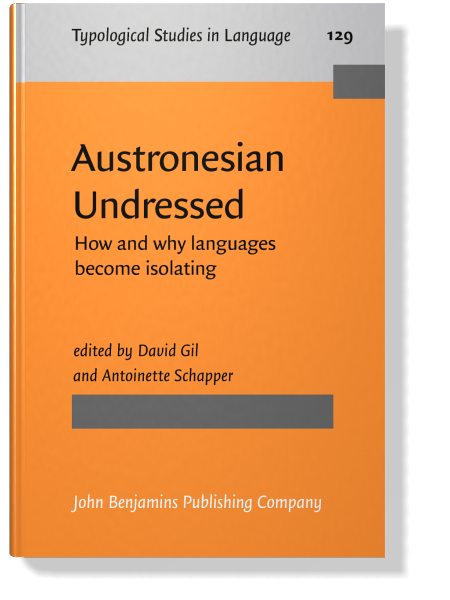
In:Austronesian Undressed: How and why languages become isolating
Edited by David Gil and Antoinette Schapper
[Typological Studies in Language 129] 2020
► pp. vii–viii
Get fulltext
This article is available free of charge.
Published online: 21 October 2020
https://doi.org/10.1075/tsl.129.toc
https://doi.org/10.1075/tsl.129.toc
Table of contents
Preface
IX
Introduction
1
David Gil
Antoinette Schapper
Chapter 1.What does it mean to be an isolating language? The case of Riau Indonesian
9
David Gil
Chapter 2.The loss of affixation in Cham: Contact, internal drift and the limits of linguistic history
97
Marc Brunelle
Chapter 3.Dual heritage: The story of Riau Indonesian and its relatives
119
David Gil
Chapter 4.Voice and bare verbs in Colloquial Minangkabau
213
Sophie Crouch
Chapter 5.Javanese undressed: Isolating phenomena in ‘peripheral’ dialects
253
Thomas J. Conners
Chapter 6.Are the Central Flores languages really typologically unusual?
287
Alexander Elias
Chapter 7.From Lamaholot to Alorese: Morphological loss in adult language contact
339
Marian Klamer
Chapter 8.Double agent, double cross? Or how a suffix changes sides in an isolating language: dór in
Tetun Dili
369
Catharina Williams-van Klinken
John Hajek
Chapter 9.The origins of isolating word structure in eastern Timor
391
Antoinette Schapper
Chapter 10.Becoming Austronesian: Mechanisms of language dispersal across Southern Island Southeast Asia and the
collapse of Austronesian morphosyntax
447
Mark Donohue
Timothy Denham
Chapter 11.Concluding reflections
483
John McWhorter
Index
507
