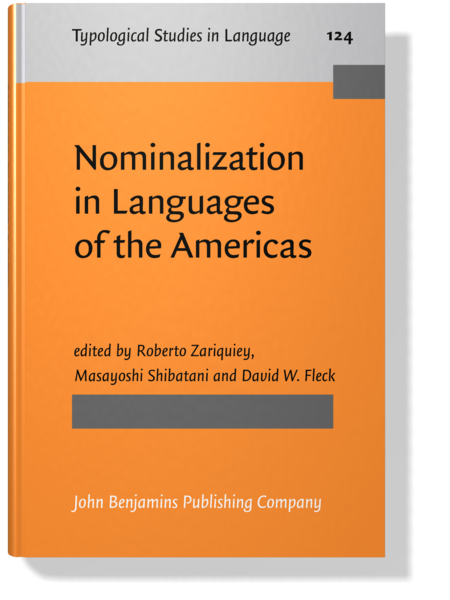
In:Nominalization in Languages of the Americas:
Edited by Roberto Zariquiey, Masayoshi Shibatani and David W. Fleck
[Typological Studies in Language 124] 2019
► pp. 169–194
Chapter 3Nominalization in cross-linguistic diachronic perspective
Published online: 8 August 2019
https://doi.org/10.1075/tsl.124.03cri
https://doi.org/10.1075/tsl.124.03cri
While more and more data are now available on languages rich in nominalizations, such as those of Latin America, the literature on nominalization is mainly synchronically orientented. The paper discusses several pieces of diachronic evidence about the origins of nominalization cross-linguistically. This evidence challenges the idea, widely held in the functional-typological literature, that the use of nominalizations reflects a non-default treatment of particular expressions, and that this motivates the distinguishing properties of nominalizations vis-a-vis other constructions. Diachronic evidence also points to possible motivations for the fact that nominalizations fail to consistently display the same structural properties, both cross-linguistically and within individual languages, and fail to be consistently used in the same contexts from one language to another.
Article outline
- 1.Introduction
- 2.Some traditional assumptions about nominalization
- 3.Nominalization and the origins of nominalizers
- 4.Diachrony and the structural diversity of nominalizations
- 5.Diachrony and the distribution of nominalizations
- 6.Concluding remarks
Abbreviations Notes References

References (58)
Beyer, Stephan V. .1992. The Classical Tibetan language. Albany: State University of New York Press.
Carlin, Eithne B. 2004. A Grammar of Trio, a Cariban Language of Suriname. Frankfurt am Main: Peter Lang.
Chamoreau, Claudine & Estrada-Fernández, Zarina (eds). 2016. Finiteness and Nominalization. Amsterdam and Philadelphia: John Benjamins.
Comrie, Bernard & Estrada-Fernández, Zarina (eds). 2012. Relative clauses in languages of Americas. Amsterdam and Philadelphia: John Benjamins.
Comrie, Bernard & Thompson, Sandra A. 2007. Lexical nominalization. In Language Typology and Syntactic Description. 2nd Edition, Volume 3: Grammatical Categories and the Lexicon, Timothy Shopen (ed.), 334–381. Cambridge: CUP.
. 2007. Deconstructing categories: Finiteness in a functional-typological perspective. In Finiteness: all over the clause. Irina Nikolaeva (ed.), 91–114, Oxford: OUP.
. 2012. Cognitive explanations, distributional evidence, and diachrony. Studies in Language 36, 645–670.
. 2016. Routes to Insubordination: a Cross-Linguistic Perspective. In Insubordination, Evans, Nicholas R. & Watanabe, Honoré (eds), 393–422. Amsterdam: John Benjamins.
Croft, William. 1991. Syntactic Categories and Grammatical Relations. Chicago and London: The University of Chicago Press.
da Silva Facundes, Sidney. 2000. The Language of the Apurinã People of Brazil (Maipure/Arawak). PhD dissertation, State University of New York, Buffalo.
DeLancey, Scott. 1986. Relativization as nominalization in Tibetan and Newari’. Ms, University of Oregon. <[URL]- [URL]>
. 1999. Relativization in Tibetan. In Topics in Nepalese Linguistics, Yogendra P. Yadava & Warren W. Glover (eds), 231–249. Kathmandu: Royal Nepal Academy.
. 2003. Lhasa Tibetan. In The Sino-Tibetan Languages, Graham Thurgood & Randy J. LaPolla (eds), 270–88. London and New York: Routledge.
Deutscher, Guy. 2009. Nominalization and the evolution of subordination. In Syntactic Complexity, Talmy Givón & Masayoshi Shibatani (eds), 199–214. Amsterdam and Philadelphia: John Benjamins
. 2009. Escape from the noun phrase: From relative clause to converb and beyond in an Amazonian language. Diachronica 26, 287–318.
Estrada-Fernández, Zarina. 2008. Cláusolas relativas en pima bajo. Línguas Indígenas Americanas 8, 69–83.
. 2012. From demonstrative to relative marker to clause linker: Relative clause formation in Pima Bajo. In Bernard Comrie & Zarina Estrada-Fernández (eds), 127–146. Amsterdam and Philadelphia: John Benjamins.
Evans, N. (2007). Insubordination and its uses. In Finiteness: all over the clause, Irina Nikolaeva (ed.), 366–431. Oxford: OUP.
Fortescue, Michael. 1995. The historical source and typological position of ergativity in Eskimo languages. Etudes/Inuit/Studies 19, 61–75.
Givón, Talmy. 2012. Towards a diachronic of relative clause. In Bernard Comrie and Zarina Estrada-Fernández (eds), 1–26. Amsterdam and Philadelphia: John Benjamins.
Heine, Bernd. 2003. Grammaticalization. In The Handbook of Historical Linguistics, Brian D. Joseph and Richard D. Janda (eds), 576–601. Oxford: Blackwell.
Heine, Bernd, Claudi, Ulrike & Hünnemeyer, Friederike. 1991. Grammaticalization. Chicago: University of Chicago Press.
Heine, Bernd & Reh, Mechtild. 1984. Grammaticalization and reanalysis in African languages. Hamburg: Helmut Buske.
Herring, Susan C. 1991. Nominalization, relativization, and attribution in Lotha, Angami, and Burmese. Linguistics of the Tibeto-Burman Area 14, 55–72.
Hopper, Paul J. & Thompson, Sandra A. 1984. The discourse basis for lexical categories in universal grammar. Language 60, 703–752.
1985. The iconicity of the universal categories noun and verb. In Iconicity in Syntax, John Haiman (ed.), 151–183. Amsterdam and Philadelphia: John Benjamins.
1991. Foundations of Cognitive Grammar. Vol. II: Descriptive Applications. Stanford: Stanford University Press.
Langdon, Margaret. 1970. A Grammar of Diegueño. The Mesa Grande Dialect. University of California Publications in Linguistics 66. Berkeley and Los Angeles: University of California Press.
LaPolla, Randy J. 2003. Qiang. In The Sino-Tibetan Languages, Graham Thurgood & Randy J. LaPolla (eds), 573–87. London and New York: Routledge.
LaPolla, Randy J. & Huang, Chenglong. 1996. A Grammar of Qiang. Berlin and New York: Mouton de Gruyter.
Malchukov, Andrej. 2004. Nominalization/verbalization: Constraining a typology of transcategorial operations. München and Newcastle: Lincom Europa.
Moore, Denny. 1989. Gavião Nominalizations as Relative Clauses and Sentential Complements Equivalents. International Journal of American Linguistics 55, 309–325.
Noonan, Michael. 1997. Versatile Nominalizations. In Essays in language function and language type, Bybee, Joan, Haiman, John & Thompson, Sandra A. (eds), 373–394. Amsterdam: John Benjamins.
. 2007. Complementation. In Language Typology and Syntactic Description. 2nd Edition, Volume 2: Complex constructions, Timothy Shopen (ed.), 52–150. Cambridge: CUP.
Shibatani, Masayoshi & bin Makhashen, Khaled A. 2009. Nominalization in Soqotri, a South Arabian language of Yemen. In Endangered languages: Contributions to Morphology and Morpho-syntax, Wetzels, W. Leo (ed.), 9–31. Leiden: Brill.
van Gijn, Rik, Haude, Katharina & Muysken, Pieter (eds). 2011. Subordination in Native South American Languages. John Benjamins.
Vidal, Alejandra. 2001. Pilagá Grammar. PhD dissertation, University of Oregon.
Weber, David J. 1983. Relativization and nominalized clauses in Huallaga (Huanaco) Quechua. University of California Publications in Linguistics 103. Berkeley and Los Angeles and London: University of California Press.
1989. A Grammar of Huallaga (Huánaco) Quechua. University of California Publications in Linguistics 112. Berkeley and Los Angeles and London: University of California Press.
Yap, Foong Ha & Wang, Jiao. 2011. From light noun to nominalizer and more: The grammaticalization of zhe and suo in Old and Middle Chinese. In Nominalization in Asian Languages: Diachronic and typological perspectives, Yap, Foong-Ha, Grunow-Hårsta, Karen & Wrona, Janick (eds), 61–108. Amsterdam and Philadelphia: John Benjamins.
Yap, Foong Ha, Grunow-Hårsta, Karen & Wrona, Janick. 2011. Introduction. Nominalization strategies in Asian languages. In Nominalization in Asian Languages: Diachronic and typological perspectives, Yap, Foong-Ha, Grunow-Hårsta, Karen & Wrona, Janick (eds), 1–57. Amsterdam and Philadelphia: John Benjamins.
Cited by (1)
Cited by one other publication
González, Albert Álvarez
2019. The ‘relative’ illusion and the origin of non-subject nominalizers in Cahita (Uto-Aztecan). In Nominalization in Languages of the Americas [Typological Studies in Language, 124], ► pp. 301 ff.
This list is based on CrossRef data as of 7 december 2025. Please note that it may not be complete. Sources presented here have been supplied by the respective publishers. Any errors therein should be reported to them.