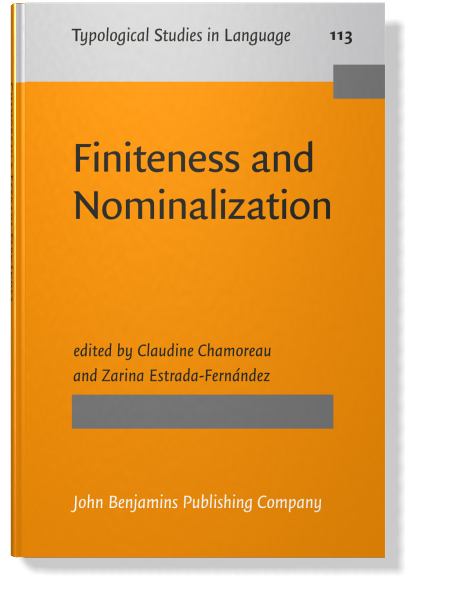
In:Finiteness and Nominalization
Edited by Claudine Chamoreau and Zarina Estrada-Fernández
[Typological Studies in Language 113] 2016
► pp. 243–268
On non-finiteness and canonical imperatives
Published online: 23 June 2016
https://doi.org/10.1075/tsl.113.10hei
https://doi.org/10.1075/tsl.113.10hei
Imperatives exhibit cross-linguistically a wide range of structures, which makes it difficult to generalize about them or to propose a structural definition that would apply to all or at least to most of them. This article is concerned with canonical imperatives, that is, information units that have an (implicit) second person singular subject referent as a hearer (or reader or signee) and express commands or requests directed at the hearer. Canonical imperatives have been called extragrammatical or extrasyntactical forms; they resemble nominalized verb forms in being non-finite. But non-finiteness appears to possess a different quality here from what it has, for example, in participial, infinitival, or other non-finite verb forms or clause types. Building on recent work on Discourse Grammar (Kaltenböck et al. 2011, Heine et al. 2013), the article attempts to account for this difference by looking at the role that imperatives play in structuring discourse.
Keywords: canonical imperative, discourse grammar, non-finiteness, suppletism, thetical

References (54)
Aijmer, Karin. 1997. “I think” – an English modal particle. In Modality in Germanic Languages. Historical and Comparative Perspectives, Toril Swan & Olaf Jansen-Westvik (eds), 1-47. Berlin: Mouton de Gruyter.
Arroyo, José Luis Blas. 2011. From politeness to discourse marking: The process of pragmaticalization of muy bien in vernacular Spanish. Journal of Pragmatics 43: 855-874.
Auer, Peter & Günthner, Susanne. 2005. Die Entstehung von Diskursmarkern im Deutschen – ein Fall von Grammatikalisierung? In Grammatikalisierung im Deutschen [Linguistik – Impulse & Tendenzen 9], Torsten Leuschner, Tanja Mortelmans & Sarah De Groodt (eds), 335-362. Berlin: Walter de Gruyter.
Biber, Douglas, Johansson, Stig, Leech, Geoffrey, Conrad, Susan, & Finegan, Edward. 1999. Longman Grammar of Spoken and Written English. London: Longman.
Brinton, Laurel J. & Traugott, Elizabeth C. 2005. Lexicalization and Language Change. Cambridge: CUP.
Childs, G. Tucker. 1995. A Grammar of Kisi, a Southern Atlantic Language [Mouton Grammar Library 16]. Berlin: Mouton de Gruyter.
Frank-Job, Barbara. 2006. A dynamic-interactional approach to discourse markers. In Approaches to Discourse Particles, Kerstin Fischer (ed.), 395-413. Amsterdam: Elsevier.
Furkó, Bálint Péter. 2005. The Pragmatic Marker-discourse Marker Dichotomy Reconsidered: The Case of well and of course
. PhD dissertation, Debreceni Egyetem, Bölcsészettudományi Kar, Debrecen.
Givón, T. 2011. Finiteness and nominalization. Ms, University of Oregon and White Cloud Ranch, Ignacio.
Haegeman, Liliane. 1991. Parenthetical adverbials: The radical orphanage approach. In
Aspects of Modern Linguistics: Papers Presented to Masatomo Ukaji on His 60th Birthday
, Shuki Chiba, Akira Ogawa, Yasuaki Fuiwara, Norio Yamada, Osamu Koma & Takao Yagi (eds), 232-254. Tokyo: Kaitakushi.
Han, Chung-Hye. 1998. The Structure and Interpretation of Imperatives: Mood and Force in Universal Grammar. PhD dissertation, University of Pennsylvania.
Hansen, Maj-Britt Mosegaard. 1998. The semantic status of discourse markers. Lingua 104(3-4): 235-260.
Heine, Bernd, Kaltenböck, Gunther & Long, Haiping. 2013. An outline of Discourse Grammar. In Reflections on Functionalism in Linguistics, Shannon Bischoff & Carmen Jeny (eds), 175-233. Berlin: Mouton de Gruyter.
Heine, Bernd & König, Christa. Forthcoming. The !Xun Language: A Dialect Grammar of Northern Khoisan [Quellen zur Khoisan-Forschung]. Cologne: Rüdiger Köppe.
Hengeveld, Kees & Mackenzie, J. Lachlan. 2008. Functional Discourse Grammar: A Typologically-Based Theory of Language Structure. Oxford: OUP.
Huddleston, Rodney & Pullum, Geoffrey K. 2002. The Cambridge Grammar of the English Language. Cambridge: CUP.
Kaltenböck, Gunther, Heine, Bernd & Kuteva, Tania. 2011. On thetical grammar. Studies in Language 35(4): 848-893.
Kavalova, Yordanka. 2007.
And-parenthetical clauses. In Parentheticals [Linguistik Aktuell/Linguistics Today 106], Nicole Dehé & Yordanka Kavalova (eds), 145-172. Amsterdam: John Benjamins.
Kibrik, Aleksandr E., Kodzasov, Sandro V., Muravyova, Irina A. & Kurebito, Megumi. 2004. Language and Folklore of the Alutor People [Endangered Languages of the Pacific Rim]. Suita: Faculty of Informatics, Osaka Gakuin University.
Kuroda, Sige-Yuki. 1972. The categorical and the thetic judgment. Evidence from Japanese syntax. Foundations of Language 9: 153-185.
Newman, Paul. 2000. The Hausa Language: An Encyclopedic Reference Grammar. New Haven CT: Yale University Press.
Quirk, Randolph, Greenbaum, Sidney, Leech, Geoffrey, & Svartvik, Jan. 1985. A Comprehensive Grammar of the English Language. London: Longman.
Rivero, María & Terzi, Arhonto. 1995. Imperatives, V-movement and logical mood. Journal of Linguistics 31: 301-332.
Rouchota, Villy. 1998. Procedural meaning and parenthetical discourse markers. In Discourse Markers: Descriptions and Theory [Pragmatics & Beyond New Series 57], Andreas H. Jucker & Yael Ziv (eds), 97-126. Amsterdam: John Benjamins.
Sadock, Jerold M. & Zwicky, Arnold M. 1985. Speech act distinctions in syntax. In Language Typology and Syntactic Description: Clause Structure, Timothy Shopen (ed.), 155-196. Cambridge: CUP.
. 2006. Theticity. In Pragmatic Organization of Discourse in the Languages of Europe, Giuliano Bernini & Marcia Schwartz, 255-308. Berlin: Mouton de Gruyter.
Takahashi, Hidemitsu. 2005. Imperatives in subordinate clauses. Annual Report on Cultural Science 117: 45-87.
. 2008. Imperatives in concessive clauses: compatibility between constructions. <[URL]>
. 2012. A Cognitive Linguistic Analysis of the English Imperative: With Special Reference to Japanese Imperatives [Human Cognitive Processing 35]. Amsterdam: Benjamins.
Veselinova, Ljuba N. 2006. Suppletion in Verb Paradigms: Bits and Pieces of the Puzzle. [Typological Studies in Language 67]. Amsterdam: John Benjamins.
Watkins, Calvert. 1963. Preliminaries to a historical and comparative analysis of the syntax of the Old Irish verb. Celtica 6: 1-49.
Cited by (8)
Cited by eight other publications
Mwinlaaru, Isaac N.
Van Olmen, Daniël
Fangqiong Zhan
Ranger, Graham
Kaltenböck, Gunther
2020. Formulaic language and Discourse Grammar. In Grammar and Cognition [Human Cognitive Processing, 70], ► pp. 233 ff.
Heine, Bernd
2018. Are there two different ways of approaching grammaticalization?. In New Trends in Grammaticalization and Language Change [Studies in Language Companion Series, 202], ► pp. 23 ff.
[no author supplied]
2020. Dualistic approaches to the analysis of forms and structures in languages. In Grammar and Cognition [Human Cognitive Processing, 70], ► pp. 157 ff.
This list is based on CrossRef data as of 7 december 2025. Please note that it may not be complete. Sources presented here have been supplied by the respective publishers. Any errors therein should be reported to them.