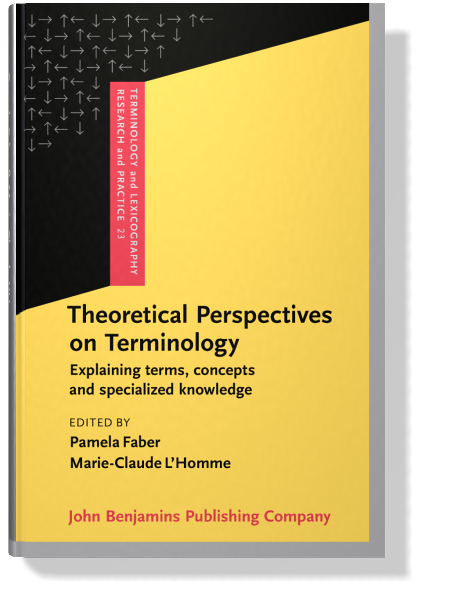
In:Theoretical Perspectives on Terminology: Explaining terms, concepts and specialized knowledge
Edited by Pamela Faber and Marie-Claude L'Homme
[Terminology and Lexicography Research and Practice 23] 2022
► pp. 477–502
Chapter 22Terminology and equivalence
Published online: 14 June 2022
https://doi.org/10.1075/tlrp.23.22leo
https://doi.org/10.1075/tlrp.23.22leo
Abstract
Equivalence has not attracted as much interest as other issues in Terminology. Nevertheless, terminological equivalence can be understood from different perspectives: (1) equivalence at the concept, term or textual level; (2) degree of equivalence (from full to zero equivalence); (3) interlinguistic or intralinguistic equivalence; (4) equivalence based on the syntactic structure of terminological correspondences; (5) equivalence depending on the solution found for each equivalence-related problem; or (6) discovered or created equivalence. This chapter addresses equivalence from different theoretical approaches and their impact on the practice of terminography by analyzing different equivalence-related problems, terminographic methods and products.
Article outline
- 1.Introduction
- 2.Equivalence in Translation and Terminology: Differences and common ground
- 3.Equivalence types in Terminology
- 3.1The scope of equivalence
- 3.2Degrees of equivalence
- 3.3Equivalent formation devices
- 4.Equivalence in terminographic resources
- 4.1Establishing equivalence
- 4.2Representing equivalence
- 5.Conclusions

Cited by (4)
Cited by four other publications
Cabezas-García, Melania & Teresa Fuentes-Pineda
2025. La asimetría conceptual en la traducción del medio ambiente. Revista Española de Lingüística Aplicada/Spanish Journal of Applied Linguistics 38:2 ► pp. 629 ff.
Denis S. Zolotukhin
Cabezas-García, Melania & Pilar León-Araúz
Cabezas-García, Melania & Pilar León-Araúz
2023. Indirect translation and its influence on term variation. Translation Spaces 12:2 ► pp. 255 ff.
This list is based on CrossRef data as of 6 december 2025. Please note that it may not be complete. Sources presented here have been supplied by the respective publishers. Any errors therein should be reported to them.