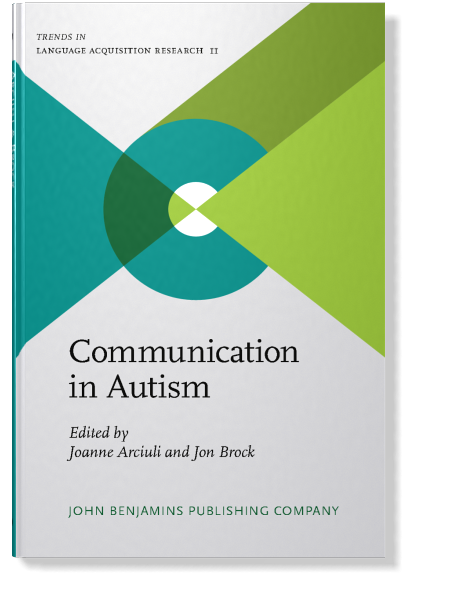
In:Communication in Autism
Edited by Joanne Arciuli and Jon Brock
[Trends in Language Acquisition Research 11] 2014
► pp. v–vi
Get fulltext
This article is available free of charge.
Published online: 30 October 2014
https://doi.org/10.1075/tilar.11.toc
https://doi.org/10.1075/tilar.11.toc
Table of contents
An introduction to communication in autism: Current findings and future directions
Section 1: Symbolic communication
Chapter 1. Prelinguistic communication
Chapter 2. Facilitating emergent verbal repertoires in individuals with autism spectrum disorders and other developmental disorders: Insights from behaviour analysis
Section 2: Oral language
Chapter 3. Echolalia and language development in children with autism
Chapter 4. Do autism spectrum disorders and specific language impairment have a shared aetiology? A review of the evidence
Chapter 5. Prosody and autism
Section 3: Literacy
Chapter 6. Reading for sound and reading for meaning in autism: Frith and Snowling (1983) revisited
Chapter 7. Language and literacy subtypes in young children with a high-functioning autism spectrum disorder
Section 4: Complex language skills
Chapter 8. The use of narrative in studying communication in Autism Spectrum Disorders: A review of methodologies and findings
Chapter 9. Using conversational structure as an interactional resource: Children with Asperger’s syndrome and their conversational partners
Section 5: Distal causes of language impairment
Chapter 10. Atypical cerebral lateralisation and language impairment in autism: Is fetal testosterone the linking mechanism?
Index
