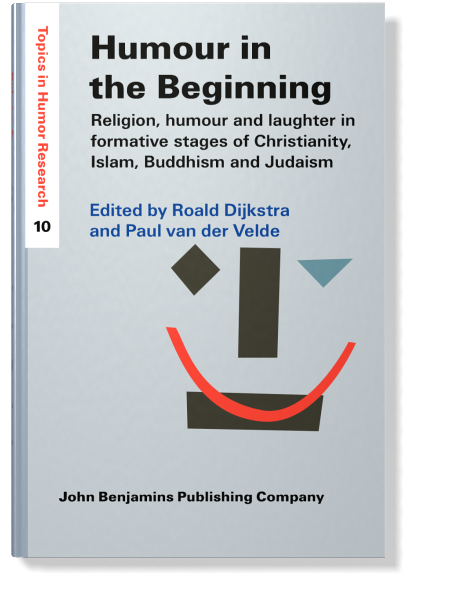
In:Humour in the Beginning: Religion, humour and laughter in formative stages of Christianity, Islam, Buddhism and Judaism
Edited by Roald Dijkstra and Paul van der Velde
[Topics in Humor Research 10] 2022
► pp. 235–252
Finicking monkeys
Sun Wukong (Monkey King) as a humorous force in the Chinese discourse on the Three Teachings
Published online: 27 October 2022
https://doi.org/10.1075/thr.10.17ste
https://doi.org/10.1075/thr.10.17ste
Abstract
This chapter discusses the Chinese trickster figure Monkey King in narrative scenes in which he
either steals or is tempted to steal food. It explores the way in which Monkey King is humorously utilised in the
discourse on which of the Three Teachings (sanjiao), Daoism, Confucianism, or Buddhism, is superior
to the others. First, this chapter discusses Monkey King’s multifarious origins. Afterwards, three texts are analysed:
The story of how the monk Tripiṭaka of the great country of Tang brought back the Sūtras;
The interpreter Pak; and The journey to the West. In all these texts, the type
of humour utilised is best described by the superiority theory.
Article outline
- 1.The beginning of the Three Teachings
- 2.Possible origins of Sun Wukong
- 2.1Namesakes
- 2.2Hanumān
- 2.3Demonic White Monkeys
- 2.5The water spirit Wizhiqi
- 2.6Summarising conclusion
- 3.The textual transformations of Sun Wukong
- 3.1The story of how the monk Tripiṭaka of the great country of Tang brought back the Sūtras (Da tang sanzang qujing shishua)
- 3.2The interpreter Pak (Pak t’ ongsa ŏnhae)
- 3.3The journey to the West (Xiyouji)
- 4.Conclusion
Bibliography

References (31)
Berger, P. (2014). Redeeming Laughter: The Comic Dimension of Human Experience (2nd Edition). Berlin: De Gruyter.
Brook, T. (2010). The Troubled Empire: China in the Yuan and Ming dynasties. Cambridge, MA: Harvard University Press.
Chang, C.-E. (1983). The monkey hero in the Hsi-yu chi cycle (Part 1). Chinese Studies, 1(1), 191–217.
Chün-Fang, Y. (1998). Ming Buddhism. In D. Twitchett & F. Mote (Eds.), The Cambridge History of China, Volume 8: The Ming Dynasty, Part 2: 1368–1644 (pp.893–952). Cambridge, MA: Cambridge University Press.
Clasquin, M. (2001). Real Buddhas Don’t Laugh: Attitudes towards Humour and Laughter in Ancient India and China. Social Identities, 7(1), 97–116.
Dardess, J. (2012). Ming China, 1368–1644: A Concise History of a Resilient Empire. Lanham: Rowman & Littlefield.
Dudbridge, G. (1970). The Hsi-yu Chi: A Study of Antecedents to the Sixteenth-Century Chinese Novel. Cambridge, MA: Cambridge University Press.
Gentz, J. (2013). Religious Diversity in Three Teachings Discourses. In P. Schmidt-Leukel & J. Gentz (Eds.), Religious Diversity in Chinese Thought (pp.123–139). New York, NY: Palgrave Macmillan.
Harvey, P. (1990). An Introduction to Buddhism: Teachings, History and Practices. Cambridge, MA: Cambridge University Press.
Heng, T. (2016). Making “Unofficial” Sacred Space: Spirit Mediums and House Temples in Singapore. Geographical Review, 106(2), 215–234.
Hsia, C.-T. (1968). The classic Chinese novel: A critical introduction. New York, NY: Columbia University Press.
Katz, P. (2009). Divine Justice: Religion and the Development of Chinese Legal Culture. New York, NY: Routledge.
Kohn, L. (2013). One Dao – Many Ways: Daoist approaches to religious diversity. In P. Schmidt-Leukel & J. Gentz (Eds.), Religious Diversity in Chinese Thought (pp.53–63). New York, NY: Palgrave Macmillan.
Lai, W. (1994). From Protean Ape to Handsome Saint: The Monkey King. Asian Folklore Studies, 53(1), 29–65.
Lutgendorf, Philip (2007). Hanuman’s Tale: The Messages of a Divine Monkey. Oxford, MS: Oxford University Press.
Moore, O. (2004). Rituals Of Recruitment in Tang China: Reading an Annual Programme in The Collected Statements by Wang Dingbao (870–940). Leiden: Brill.
Mulder, M., & Nijholt, A. (2002). Humour Research: State of the Art. Enschede: Centre for Telematrics and Information Technology.
Plaks, A. (1987). The four masterworks of the Ming novel: Ssu ta ch’i-shu. Princeton, NJ: Princeton University Press.
Robinet, I. (1997). Taoism: Growth of a Religion. Translated by Phyllis Brooks. Stanford, CA: Stanford University Press.
Subharaman, R. (2002). Beyond the Question of the Monkey Imposter: Indian Influence on the Chinese Novel The Journey to the West. Sino-Platonic Paper, 114, 1–35.
Taylor, R. (1998). Official religion in the Ming. In D. Twitchett & F. Mote (Eds.), The Cambridge History of China, Volume 8: The Ming Dynasty, Part 2: 1368–1644 (pp.840–892). Cambridge, MA: Cambridge University Press.
Walker, H. (1998). Indigenous or Foreign? A Look at the Origins of the Monkey Hero Sun Wukong. Sino-Platonic Paper, 82, 1–110.
Wei, C. (2015). Daoism in China. In M. Deeg & B. Scheid (Eds.), Religion in China: Major Concepts and Minority Positions (pp.13–28). Vienna: Austrian Academy of Sciences Press.
Wivell, C. (1994). The story of how the monk Tripiṭaka of the great country of Tang brought back the sūtras. In V. Mair (Ed.), & C. Wivell (Trans.), The Columbia anthology of traditional Chinese literature (pp.1181–1207). New York, NY: Columbia University Press.
Xinzhong, Y. (2013). Confucian approaches to religious diversity. In P. Schmidt-Leukel & J. Gentz (Eds.), Religious Diversity in Chinese Thought (pp.65–79). New York, NY: Palgrave Macmillan.