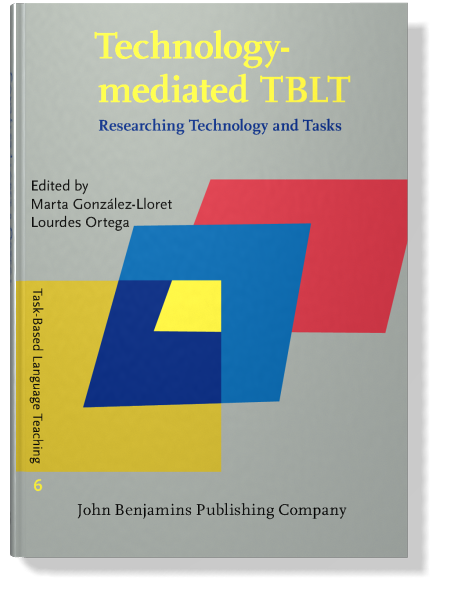
In:Technology-mediated TBLT: Researching Technology and Tasks
Edited by Marta González-Lloret and Lourdes Ortega
[Task-Based Language Teaching 6] 2014
► pp. 323–334
Chapter 12. Afterword
Technology-mediated TBLT and the evolving role of the innovator
Published online: 24 July 2014
https://doi.org/10.1075/tblt.6.12cha
https://doi.org/10.1075/tblt.6.12cha

References (29)
Adams, R., & Nik, A.M. N. (this volume). Prior knowledge and second language task production in text chat. (pp. 327).
Auerbach, E. R., & Burgess, D. (1985). The hidden curriculum of survival ESL.
TESOL Quarterly
, 19, 475–495.
Bachman, L. F., & Palmer, A. S. (1996).
Language testing in practice
. Oxford, UK: Oxford University Press.
Bowers, C. A. (2000).
Let them eat data: How computers affect education, cultural diversity, and prospects of ecological sustainability
. Athens, GA: The University of Georgia Press.
Canto, S., de Graaff, R., & Jauregi, K. (this volume). Collaborative tasks for negotiation of intercultural meaning in virtual worlds and video-web communication. (pp. 328).
Carless, D. (2013). Innovation in language learning and teaching. In C. Chapelle (Ed.),
Encyclopedia of applied linguistics
(pp. 2689–2692). Malden, MA: Blackwell.
Chapelle, C. A. (2001).
Computer applications in second language acquisition: Foundations for teaching, testing, and research
. Cambridge, UK: Cambridge University Press.
2003).
English language learning and technology: Lectures on applied linguistics in the age of information and communication technology
. Amsterdam: John Benjamins.
Chapelle, C. A. (2009). The relationship between SLA theory and CALL.
Modern Language Journal
, 93(4), 742–754.
Cotos, E. (2010).
Automated writing evaluation for non-native speaker English academic writing: The case of IADE and its formative feedback
. Unpublished doctoral dissertation. Ames, IA: Iowa State University.
Gánem-Gutiérrez, G. A. (this volume). The third dimension: A sociocultural theory approach to the design and evaluation of 3D virtual worlds tasks. (pp. 329).
González-Lloret, M. (this volume). The need for needs analysis in technology-mediated TBLT. (pp. 326).
González-Lloret, M. & Ortega, L. (this volume). Towards technology-mediated TBLT: An introduction. (pp. 323–332).
Grgurović, M., Chapelle, C. A., & Shelley, M. C. (2013). A meta-analysis of effectiveness studies on computer technology-supported language learning.
ReCALL
, 25, 165–198.
Jamiesion, J., & Chapelle, C. A. (2010). Evaluating CALL use across multiple contexts.
System
, 38, 357–369.
Long, M. H. (2005). Methodological issues in learner needs analysis. In M. H. Long (Ed.),
Second language needs analysis
(pp. 19–76). Cambridge, UK: CUP.
Nielson, K. B. (this volume) Assessments in an online, task-based Chinese course.
2009). Task-based teaching and testing. In M. H. Long & C. J. Doughty (Eds.),
Handbook of language teaching
(pp. 578–594). Malden, MA: Wiley/Blackwell.
Oskoz A. & Elola, I. (this volume). Promoting foreign language collaborative writing through the use of Web 2.0 tools and tasks. (pp. 328–329).
Sauro, S. (this volume). Lessons from the fandom: Technology-mediated tasks for language learning.
Solares, M. E. (this volume). Textbooks, tasks, and technology: An action research study in a textbook-bound EFL context.. (pp. 327).
Sykes, J. M. (this volume). TBLT and synthetic immersive environments: What can in-game task restarts tell us about design and implementation?. (pp. 331).
Van den Branden, K. (Ed.). (2006).
Task-based language education: From theory to practice
. Cambridge, UK: CUP.
Wall, D. (2013). Washback in language assessment. In C. Chapelle (Ed.),
Encyclopedia of applied linguistics
(pp. 6161–6166). Malden, MA: Blackwell.
Winke, P. M. (this volume). Formative, task-based oral assessments in an advanced Chinese-language class.. (pp. 327–330).
Cited by (12)
Cited by 12 other publications
Aljohani, Nouf J.
Morgana, Valentina
Canals, Laia & Yishay Mor
Young, Anthony & Jeong-Bae Son
Tong, Peiru, Irene Shidong An & Yijun Zhou
Tavakoli, Hossein, Ahmad Reza Lotfi, Reza Biria & Shuyan Wang
González-Lloret, Marta & Lourdes Ortega
2018. Pragmatics, tasks, and technology. In Task-based approaches to teaching and assessing pragmatics [Task-Based Language Teaching, 10], ► pp. 191 ff.
Chapelle, Carol A.
2016. My Two Problems in Applied Linguistics. In Becoming and Being an Applied Linguist, ► pp. 275 ff.
González-Lloret, Marta
González-Lloret, Marta
González‐Lloret, Marta
Ortega, Lourdes & Marta González-Lloret
2015. Staking out the territory of technology-mediated TBLT. In Domains and Directions in the Development of TBLT [Task-Based Language Teaching, 8], ► pp. 59 ff.
This list is based on CrossRef data as of 5 december 2025. Please note that it may not be complete. Sources presented here have been supplied by the respective publishers. Any errors therein should be reported to them.