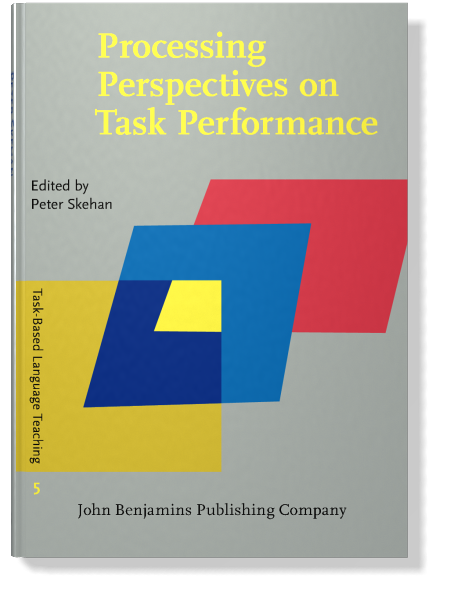
In:Processing Perspectives on Task Performance
Edited by Peter Skehan
[Task-Based Language Teaching 5] 2014
► pp. 211–260
Chapter 8. Limited attentional capacity, second language performance, and task-based pedagogy
Published online: 30 April 2014
https://doi.org/10.1075/tblt.5.08ske
https://doi.org/10.1075/tblt.5.08ske

References (53)
Bruton, A. (2002). From tasking purposes to purposing tasks. English Language Teaching Journal, 56, 280–288.
Bygate, M. (2001). Effects of task repetition on the structure and control of oral language. In M. Bygate, P. Skehan, & M. Swain (Eds.), Researching pedagogic tasks (pp. 23–48). London: Longman.
. (2006). Areas of research that influence L2 speaking instruction. In E. Uso-Juan & A. Martinez-Flor (Eds.), Current trends in the development and teaching of the four language skills (pp. 159–186). Berlin: Mouton de Gruyter.
Bygate M., & Samuda V. (2009). Creating pressure in task pedagogy: The joint roles of field, purpose, and engagement within the interactional approach. In A. Mackey & C. Polio (Eds.), Multiple perspectives on interaction (pp. 90–116). New York, NY: Routledge.
Crookes, G. (1989). Planning and interlanguage variation. Studies in Second Language Acquisition, 11, 367–383.
Dornyei, Z. (2005). The psychology of the language learner: Individual differences in second language acquisition. Mahwah, NJ: Lawrence Erlbaum Associates.
Ellis, R. (1987). Interlanguage variability in narrative discourse: Style shifting in the use of the past tense. Studies in Second Language Acquisition, 9, 12–20.
. (2005). Planning and task-based performance: Theory and research. In R. Ellis (Ed.), Planning and task performance in a second language (pp. 3–34). Amsterdam: John Benjamins.
. (2009). The differential effects of three types of task planning on the fluency, complexity, and accuracy in L2 oral production. Applied Linguistics, 30(4), 474–509.
Foster, P., & Skehan, P. (1996). The influence of planning on performance in task-based learning. Studies in Second Language Acquisition, 18, 299–324.
Kintsch, W. (1994). The psychology of discourse processing. In M.A. Gernsbacher (Ed.), Handbook of psycholinguistics (pp. 721–740). San Diego CA: Academic Press.
. (2006). Speech production and second language acquisition. Mahwah, NJ: Lawrence Erlbaum Associates.
. (1999). Language production: A blueprint of the speaker. In C. Brown & P. Hagoort (Eds.), Neurocognition of language (pp. 83–122). Oxford: OUP.
Li, Q. (2010). Focus on form in task based language teaching: exploring the effects of post-task activities and task practice on learners’ oral performance. Unpublished Ph.D. thesis. Chinese University of Hong Kong.
Littlewood, W. (2004). The task-based approach: Some problems and suggestions. English Language Teaching Journal, 58(4), 319–326.
Long, M.H., & Crookes, G. (1992). Three approaches to task-based syllabus design. TESOL Quarterly, 26, 27–55.
Loschky, L., & Bley-Vroman, R. (1993). Grammar and task-based methodology. In G. Crookes & S. Gass (Eds.), Tasks and language learning: Integrating theory and practice. Clevedon: Multilingual Matters.
McDonough, K., & Trofimovich, P. (2009). Using priming methods in second language research. London: Routledge.
Norris, J. (2009). Task-based teaching and testing. In M.H.Long & C.Doughty (Eds.), Handbook of language teaching (pp. 578–594). Oxford: Blackwell.
O'Malley, J.M. & Chamot, A.U. (1990). Learning strategies in second language acquisition. Cambridge: Cambridge University Press.
Ortega, L. (2005). What do learners plan? Learner-driven attention to form during pre-task planning. In R. Ellis (Ed.), Planning and task performance in a second language (pp. 77–109). Amsterdam: John Benjamins.
Pienemann, M. (2003). Language processing capacity. In C. Doughty & M.H. Long (Eds.), The handbook of second language acquisition (pp. 679–714). Oxford: Blackwell.
Pinter, A. (2005). Task repetition with a 10-year-old. In C. Edwards & J. Willis (Eds.), Teachers exploring tasks in English language teaching (pp. 113–126). Basingstoke: Palgrave Macmillan.
Robinson, P. (2001). Task complexity, cognitive resources, and syllabus design: A triadic framework for examining task influences on SLA. In P. Robinson (Ed.), Cognition and second language instruction (pp. 287–318). Cambridge: CUP.
. (2011). Second language task complexity, the Cognition Hypothesis, language learning, and performance. In P. Robinson (Ed.), Second language task complexity: Researching the Cognition Hypothesis of language learning and performance (pp. 3–38). Amsterdam: John Benjamins.
Robinson, P., & Gilabert, R. (2007). Task complexity, the Cognition Hypothesis, and second language learning and performance. International Review of Applied Linguistics, 45, 161–176.
Schmidt, R. (1990). The role of consciousness in second language learning. Applied Linguistics, 11, 17–46.
Skehan, P. (1986). Cluster analysis and the identification of learner types. In V. Cook (Ed.), Experimental approaches to second language acquisition (pp. 81–94). Oxford: Pergamon.
. (2001). Tasks and language performance. In M. Bygate, P. Skehan, & Swain M. (Eds.), Researching pedagogic tasks: Second language learning, teaching, and testing (pp. 167–185). London: Longman.
. (2007). Task research and language teaching: Reciprocal relationships. In S. Fotos & H. Nassaji (Eds.), Form-focused instruction and teacher education: Studies in honour of Rod Ellis (pp. 55–69). Oxford: OUP.
. (2009a). Modelling second language performance: Integrating complexity, accuracy, fluency and lexis. Applied Linguistics, 30(4), 510–532.
. (2009b). Models of speaking and the assessment of second language proficiency. In A. Benati (Ed.), Issues in second language proficiency (pp. 202–215). London: Continuum.
. (2013). Nurturing noticing. In J. Bergleitner & S. Fotos (Eds.), Festschrift in honour of Richard Schmidt. Honolulu, HI: National Foreign Language Resource Center.
Skehan, P., Bei, X., Li, Q., & Wang Z. (2012). The task is not enough: Processing approaches to task-based performance. Language Teaching Research, 16(2), 170–187.
Skehan, P., & Foster, P. (1997). Task type and task processing conditions as influences on foreign language performance. Language Teaching Research, 1(3), 185–211.
. (1999). The influence of task structure and processing conditions on narrative retellings. Language Learning, 49(1), 93–120.
Swain, M. (1985). Communicative competence: Some roles of comprehensible input and comprehensible output in its development. In S. Gass & C. Madden (Eds.), Input in second language acquisition. Rowley, MA: Newbury House.
. (1995). Three functions of output in second language learning. In G. Cook & B. Seidlhofer (Eds.), Principle and practice in applied linguistics (pp. 245–256). Oxford: OUP.
Swan, M. (2005). Legislating by hypothesis: The case of task-based instruction. Applied Linguistics, 26, 376–401.
Tannen, D. (1989). Talking voices: Repetition, dialogue, and imagery in conversational discourse. Cambridge: CUP.
Tavakoli, P., & Skehan, P. (2005). Strategic planning, task structure, and performance testing. In R. Ellis (Ed.), Planning and task performance in a second language (pp. 239–276). Amsterdam: John Benjamins.
Cited by (62)
Cited by 62 other publications
Abdi Tabari, Mahmoud, Ali Kushki & Yizhou Wang
Abdi Tabari, Mahmoud, Xiaofei Lu & Renfen Hu
Jiang, Rong, Zhe Xiao, Yihan Jiang & Xueqing Jiang
Li, Cha & Mingcai Sui
Liu, Chunyan, Yan He & Chuan Liu
Mostafaei Alaei, Mahnaz & Abbas Mansouri
Simard, Daphnée, Michael Zuniga & Florian Hameau
Suzuki, Shungo & Judit Kormos
Tao, Na & Ying Wang
Wu, Yiman
Yang, Yingli, Wanyue Peng & Gong Chen
Yenkimaleki, Mahmood & Vincent J. van Heuven
2025. The effect of fluency training on interpreter trainees’ speech fluency, comprehensibility, and
accentedness. Revista Española de Lingüística Aplicada/Spanish Journal of Applied Linguistics 38:1 ► pp. 107 ff.
Zhang, Ying
Abdi Tabari, Mahmoud
Abdi Tabari, Mahmoud, Gavin Bui & Yizhou Wang
Albarqi, Ghadah
Alzoubi, Osama
Kourtali, Nektaria-Efstathia & Lais Borges
Ryan, Jonathon, Pauline Foster, Yi Wang, Anthea Fester & Jia Rong Yap
Silva, Breno B., Katarzyna Kutyłowska & Agnieszka Otwinowska
Tran, Mai Ngoc & Kazuya Saito
Jiang, Michael Yi‐Chao, Morris Siu‐Yung Jong, Wilfred Wing‐Fat Lau, Ching‐Sing Chai & Na Wu
Rezaei, Amir & Antonella Valeo
Ryan, Jonathon, Pauline Foster, Anthea Fester, Yi Wang, Jenny Field, Celine Kearney & Jia Rong Yap
Vandeweerd, Nathan, Alex Housen & Magali Paquot
Xing, Jiaxin
Abdi Tabari, Mahmoud & Yizhou Wang
2022. The effects of prompt types on L2 learners’ textual emotionality and lexical complexity. Journal of Second Language Studies 5:1 ► pp. 34 ff.
Albert, Ágnes
B. Silva, Breno
B. Silva, Breno
B. Silva, Breno
Kobayashi, Manami
Yenkimaleki, Mahmood, Vincent Van Heuven & Mostafa Hosseini
Terres, Mariana Lima, Marilia Camponogara Torres & Ana Flávia Boeing Marcelino
Brown, Alan V., Gregory L. Thompson & Troy Cox
2021. ACTFL OPIc question prompt and advanced Spanish fluency. In Advancedness in Second Language Spanish [Issues in Hispanic and Lusophone Linguistics, 31], ► pp. 41 ff.
PANG, FRANCINE & PETER SKEHAN
Van den Branden, Kris & Koen Van Gorp
2021. Implementing task-based language education in primary education. Language Teaching for Young Learners 3:1 ► pp. 3 ff.
YILDIZ, Mine & Savaş YEŞİLYURT
Duran-Karaoz, Zeynep & Parvaneh Tavakoli
Khezrlou, Sima
Khezrlou, Sima
Kourtali, Nektaria‐Efstathia & Andrea Révész
Matsumoto, Kazumi, Maki Hirotani & Atsushi Fukada
Mohammadzadeh, Aysheh, Touran Ahour, Mahnaz Saeidi & María Consuelo Sáiz Manzanares
TAVAKOLI, PARVANEH, FUMIYO NAKATSUHARA & ANN–MARIE HUNTER
D’Ely, Raquel, Mailce Borges Mota & Martin Bygate
2019. Strategic planning and repetition as metacognitive processes in task performance. In Researching L2 Task Performance and Pedagogy [Task-Based Language Teaching, 13], ► pp. 199 ff.
Ellis, Rod
2019. Task preparedness. In Researching L2 Task Performance and Pedagogy [Task-Based Language Teaching, 13], ► pp. 15 ff.
Ellis, Rod
2024. Conclusion. In Individual Differences and Task-Based Language Teaching [Task-Based Language Teaching, 16], ► pp. 346 ff.
Rahimi, Muhammad
Rahimi, Muhammad & Lawrence Jun Zhang
Sasayama, Shoko & John Norris
2019. Unravelling cognitive task complexity. In Researching L2 Task Performance and Pedagogy [Task-Based Language Teaching, 13], ► pp. 95 ff.
Xing, Jiaxin & Shaoqian Luo
2019. The effects of reasoning demands on Chinese EFL learners’ oral performance and cognitive processes. In Researching L2 Task Performance and Pedagogy [Task-Based Language Teaching, 13], ► pp. 153 ff.
Bui, Gavin, Peter Skehan & Zhan Wang
de Jong, Nel & Philip Tillman
2018. Grammatical structures and oral fluency in immediate task repetition. In Learning Language through Task Repetition [Task-Based Language Teaching, 11], ► pp. 43 ff.
Kim, YouJin, Scott A. Crossley, YeonJoo Jung, Kristopher Kyle & Sanghee Kang
2018. The effects of task repetition and task complexity on L2 lexicon use. In Learning Language through Task Repetition [Task-Based Language Teaching, 11], ► pp. 75 ff.
Lambert, Craig, Judit Kormos & Danny Minn
Tavakoli, Parvaneh, Colin Campbell & Joan McCormack
Robinson, Peter
2015. The Cognition Hypothesis, second language task demands, and the SSARC model of pedagogic task sequencing. In Domains and Directions in the Development of TBLT [Task-Based Language Teaching, 8], ► pp. 87 ff.
Skehan, Peter
2015. Limited Attention Capacity and Cognition. In Domains and Directions in the Development of TBLT [Task-Based Language Teaching, 8], ► pp. 123 ff.
Skehan, Peter
2016. Sidesteps towards applied linguistics. In Becoming and Being an Applied Linguist, ► pp. 89 ff.
Skehan, Peter
2016. Foreign language aptitude, acquisitional sequences, and psycholinguistic processes. In Cognitive Individual Differences in Second Language Processing and Acquisition [Bilingual Processing and Acquisition, 3], ► pp. 17 ff.
This list is based on CrossRef data as of 5 december 2025. Please note that it may not be complete. Sources presented here have been supplied by the respective publishers. Any errors therein should be reported to them.