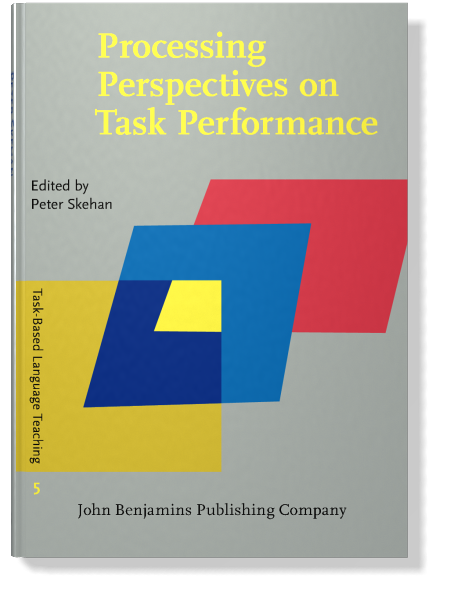
In:Processing Perspectives on Task Performance
Edited by Peter Skehan
[Task-Based Language Teaching 5] 2014
► pp. 129–154
Chapter 5. Get it right in the end
The effects of post-task transcribing on learners’ oral performance
Published online: 30 April 2014
https://doi.org/10.1075/tblt.5.05qia
https://doi.org/10.1075/tblt.5.05qia
Given the small body of existing research concerning focus on form at the post-task stage in task-based language teaching, the present study uses a post-task transcribing condition as a focus on form activity and explores the effects of transcribing under various conditions. Eighty participants, divided into four experimental groups and one control group completed four tasks with a one-week interval between each task. Different experimental groups were assigned various post-task activities respectively. No post-task activity was adopted in the control group. Task performance was measured in terms of complexity, accuracy and lexical performance. The findings are multifaceted. First of all, the adoption of post-task transcribing, in general, was found to be efficient for different formal aspects of task performance. In the second place, pair-based transcribing led to more syntactically complex language, whereas the individual-based transcribing at the post-task stage led to an improvement in lexical sophistication. Thirdly, further revision after transcribing had mixed effects on accuracy and complexity. The findings are discussed in light of the concepts of noticing and attention, interaction theory and other related SLA theories. Based on the theoretical discussion, pedagogical implications are proposed.

References (64)
Bialystok, E. (1990). Communication strategies: A psychological analysis of second Language use. Oxford: Basil Blackwell.
Bygate, M. (1996). Effects of task repetition: Appraising the developing languages of learners. In J. Willis & D. Willis (Eds.), Challenge and change in language teaching (pp. 136–145). Oxford: Macmillan Heinemann.
. (2001). Effects of task repetition on the structure and control of oral language. In M. Bygate, P. Skehan, & M.Swain (Eds.), Researching pedagogic tasks: Second language learning, teaching and testing (pp. 23–48). Harlow: Longman.
Clennell, C. (1999). Promoting pragmatic awareness and spoken discourse skills with EAP classes. ELT Journal, 53, 83–91.
Cohen, J. (1988). Statistical power analysis for the behavioral sciences (2nd ed.).Hillsdale, NJ: Lawrence Erlbaum Associates.
Doughty, C. (2001). Cognitive underpinnings of focus on form. In P. Robinson (Ed.), Cognition and second language instruction (pp. 206–257). Cambridge: CUP.
. (2003). Instructed SLA: Constraints, compensation, and enhancement. In C. Doughty & M. Long (Eds.), Handbook of second language acquisition (pp. 256–310). New York, NY: Blackwell.
Doughty, C., & Williams, J. (1998a). Issues and terminology. In C. Doughty & J. Williams (Eds.), Focus on form in classroom language acquisition (pp.1–11). Cambridge: CUP.
. (1998b). Pedagogical choices in focus on form. In C. Doughty & J. Williams (Eds.), Focus on form in classroom language acquisition (pp.197–261). Cambridge: CUP.
Ellis, R. (2001). Introduction: Investigating form-focused instruction. Language Learning, 51, 1–46.
Ferris, D.R. (2003). Response to student writing: Implications for second language students. Mahwah, NJ: Lawrence Erlbaum Associates.
Foster P., & Skehan P. (2013), Anticipating a post-task activity: The effects on accuracy, complexity and fluency of L2 language performance. Canadian Modern Language Journal 69, 3, 249–273.
Foster, P., Tonkyn, A., & Wigglesworth, G. (2000). Measuring spoken language: A unit for all reasons. Applied Linguistics, 21, 354–375.
Fotos, S., & Nassaji, H. (Eds.). (2007). Form-focused instruction and teacher education: Studies in honor of Rod Ellis. Oxford: OUP.
Hyland, K., & Hyland, F. (2006). Feedback in second language writing: Contexts and Issues. Cambridge: CUP.
Kepner, C.G. (1991). An experiment in the relationship of types of written feedback to the development of second-language writing skills. Modern Language Journal, 75, 305–313.
Leeman, J. (2007). Feedback in L2 learning: Responding to errors during practice. In R. Dekeyser (Ed.), Practice in a second language: Perspectives from applied linguistics and cognitive psychology (pp.111–137). Cambridge: CUP.
Leeser, M. (2004). Learner proficiency and focus on form during collaborative dialogue. Language Teaching Research, 8, 55–81.
Lightbown, P., & Spada, N. (1990). Focus-on-form and corrective feedback in communicative language teaching: effects on second language learning. Studies in Second Language Acquisition, 12, 429–448.
Loewen, S. (2005). Incidental focus on form and second language learning. Studies in Second Language Acquisition, 27, 361–386.
Long, M. (1983). Native speaker/non-native speaker conversation and the negotiation of comprehensible input. Applied Linguistics, 4, 126–141.
. (1991). Focus on form: A design feature in language teaching methodology. In K. de Bot, R. Ginsberg, & C. Kramsch (Eds.), Foreign language research in cross-cultural perspective (pp. 39–52). Amsterdam: John Benjamins.
. (1996). The role of the linguistic environment in second acquisition. In W. Ritchie & T. Bhatia (Eds.), Handbook of research on second language acquisition (pp.413–468). New York: Academic Press.
Long, M., & Robinson, P. (1998). Focus on form: Theory, research and practice. In C. Doughty & J. Williams (Eds.), Focus on form in classroom language acquisition (pp. 15–41). Cambridge: CUP.
Lynch, T. (2001). Seeing what they meant: Transcribing as a route to noticing. ELT Journal, 55, 124–132.
Lynch, T., & Maclean, J. (2001). A case of exercising: Effects of immediate task repetition on learners’ performance. In M. Bygate, P. Skehan, & M.Swain (Eds.), Researching pedagogic tasks: Second language learning, teaching and testing (pp.141–162). Harlow: Longman.
Malvern, D., & Richards, B. (2002). Investigating accommodation in language proficiency interviews using a new measure of lexical diversity. Language Testing, 19, 85–104.
Norris, J., & Ortega, L. (2000). Effectiveness of L2 instruction: A research synthesis and quantitative meta-analysis. Language Learning, 50, 417–528.
Pica, T. (2002). Subject-matter content: How does it assist the interactional and linguistic needs of classroom language learners? Modern Language Journal, 86, 1–19.
Schmidt, R. (2001). Attention. In P. Robinson (Ed.), Cognition and second language instruction (pp. 3–28). Cambridge: Cambridge University Press.
Skehan, P. (1996). A framework for the implementation of task-based instruction. Applied Linguistics, 37, 38–62.
. (2007). Task research and language teaching: Reciprocal relationships. In S. Fotos & H. Nassaji (Eds.), Form-focused instruction and teacher education: Studies in honor of Rod Ellis (pp. 55–69). Oxford: OUP.
Skehan, P., & Foster, P. (1997). Task type and task processing conditions as influences on foreign language performance. Language Teaching Research, 1, 185–211.
. (2001). Cognition and tasks. In P. Robinson (Ed.), Cognition and second language instruction (pp. 183–205). Cambridge: CUP.
Spada, N. (1997). Form-focused instruction and second language acquisition: A review of classroom and laboratory research. Language Teaching, 30, 73–87.
Stillwell, C., Curabba, B., Alexander, K., Kidd, A., Kim, E., Stone, P., & Wyle, C. (2010). Students transcribing tasks: Noticing fluency, accuracy and complexity. ELT Journal, 64, 445–455.
Storch, N. (2007). Investigating the merits of pair work on a text editing task in ELS classes. Language Teaching Research, 11, 143–159.
Swain, M. (1993). The output hypothesis: Just speaking and writing aren’t enough. The Canadian Modern Language Review, 50, 158–164.
. (1995). Three functions of output in second language learning. In G. Cook & B. Seidhofer (Eds.), Principles and practice in applied linguistics: Studies in honor of H.G. Widdowson (pp. 125–144).Oxford: OUP.
. (2005). The output hypothesis: theory and research. In E. Hinkel (Ed.), Handbook on research in second language teaching and learning (pp. 471–483).Mahwah, NJ: Lawrence Erlbaum Associates.
Swain, M., & Lapkin, S. (1995). Problems in output and the cognitive processes they generate: A step towards second language learning. Applied Linguistics, 16, 371–391.
. (1998). Interaction and second language learning: Two adolescent French immersion students working together. The Modern Language Journal, 82, 320–337.
Cited by (3)
Cited by three other publications
van de Guchte, Marrit, Martine Braaksma, Gert Rijlaarsdam & Peter Bimmel
Skehan, Peter
2015. Limited Attention Capacity and Cognition. In Domains and Directions in the Development of TBLT [Task-Based Language Teaching, 8], ► pp. 123 ff.
Skehan, Peter
2022. Performance on second language speaking tasks. In Second Language Acquisition Theory [Bilingual Processing and Acquisition, 14], ► pp. 211 ff.
This list is based on CrossRef data as of 5 december 2025. Please note that it may not be complete. Sources presented here have been supplied by the respective publishers. Any errors therein should be reported to them.