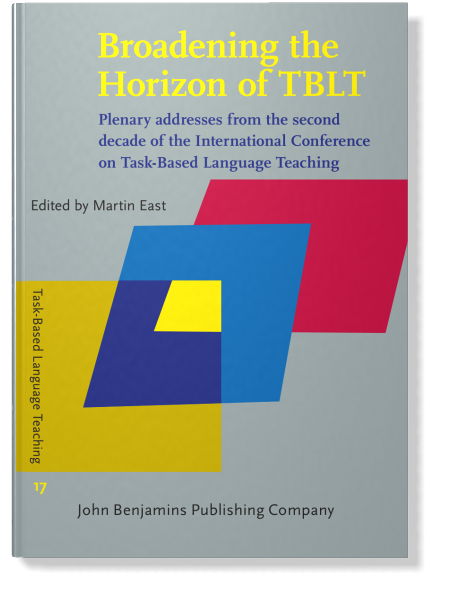
In:Broadening the Horizon of TBLT: Plenary addresses from the second decade of the International Conference on Task-Based Language Teaching
Edited by Martin East
[Task-Based Language Teaching 17] 2025
► pp. 147–161
Chapter 8From CAF to CAFFA
Measuring linguistic performance and functional adequacy in task-based language teaching
Published online: 24 April 2025
https://doi.org/10.1075/tblt.17.08kui
https://doi.org/10.1075/tblt.17.08kui
Abstract
Linguistic performance elicited by language tasks has generally been operationalised and measured
in terms of complexity, accuracy, and fluency (CAF). We argue, however, that the assessment of second language (L2)
proficiency is impossible without considering the efficacy and appropriacy of L2 performance, so-called Functional
Adequacy (FA). From the perspective of task-based language assessment, FA is conceived of as a multi-layered,
goal-directed, task-related construct, in terms of successful task completion by the speaker/writer. In this chapter,
we discuss the rating scale for FA with regard to the assessment of oral and written performance developed by Kuiken and Vedder (2017) which was tested out for different tasks and
languages. We also indicate future directions for research on FA, particularly with respect to reliability and
validity, FA in relation to (sub)components of CAF, use of the scale in classroom practice, and assessment of
interactional tasks.
Article outline
- Introduction
- The FA rating scale
- The FA rating scale in research
- Future directions
- Reliability and validity
- FA in relation to (sub)components of CAF
- FA in classroom practice
- FA in interactional tasks
- Concluding remarks
Notes References Appendix

References (43)
Bachman, L. F. (2002). Some
reflections on task-based language performance assessment. Language
Testing, 19(4), 453–476.
Bulté, B., & Housen, A. (2012). Defining
and operationalising L2 complexity. In A. Housen, F. Kuiken, & I. Vedder (Eds.), Dimensions
of L2 performance and proficiency. Complexity, accuracy and fluency in
SLA (pp. 21–46). John Benjamins.
Council of
Europe (2001). Common European framework of reference for
languages: Learning, teaching, assessment. Cambridge University Press.
De Jong, N. H., Steinel, M. P., Florijn, A. F., Schoonen, R., & Hulstijn, J. H. (2012a). The
effect of task complexity on functional adequacy, fluency and lexical diversity in speaking performances of
native and non-native speakers. In A. Housen, F. Kuiken, & I. Vedder (Eds.), Dimensions
of L2 performance and proficiency. Complexity, accuracy and fluency in
SLA (pp. 121–142). John Benjamins.
Del Bono, F. (2019). Aspetti
pragmatici nella valutazione di testi scritti: Uno studio sull’adeguatezza funzionale in italiano
L2. In E. Nuzzo & I. Vedder (Eds.), Lingua
in contesto. La prospettiva pragmatica. Studi
AItLA 9 (pp. 231–244). Associazione Italiana di Linguistica Applicata (AitLA).
(2020). L’utilizzo
delle scale dell’adeguatezza funzionale su testi narrativi in L2: Uno studio esplorativo sugli effetti del
task design. In E. Nuzzo, E. Santoro, & I. Vedder (Eds.), Valutazione
e misurazione delle produzioni orali e scritte in italiano lingua
seconda (pp. 71–82). Franco Cesati Editore.
Ekiert, M., Révész, A., Torgersen, E., & Moss, E. (2022). The
role of pausing in L2 oral task performance: Toward a complete construct of functional
adequacy. TASK 2(1), 33–59.
González-Lloret, M. (2016). A
practical guide to integrating technology into task-based language
teaching. Georgetown University Press.
(2022). The
present and future of functional
adequacy. TASK 2(1),146–158.
Grice, H. P. (1975). Logic
and conversation. In P. Cole & J. L. Morgan (Eds.), Speech
acts (pp. 41–58). Brill.
Herraiz Martínez, A. (2018). Functional
adequacy: The influence of English-medium instruction, English proficiency, and previous language learning
experiences [Unpublished doctoral
dissertation]. Universitat Jaume I, Castellón de la Plana.
Herraiz Martínez, A., & Alcón Soler, E. (2019). Pragmatic
outcomes in the English-medium instruction context. Applied
Pragmatics, 1(1), 68–91.
Kuiken, F., & Vedder, I. (2014). Rating
written performance: What do raters do and why? Language
Testing, 31(3), 329–348.
(2017). Functional
adequacy in L2 writing. Towards a new rating scale. Language
Testing, 34(3), 321–336.
(2018). Assessing
functional adequacy of L2 performance in a task-based
approach. In N. Taguchi & Y-J. Kim (Eds.), Task-based
approaches to assessing
pragmatics (pp. 265–286). John Benjamins.
(2022). Measurement
of functional adequacy in different learning contexts: Rationale, key issues, and future
perspectives. TASK 2(1), 8–32.
Kuiken, F., Vedder, I., & Gilabert, R. (2010). Communicative
adequacy and linguistic complexity in L2
writing. In I. Bartning, M. Martin, & I. Vedder (Eds.), Communicative
proficiency and linguistic development: Intersections between SLA and language testing
research (pp. 81–100). European Second Language Association.
Loewen, S. (2022). Functional
adequacy, task-based language teaching and instructed second language acquisition: A
commentary. TASK 2(1), 137–145.
(2016). In
defense of tasks and TBLT: Nonissues and real issues. Annual Review of Applied
Linguistics, 36, 5–33.
Norris, J. M. (2016). Current
uses for task-based language assessment. Annual Review of Applied
Linguistics, 36, 23–244.
Norris, J. M., & East, M. (2022). Task-based
language assessment. In M. J. Ahmadian & M. H. Long (Eds.), The
Cambridge handbook of task-based language
teaching (pp. 507–528). Cambridge University Press.
Nuzzo, E., & Bove, G. (2020). Assessing
functional adequacy across tasks: A comparison of learners’ and speakers’ written
texts. E-JournALL, 7(2), 9–27.
(2022). Exploring
the pedagogical use of the rating scale for functional adequacy in L1 writing
instruction. TASK 2(1), 115–136.
Pallotti, G. (2009). CAF:
Defining, refining and differentiating constructs. Applied
Linguistics, 30(4), 590–601.
(2017). Applying
the interlanguage approach to language teaching. International Review of
Applied Linguistics in Language
Teaching, 55(4), 393–412.
(2022). Holistic
and analytic assessment of functional
adequacy. TASK 2(1), 85–114.
Pallotti, G., & Brezina, V. (2019). Morphological
complexity in written L2 texts. Second Language
Research, 35(1), 99–119.
Paquot, M. (2018). Phraseological
competence: A missing component in university entrance language tests? Insights from a study of EFL learners’
use of statistical collocations. Language Assessment
Quarterly, 15(1), 29–43.
(2019). The
phraseological dimension in interlanguage complexity research. Second Language
Research, 35(1), 121–145.
Pill, J., & Smart, C. (2020). Rating:
Behavior and training. In P. Winke & T. Brunfaut (Eds.), The
Routledge handbook of second language acquisition and language
testing (pp. 135–144). Routledge.
Révész, A., Ekiert, M., & Torgersen, E. (2016). The
effects of complexity, accuracy and fluency on communicative adequacy in oral task
performance. Applied
Linguistics, 37(6), 828–848.
Rezaei, A. R., & Lovorn, M. (2010). Reliability
and validity of rubrics for assessment through writing. Assessing
Writing 15, 18–39.
Shehadeh, A. (2018). Task-based
language assessment. In J. I. Liontas (Ed.), The
TESOL encyclopedia of English language
teaching (pp. 1–6). John Wiley & Sons.
Strobl, C., & Baten, K. (2022). Assessing
writing development during study abroad: The role of task and measures of linguistic and communicative
performance. TASK 2(1), 60–84.
Timpe-Laughlin, V. (2018). Pragmatics
in task-based language assessment. Opportunities and
challenges. In N. Taguchi & Y-J. Kim (Eds.), Task-based
approaches to assessing
pragmatics (pp. 288–304). John Benjamins.
Vasylets, O., Gilabert, R., & Manchón, R. M. (2019). Differential
contribution of oral and written modes to lexical, syntactic and propositional complexity in L2 performance in
instructed contexts. Instructed Second Language
Acquisition, 3(2), 206–227.
Wolfe-Quintero, K., Inagaki, S., & Kim, H.-Y. (1998). Second
language development in writing: Measures of fluency, accuracy, and
complexity. University of Hawai’i Press.
Cited by (1)
Cited by one other publication
[no author supplied]
This list is based on CrossRef data as of 5 december 2025. Please note that it may not be complete. Sources presented here have been supplied by the respective publishers. Any errors therein should be reported to them.