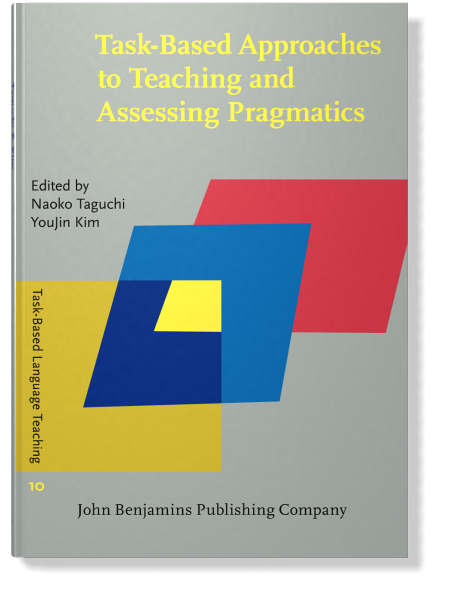
In:Task-Based Approaches to Teaching and Assessing Pragmatics
Edited by Naoko Taguchi and YouJin Kim
[Task-Based Language Teaching 10] 2018
► pp. 83–109
Chapter 4Task complexity effects on interaction during a collaborative persuasive writing task
A conversation analytic perspective
Published online: 15 August 2018
https://doi.org/10.1075/tblt.10.04gom
https://doi.org/10.1075/tblt.10.04gom
Abstract
This study examined whether task complexity (Robinson, 2011a, b), induced through reasoning demands, affects L2 learners’ interaction patterns during a collaborative writing task that involved the pragmatic act of persuasion. We analyzed interaction of two pairs of students when they co-constructed a persuasive essay in English based on a prompt. One pair completed a ‘simple’ task, which provided explicit information about the arguments, macro-structure of the essay, and linguistic devices to use in a persuasive essay, while the other pair completed a ‘complex’ task in which such information was withheld, and thus they needed to use reasoning skills to figure out the structure of the persuasive essay. Using a conversation analysis-inspired approach, we examined how students co-constructed an essay. Results revealed differences between pairs completing a complex and simple task in terms of (1) pre-writing negotiation over the essay’s structure and (2) during-writing negotiation over sources of trouble. The complex task condition prompted participants to use more reasoning processes to accomplish the task goal, as shown in more extended negotiation sequences and turn taking, frequent pauses, and hesitant ways of speaking (e.g., use of rising intonation and epistemic markers).
Article outline
- Introduction
- Background
- L2 pragmatics and genre
- The Cognition Hypothesis: Task complexity and interaction-driven learning opportunities
- Collaborative writing
- Purpose of the study
- Methods
- Participants
- Instructional targets: Rhetorical moves and linguistic forms in a persuasive essay
- Conceptualization of task in this study
- Operationalization of task complexity
- Data collection procedures
- Data analysis procedures
- Results
- Pre-writing negotiation over the essay’s outline
- During-writing negotiation over sources of trouble and actions to take
- Discussion
- Limitations and directions for future research
Note References Appendix

References (50)
Bardovi-Harlig, K., & Mahan-Taylor, R. (2003). Teaching pragmatics. Washington, DC: US Department of State, Office of English Language Programs.
Biber, D., Johansson, S., Leech, G., Conrad, S., & Finegan, E. (1999). Longman grammar of spoken and written English. Harlow: Pearson Education.
Cohen, A. & Tarone, E. (1994). The effects of training on written speech act behavior: Stating and changing an opinion. MinneTESOL Journal, 12, 39–62.
Crystal, D. (1997). The Cambridge encyclopedia of language (2nd ed.). New York, NY: Cambridge University Press.
Dippold, D. (2011). Argumentative discourse in L2 German: A sociocognitive perspective on the development of facework strategies. Modern Language Journal,
95
, 171–187.
Ede, L., & Lunsford, A. (1990). Singular texts/plural authors. Carbondale, IL: Southern Illinois University Press.
Fairclough, N. (2003). Analysing discourse: Textual analysis for social research. New York, NY: Routledge.
Gilabert, R., Barón, J., & Llanes, A. (2009). Manipulating cognitive complexity across task types and its impact on learners’ interaction during oral performance. International Review of Applied Linguistics in Language Teaching,
47
, 367–395.
Gilabert, R., & Barón, J. (2013). The impact of increasing task complexity on L2 pragmatic moves. In A. Mackey & K. McDonough (Eds.), Second language interaction in diverse educational settings (pp. 45–69). Amsterdam: John Benjamins.
Gomez-Laich, M. P. (2017). Effects of task complexity on ESL students’ academic writing. Unpublished doctoral dissertation, Carnegie Mellon University, Pittsburgh.
Graff, G., & Birkenstein, C. (2010). They say. I say. The moves that matter in academic writing. New York, NY: Norton.
Hellermann, J. (2007). The development of practices for action in classroom dyadic interaction: Focus on task openings. The Modern Language Journal,
91
, 83–96.
Huth, T. (2006). Negotiating structure and culture: L2 learners’ realization of L2 compliment-response sequences in talk-in-interaction. Journal of Pragmatics,
38
, 2025–2050.
(1998). Persuasion and context: The pragmatics of academic metadiscourse. Journal of Pragmatics,
30
, 437–455.
Johnstone, B. (1989). Linguistic strategies and cultural styles for persuasive discourse. In S. Ting-Toomey & F. Korzenny (Eds.), Language, communication, and culture: Current directions (pp. 139–156). Beverly Hills, CA: Sage.
Kasper, G., & Wagner, J. (2014). Conversation analysis in applied linguistics. Annual Review of Applied Linguistics,
34
, 1–42.
Kim, Y. (2009). The effects of task complexity on learner-learner interaction. System,
37
, 254–268.
(2012). Task complexity, learning opportunities, and Korean EFL learners’ question development. Studies in Second Language Acquisition,
34
, 627–658.
Kim, Y., & Taguchi, N. (2015). Promoting task-based pragmatics instruction in EFL classroom contexts: The role of task complexity. The Modern Language Journal,
99
, 656–677.
Linell, P. (1998) Approaching dialogue: Talk, interaction and contexts in dialogical perspectives. Amsterdam: John Benjamins.
Long, M. (2015). Second language acquisition and task-based language teaching. Oxford: Wiley-Blackwell.
Loewen, S., & Basturkmen, H. L. (2005). Interaction in group writing tasks in genre-based instruction in an EAP classroom. Journal of Asian Pacific Communication,
15
, 171–189.
Martin, J. R. (1992). English text: System and structure. Amsterdam: John Benjamins.
Miller, R., Mitchell, T., & Pessoa, S. (2014). Valued voices: Students’ use of engagement in argumentative history writing. Linguistics and Education,
28
, 107–120.
Nuevo, A., Adams, R., & Ross-Feldman, L. (2011). Task complexity, modified output, and L2 development. In P. Robinson (Ed.), Second language task complexity: Researching the cognition hypothesis of language learning and performance (pp. 175–202). Amsterdam: John Benjamins.
Révész, A. (2011). Task complexity, focus on L2 constructions, and individual differences: A classroom-based study. The Modern Language Journal, 95, 162–181.
Révész, A., Kourtali, N., & Mazgutova, D. (2016). Effects of task complexity on L2 writing behaviors and linguistic complexity. Language Learning, 67, 208–241.
Robinson, P. (2001). Task complexity, task difficulty, and task production: Exploring interactions in a componential framework. Applied Linguistics, 22, 27–57.
(2003a). Attention and memory during SLA. In C. Doughty & M. H. Long (Eds.), Handbook of second language acquisition (pp. 631–678). Oxford: Blackwell.
(2003b). The Cognition Hypothesis, task design, and adult task-based language learning. Second Language Studies, 21, 45–105.
(2007). Task complexity, theory of mind, and intentional reasoning: Effects on L2 speech production, interaction, uptake and perceptions of task difficulty. International Review of Applied Linguistics in Language Teaching, 45, 3, 193–213.
(2011b). Second language task complexity, the Cognition Hypothesis, language learning, and performance. In P. Robinson (Ed.), Second language task complexity: Researching the cognition hypothesis of language learning and performance (pp. 3–37). Amsterdam: John Benjamins.
Sacks, H., Schegloff, E., & Jefferson, G. (1974). A simplest systematics for the organization of turn-taking for conversation. Language, 50, 696–735.
Searle, J. R. (1969). Speech acts: An essay in the philosophy of language. Cambridge: Cambridge University Press.
Storch, N., & Wigglesworth, G. (2007). Writing tasks: Comparing individual and collaborative writing. In M. P. Garcia-Mayo (Ed.), Investigating tasks in formal language learning (pp. 157–177). London: Multilingual Matters.
Street, B. (2009). Hidden features of academic paper writing. Working Papers in Educational Linguistics, 24, 1–17.
Swain, M., & Lapkin, S. (1998). Interaction and second language learning: Two adolescent French immersion students working together. The Modern Language Journal, 82, 320–337.
Swales, J. M. (1990). Genre analysis: English in academic and research settings. Cambridge: Cambridge University Press.
Taguchi, N. (2015). Instructed pragmatics at a glance: Where instructional studies were, are, and should be going. Language Teaching,
48
, 1–50.
Unger, C. (2006). Genre, relevance and global coherence: The pragmatics of discourse type. New York, NY: Palgrave MacMillan.
Wingate, U. (2012). Argument! Helping students understand what essay writing is about. Journal of English for Academic Purposes,
11
, 145–154.
Zhao, H., & Kaufer, D. (2013). DocuScope: Analyzing pragmatic competence in second language writing of genres. In N. Taguchi & J. M. Sykes (Eds.), Technology in interlanguage pragmatics research and teaching (pp. 235–260). Amsterdam: John Benjamins.
Cited by (7)
Cited by seven other publications
Chen, Tzu-Hua
Róg, Tomasz
Róg, Tomasz
Gomez Laich, Maria Pia & Naoko Taguchi
Herraiz-Martinez, Ana & Eva Alcón-Soler
[no author supplied]
This list is based on CrossRef data as of 5 december 2025. Please note that it may not be complete. Sources presented here have been supplied by the respective publishers. Any errors therein should be reported to them.