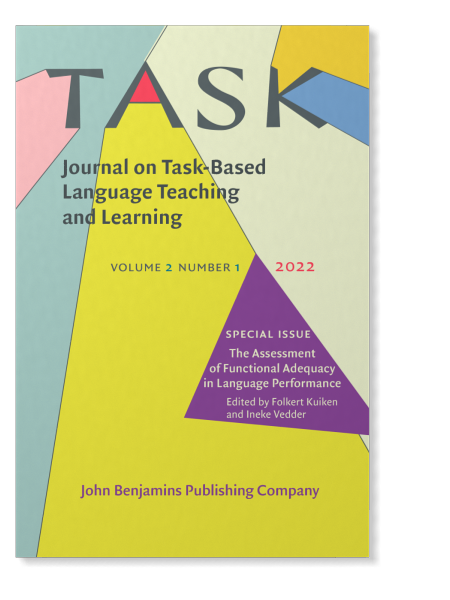
Article published In: The Assessment of Functional Adequacy in Language Performance: Special issue of the Journal on Task-Based Language Teaching and Learning 2:1 (2022)
Edited by Folkert Kuiken and Ineke Vedder
[TASK 2:1] 2022
► pp. 146–158
The present and future of functional adequacy
Published online: 20 June 2022
https://doi.org/10.1075/task.21008.gon
https://doi.org/10.1075/task.21008.gon
Abstract
The concept of Functional Adequacy (FA) proposed by Kuiken and Vedder, and the research conducted by the authors
in this special issue is pushing the field of Task- Based Language Teaching (TBLT) and Task-Based Language Assessment (TBLA)
towards a more inclusive understanding of what it means to perform a task successfully. In addition, the idea of FA is an
important contribution not just for assessment but for research on L2 pragmatic learning through tasks. As demonstrated by the
authors in this special issue, the FA rating scale is a reliable and easy-to-use tool. And as I argue, the rating scale can be
expanded to assess interactional tasks and tasks mediated by technology, and that has repercussion for practice in the language
classroom as well as for research in the fields of TBLT, TBLA, and L2 Pragmatics.
Article outline
- Introduction
- What we know about FA so far
- Relationship between CAF and FA
- The impact of FA
- Looking forward
- Interactional tasks
- Modality
- Conclusion
References

References (30)
Brown, P. (2015). Politeness
and language. In International Encyclopedia of the Social &
Behavioral Sciences (Pragmat;
pp. 326–330). Elsevier.
De Jong, N., Steinel, M. P., Florijn, A. F., Schoonen, R., & Hulstijn, J. H. (2012). The
effect of task complexity on functional adequacy, fluency and lexical diversity in speaking performances of native and
non-native speakers. In A. Housen, F. Kuiken, & I. Vedder (Eds.), Language
learning & language
teaching (Vol. 321, pp. 121–142). John Benjamins.
Ekiert, M., Lampropoulos, S., Révész, A., & Torgersen, E. (2018). The
effects of task type and proficiency on discourse appropriacy in oral task
performance. In N. Taguchi & Y. Kim (Eds.), Task-based
approaches to teaching and assessing
pragmatics (pp. 247–263). John Benjamins.
Grice, P. (1975). Language
and conversation. In P. Cole & J. L. Morgan (Eds.), Syntax
and semantics, volume 3: Speech
acts (pp. 41–58). Academic Press.
González-Lloret, M. (2019). Technology
and L2 pragmatics learning. Annual Review of Applied
Linguistics, 391, 113–127.
(2020). Pragmatic
development in L2: An overview. In K. P. Schneider & E. Infantidou (Eds.), Developmental
and clinical
pragmatics. (pp. 237–267). Mouton De Gruyter.
González-Lloret, M., & Ortega, L. (2018). Pragmatics,
tasks, and technology: A synergy. In N. Taguchi & Y. Kim (Eds.), Task-Based
approaches to teaching and assessing
pragmatics (pp. 191–214). John Benjamins.
Gumperz, J. J. (1982). Fact
and inference in courtroom testimony. In J. J. Gumperz (Ed.), Language
and social
identity (pp. 163–195). Cambridge University Press.
Housen, A., Kuiken, F., & Vedder, I. (2012). Complexity,
accuracy and fluency: Definitions, measurement and research. In A. Housen, F. Kuiken, & I. Vedder (Eds.), Dimensions
of L2 performance and proficiency: Complexity, accuracy and fluency in
SLA (pp. 1–20). John Benjamins.
Ishihara, N. (2019). Identity
and agency in L2 pragmatics. In N. Taguchi (Ed.), The
Routledge handbook of second language acquisition and
pragmatics (pp. 161–175). Routledge.
Ishihara, N., & Tarone, E. (2009). Subjectivity
and pragmatic choice in L2 Japanese: Emulating and resisting pragmatic
norms. In N. Taguchi (Ed.), Pragmatic
competence (pp. 101–128). Mouton de Gruyter.
Kim, H. Y. (2014). Learner
investment, identity, and resistance to second language pragmatic
norms. System, 451, 92–102.
Kramsch, C. J. (Ed.). (1995). Introduction:
Making the invisible visible. In Redefining the boundaries of
language
study (pp. ix–xxxiii). Heinle & Heinle.
Kuiken, F., & Vedder, I. (2017). Functional
adequacy in L2 writing. Towards a new rating scale. Language
Testing, 34(3), 321–336.
(2018). Assessing
functional adequacy of L2 performance in a task-based
approach. In N. Taguchi & Y. Kim (Eds.), Task-Based
approaches to teaching and assessing
pragmatics (pp. 266–285). John Benjamins.
Kuiken, F., Vedder, I., & Gilabert, R. (2010). Communicative
adequacy and linguistic complexity in L2 writing. In I. Bartning, M. Martin, & I. Vedder (Eds.), Communicative
proficiency and linguistic development: Intersections between SLA and language testing
research (pp. 81–99). European Second Language Association.
Norris, J. M., & Ortega, L. (2009). Towards
an organic approach to investigating CAF in instructed SLA: The case of complexity. Applied
Linguistics, 30(4), 555–578.
Pallotti, G. (2009). CAF:
Defining, refining and differentiating constructs. Applied
Linguistics, 30(4), 590–601.
Révész, A., Ekiert, M., & Torgersen, E. N. (2016). The
effects of complexity, accuracy, and fluency on communicative adequacy in oral task
performance. Applied
Linguistics, 37(6), 828–848.
Robinson, P. (2011). Second
language task complexity, the Cognition Hypothesis, language learning, and
performance. In P. Robinson (Ed.), Researching
task complexity: Task demands, task-based language learning and
performance (pp. 3–38). John Benjamins.
(2015). The
Cognition Hypothesis, second language task demands, and the SSARC model of pedagogic task
sequencing. In M. Bygate (Ed.), Domains
and directions in the development of TBLT: A decade of plenaries from the international
conference (Vol. 81, pp. 87–121). John Benjamins Publishing Company.
Schegloff, E. A. (2007). Sequence
organization in interaction: A primer in conversation analysis
I (Vol. 11). Cambridge University Press.
Skehan, P. (2015). Limited
attention capacity and cognition: Two hypotheses regarding second language performance on
tasks. In M. Bygate (Ed.), Domains
and directions in the development of TBLT: A decade of plenaries from the international
conference (Vol. 81, pp. 123–155). John Benjamins.
Timpe-Laughlin, V. (2018). Pragmatics
in task-based language assessment: Opportunities and
challenges. In N. Taguchi & Y. Kim (Eds.), Task-Based
approaches to teaching and assessing
pragmatics (pp. 288–304). John Benjamins.
Van Compernolle, R. A. (2014). Sociocultural
theory and L2 instructional pragmatics. Multilingual Matters.
Youn, S. J. (2015). Validity
argument for assessing L2 pragmatics in interaction using mixed methods. Language
Testing, 32(2), 199–225.
(2018). Task
design and validity evidence for assessment of L2 pragmatics in
interaction. In N. Taguchi & Y. Kim (Eds.), Task-Based
approaches to teaching and assessing
pragmatics (pp. 218–246). John Benjamins.
Cited by (4)
Cited by four other publications
Cornillie, Frederik, Julie Gijpen, Sameh Said-Metwaly, Steffen Luypaert & Wim Van Den Noortgate
Gonzalez‐Lloret, Marta
Kuiken, Folkert & Ineke Vedder
2022. Speaking. In Research methods in instructed second language acquisition [Research Methods in Applied Linguistics, 3], ► pp. 329 ff.
Kuiken, Folkert & Ineke Vedder
2025. From CAF to CAFFA. In Broadening the Horizon of TBLT [Task-Based Language Teaching, 17], ► pp. 147 ff.
This list is based on CrossRef data as of 5 december 2025. Please note that it may not be complete. Sources presented here have been supplied by the respective publishers. Any errors therein should be reported to them.