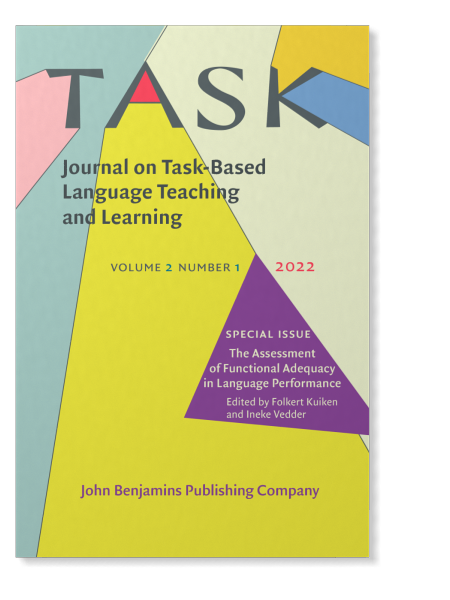
Article published In: The Assessment of Functional Adequacy in Language Performance: Special issue of the Journal on Task-Based Language Teaching and Learning 2:1 (2022)
Edited by Folkert Kuiken and Ineke Vedder
[TASK 2:1] 2022
► pp. 137–145
Functional adequacy, task-based language teaching and instructed second language acquisition
A commentary
Published online: 20 June 2022
https://doi.org/10.1075/task.21007.loe
https://doi.org/10.1075/task.21007.loe
Abstract
This commentary synthesizes the five articles in Kuiken and Vedder’s special issue on functional adequacy in
linguistic performance. The commentary considers the different scales that were used to measure functional adequacy, as well as
the relationship between functional adequacy and other measures of linguistic performance such as complexity, accuracy, and
fluency. The commentary also considers how functional adequacy might be usefully incorporated more frequently into studies from a
task-based language teaching or instructed second language acquisition perspective, both as pedagogical instruction and as a means
of measuring linguistic development.

References (10)
Council of Europe. (2001). Commonm European Framework of Reference for Languages: Learning, teaching, assessment. Council of Europe.
Kuiken, F., & Vedder, I. (2017). Functional
adequacy in L2 writing. Towards a new rating scale. Language
Testing, 34(3), 321–336.
(2018). Assessing
functional adequacy of L2 performance in a task-based
approach. In N. Taguchi & Y-J. Kim (Eds.), Task-based
approaches to assessing
pragmatics (pp. 265–286). John Benjamins.
Kuiken, F., Vedder, I., & Gilabert, R. (2010). Communicative
adequacy and linguistic complexity in L2 writing. In I. Bartning, M. Martin & I. Vedder (Eds.) Communicative
proficiency and linguistic development: Intersections between SLA and language testing
research (pp. 81–100). Eurosla
Monographs Series
1. Roma: Eurosla.
Loewen, S. & Sato, M. (2021). Exploring
the relationship between TBLT and ISLA. TASK: Journal on Task-based Language Learning and
Teaching. Early View.
Loewen, S., & Wolff, D. (2016). Peer
interaction in F2F and CMC contexts. In M. Sato & S. Ballinger (Eds.), Peer
interaction and second language learning: Pedagogical potential and research
agenda (pp. 163–184). John Benjamins.
Marsden, E., Morgan-Short, K., Thompson, S., & Abugaber, D. (2018). Replication
in second language research: Narrative and systematic reviews and recommendations for the field: replication in second
language research. Language
Learning, 68(2), 321–391.
Cited by (3)
Cited by three other publications
Wei, Ran & Xiaoyan Zhao
Kuiken, Folkert & Ineke Vedder
2022. Speaking. In Research methods in instructed second language acquisition [Research Methods in Applied Linguistics, 3], ► pp. 329 ff.
Kuiken, Folkert & Ineke Vedder
2025. From CAF to CAFFA. In Broadening the Horizon of TBLT [Task-Based Language Teaching, 17], ► pp. 147 ff.
This list is based on CrossRef data as of 5 december 2025. Please note that it may not be complete. Sources presented here have been supplied by the respective publishers. Any errors therein should be reported to them.