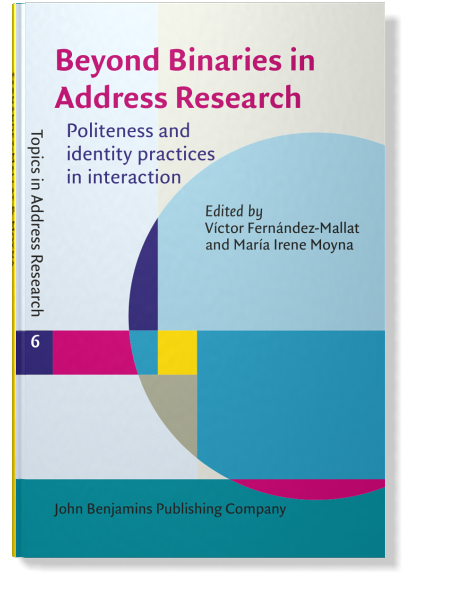
In:Beyond Binaries in Address Research: Politeness and identity practices in interaction
Edited by Víctor Fernández-Mallat and María Irene Moyna
[Topics in Address Research 6] 2025
► pp. 146–170
Chapter 7Complex address practices in Finland-Swedish
Actual and reported use of address in service encounters
Published online: 17 July 2025
https://doi.org/10.1075/tar.6.07wid
https://doi.org/10.1075/tar.6.07wid
Abstract
This chapter compares actual address in service situations with reported use and perceptions of address. We focus on
Finland-Swedish and compare it with Sweden-Swedish to highlight typical features of Finland-Swedish address practices. Our
data come from two sources: observations of address practices in service encounters and responses to a questionnaire
administered to Finland-Swedish speakers, which explored address use in service situations. Findings show that Finland-Swedish
address practices go beyond a conventional T/V dichotomy. T address dominates, but V address still occurs to some extent in
service contexts. Nevertheless, some speakers find V address highly inappropriate. Furthermore, plural V and absence of direct
address are common in service contexts. Our results confirm the non-binary character of the Finland-Swedish address
system.
Keywords: Swedish, Finland-Swedish, service encounters, address practices, variation
Article outline
- 1.Introduction
- 2.Background
- 2.1The address system in Swedish
- 2.2Variation in address practice in Sweden-Swedish and Finland-Swedish
- 3.Data and methods
- 3.1Service encounters
- 3.2Qualitative questionnaire data
- 3.3Methods
- 4.Results of the study of address in authentic service encounters
- 4.1Quantitative comparison of service interactions in Finland and Sweden
- 4.2Qualitative analysis of service encounter interactions from Finland
- 5.Results of the survey study on reported use and perceptions of address
- 5.1Perceptions of T and V address in service encounters
- 6.Discussion
Transcription symbols Notes References

References (34)
Ahlgren, Perry. 1978. Tilltalsordet
ni: Dess semantik och användning i historiskt perspektiv [The address word
ni. Its semantics and use in a historical
perspective]. Uppsala: Almqvist & Wiksell.
Brown, Roger & Albert Gilman. 1960. The
pronouns of power and solidarity. In Thomas A. Sebeok (ed.), Style
in language, 253–276. Cambridge, MA: MIT Press.
Clyne, Michael, Catrin Norrby & Jane Warren. 2009. Language
and human relations: Styles of address in contemporary
language. Cambridge: Cambridge University Press.
Fernández-Mallat, Víctor. 2020. Forms
of address in interaction: Evidence from Chilean Spanish. Journal of
Pragmatics 161. 95–106.
Fremer, Maria. 1996. Personlig
referens i servicesituationer. Svenska och finska samtal från Helsingfors, Stockholm och Uppsala i en jämförande
analys [Personal reference in service situations. Conversations in Swedish and Finnish from
Helsinki, Stockholm, and Uppsala]. Master’s
thesis. Helsinki, Finland: University of
Helsinki.
. 2019. Finlandssvenskt
tilltal [Finland-Swedish address]. In Marika Tandefelt (ed.), Finländsk
svenska från 1860 till
nutid, 415–429. Helsinki: The Society of Swedish Literature in Finland.
Gumperz, John J. 2015. Interactional
sociolinguistics: A personal perspective. In Deborah Tannen, Heidi E. Hamilton & Deborah Schiffrin (eds.), The
handbook of discourse analysis (2nd
edn.), 309–323. Malden, MA: Wiley Blackwell.
Hagström, Charlotte & Carina Sjöholm. 2017. Nya
frågor till gamla svar. Frågelistor som historisk källa [New questions to old answers. List of questions as a
historical resource]. In Lars-Eric Jönsson & Fredrik Nilsson (eds.), Kulturhistoria:
En etnologisk metodbok (Lund Studies in Arts and Cultural
Sciences 13), 137–160. Lund: Lund University, Department of Arts and Cultural Sciences, Ethnology.
Lappalainen, Hanna. 2015. Sinä
vai te vai sekä että? Puhuttelukäytännöt suomen kielessä [Yout or
youv or both? Forms of address in
Finnish]. In Johanna Isosävi & Hanna Lappalainen (eds.), Saako
sinutella vai täytyykö teititellä? Tutkimuksia eurooppalaisten kielten
puhuttelukäytännöistä, 72–104. Helsinki: Finnish Literature Society.
Lassus, Jannika. 2010. Betydelser
i barnfamiljsbroschyrer. Systemisk-funktionell analys av den tänkta läsaren och
institutionen [Meanings in brochures to families with children. A systemic-functional
analysis of the reader and the institution]. Doctoral
dissertation. Helsinki, Finland: University of
Helsinki.
Latomaa, Sirkku & Pirkko Nuolijärvi. 2005. The
language situation in Finland. In Richard B. Baldauf Jr. & Robert B. Kaplan (eds.), Language
planning and policy in Europe, Vol. 1: Hungary, Finland and
Sweden, 125–232. Clevedon: Multilingual Matters.
Mara, Johanna & Lena Huldén. 2000. “Långväga
främmande tar man i hand när man hälsar”. Hälsningsvanor, tilltal och omtal i Svenskfinland under 1900-talet [“Long
distance friends you shake hands with when greeting”. Greeting customs in Swedish-speaking Finland in the 20th
century]. Källan 2.
Norrby, Catrin, Jan Lindström, Jenny Nilsson & Camilla Wide. 2021. Interaktion
och variation i pluricentriska språk. Kommunikativa mönster i sverigesvenska och finlandssvenska. Rapport från ett
forskningsprogram [Interaction and variation in pluricentric languages. Communicative
patterns in Sweden-Swedish and
Finland-Swedish]. Stockholm: Riksbankens jubileumsfond & Santérus.
Norrby, Catrin, Camilla Wide, Jenny Nilsson & Jan Lindström. 2015. Address
and interpersonal relationships in Finland-Swedish and Sweden-Swedish service
encounters. In Catrin Norrby & Camilla Wide (eds.), Address
practice as social action: European
perspectives, 75–96. Basingstoke: Palgrave Macmillan.
. 2018. Positioning
through address practice in Finland-Swedish and Sweden-Swedish service
encounters. In Kate Beeching, Chiara Ghezzi & Piera Molinelli (eds.), Positioning
the self and others: Linguistic perspectives (Pragmatics &
Beyond 292), 19–49. Amsterdam: John Benjamins.
Nyblom, Heidi. 2006. The
use of address pronouns among Finnish and Finland-Swedish students. Australian Review
of Applied
Linguistics 29. 19.1–19.12.
Parkvall, Mikael. 2016. Sveriges
språk i siffror. Vilka språk talas och av hur många? [Sweden’s languages in numbers. Which
languages are spoken and by how
many?]. Stockholm: Morfem.
Paulston, Christina Bratt. 1976. Pronouns of address
in Swedish: Social class semantics and changing system. Language in
Society 5. 359–386.
Rampton, Ben. 2006. Language
in late modernity: Interaction in an urban
school. Cambridge: Cambridge University Press.
Raymond, Chase Wesley. 2016. Linguistic
reference in the negotiation of identity and action: Revisiting the T/V
distinction. Language 92. 636–670.
Rivano Eckerdal, Johanna & Charlotta Hagström. 2017. Qualitative
questionnaires as a method for information studies research. Information
Research 22. CoLIS paper 1639, [URL]. (23 June,
2023.)
Saari, Mirja, 1995. ”Jo,
nu kunde vi festa nog”. Synpunkter på svenskt språkbruk i Sverige och Finland [“Yes, we were good at partying”.
Comments on language use in Sweden and
Finland]. Folkmålsstudier 36. 75–108.
Södergård, Lisa, 2020. Duande
och niande — hur gör man i dag? [T address and V address — How do you do
today?]. SLS-bloggen 3.9.2020, [URL]. (8 May, 2024.)
Statistics
Finland. 2023. Helsinki: Statistics
Finland, [URL]. (23 June,
2023.)
Stenberg-Sirén, Jenny, 2021. Svenskan
stark i de ungas vardag: glädjande stor användning av svenskspråkiga medier [Swedish is strong in the everyday life of
young people: a pleasingly large use of Swedish-language
media]. In Kaisa Kepsu & Lia Markelin (eds.), Den
svenskspråkiga ungdomsbarometern 2020. Del 2: Språk, medier och
hobbyer, 11–20. Helsinki: The Think-thank Magma.
Vismans, Roel. 2018. Address
choice in Dutch 2: Pragmatic principles of address choice in Dutch. Dutch
Crossing 42. 279–302.
Wide, Camilla. 2022. Tilltal
på två språk i samma land. Svenskspråkiga finländares uppfattningar om tilltalsskicket på finska [Address in two
languages in the same country. Swedish-speaking Finns’ perceptions of address patterns in
Finnish]. In Kirsi Lepistö, Riitta Kosunen & Elisa Risto (eds.), Humanisten
med många roller. En festskrift till Paula Rossi på hennes 60-årsdag (Studia Humaniora
Ouluensia 18), 283–301. Oulu: University of Oulu.
Wide, Camilla, Hanna Lappalainen, Anu Rouhikoski, Catrin Norrby, Camilla Lindholm, Jan Lindström & Jenny Nilsson. 2019. Variation
in address practices across languages and nations: A comparative study of doctors’ use of address forms in medical
consultations in Sweden and
Finland. Pragmatics 29. 595–621.
Wide, Camilla & Catrin Norrby. 2022. Duande
eller niande? Uppfattningar om tilltal på svenska i Finland [T address or V address. Perceptions of address practices
in Swedish in Finland]. In Siv Björklund, Bodil Haagensen, Marianne Nordman & Anders Westerlund (eds.), Svenskan
i Finland 19: Föredrag vid den nittonde sammankomsten för beskrivningen av svenskan i
Finland, 361–374. Vasa: Svensk-Österbottniska Samfundet.