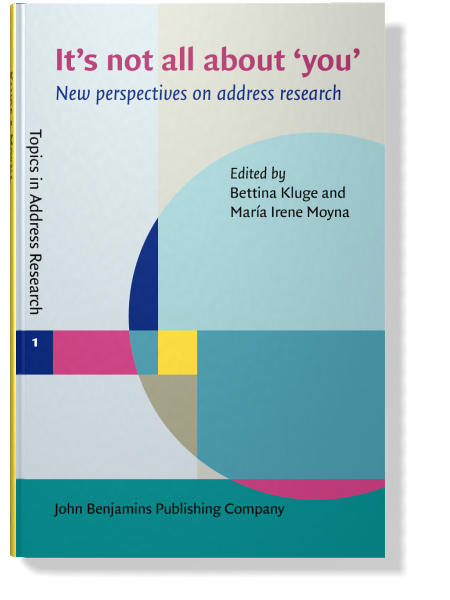
In:It’s not all about you: New perspectives on address research
Edited by Bettina Kluge and María Irene Moyna
[Topics in Address Research 1] 2019
► pp. 1–20
Address and address research
Here’s looking at you, kid
Published online: 28 November 2019
https://doi.org/10.1075/tar.1.int
https://doi.org/10.1075/tar.1.int
Article outline
- 1.Introduction
- 2.Forms of address
- 3.The distribution of address forms
- 4.The functions of address forms
- 5.The story behind this book and this book series
- 6.Book contents
Acknowledgements Notes References

References (51)
Bertolotti, Virginia. 2016. A mí de vos no me trata ni usted ni nadie: Sistemas e historia de las formas de tratamiento en la lengua española en América, Mexico City: Universidad Nacional Autónoma de México.
Braun, Friederike, Armin Kohz & Klaus Schubert. 1986. Anredeforschung: Kommentierte Bibliographie zur Soziolinguistik der Anrede. Tübingen: Gunter Narr.
Braun, Friederike. 1984. Die Leistungsfähigkeit der von Brown/Gilman und Brown/Ford eingeführten anredetheoretischen Kategorien bei der praktischen Analyse von Anredesystemen. In Werner Winter (ed.), Anredeverhalten, 41–72. Tübingen: Gunter Narr.
. 1988. Terms of address: Problems of patterns and usage in various languages and cultures. Berlin/New York/Amsterdam: De Gruyter.
Bravo, Diana. 2004. Tensión entre universalidad y relatividad entre las teorías de cortesía. In Diana Bravo & Antonio Briz (eds.), Pragmática sociocultural: estudios sobre el discurso de cortesía en español, 15–37. Barcelona: Ariel.
Brown, Penelope & Stephen C. Levinson. 1987. Politeness. Some universals in language usage (Studies in Interactional Sociolinguistics 4). Cambridge: Cambridge University Press.
Brown, Roger W. & Albert Gilman. 1960. The pronouns of power and solidarity. In Thomas A. Sebeok (ed.). Style in language, 253–276. Cambridge (Mass.): MIT Press.
Brown, Roger W. & Marguerite Ford. 1961. Address in American English. Journal of Abnormal and Social Psychology 62. 375–385.
Clyne, Michael, Catrin Norrby & Jane Warren. 2009. Language in human relations: Styles of address in contemporary language. Cambridge: Cambridge University Press.
Cooke, Joseph R. 1968. Pronominal reference in Thai, Burmese, and Vietnamese. Berkeley & Los Angeles: University of California Press.
De Jonge, Bob. 2005. El desarrollo de las variantes de ‘vuestra merced’ a ‘usted.’ In Estudios de Lingüística del Español 22. [URL]; (17 October 2018).
Díaz Collazos, Ana María. 2015. Desarrollo sociolingüístico del voseo en la región andina de Colombia (1555–1976). Berlin/Boston: De Gruyter.
Eckert, Penelope. 2018. Meaning and linguistic variation. The third wave in sociolinguistics. Cambridge: Cambridge University Press.
Eguiluz, Luisa. 1952. Fórmulas de tratamiento en el español de Chile. Boletín de Filología 14. 169–233.
Ehrismann, Gustav. 1901–1904. Duzen und Ihrzen im Mittelalter. Zeitschrift für deutsche Wortforschung 1. 117–149; 2. 118–159; 4. 210–248; 5. 127–220. [4 parts]
Ervin-Tripp, Susan. 1972. On sociolinguistic rules: Alternation and co-occurrence. In John J. Gumperz & Dell Hymes (eds.), Directions in sociolinguistics. The ethnography of communication, 213–250. New York: Holt.
Formentelli, Maicol. 2007. The vocative mate in contemporary English: A corpus based study. In Andrea Sansò (ed.), Language resources and linguistic theory, 180–199. Milan: Franco Angeli.
. 2014. Vocatives galore in audiovisual dialogue: Evidence from a corpus of American and British films. English Text Construction 7 (1). 53–83.
Hajek, John, Heinz L. Kretzenbacher & Robert Lagerberg. 2013. Towards a linguistic typology of address pronouns in Europe – past and present. In John Henderson, Marie-Eve Ritz, Celeste Rodríguez Louro (eds), Proceedings of the 2012 Conference of the Australian Linguistic Society (Perth, 5–7 December 2012), 1–15. [URL]
Hammermüller, Gunther. 2010. Evolución de las formas de tratamiento del español medieval hasta el siglo XVI. In Martin Hummel, Bettina Kluge & María Eugenia Vázquez Laslop (eds.). Formas y fórmulas de tratamiento en el mundo hispánico, 507–529. Mexico City/Graz: El Colegio de México/Karl-Franzens-Universität Graz.
Head, Brian F. 1978. Respect degrees in pronominal reference. In Joseph H. Greenberg (ed.). Universals of human language. Vol. 3, 151–211. Stanford: University Press.
Heine, Bernd & Kyung-An Song. 2011. On the grammaticalization of personal pronouns. Journal of Linguistics 47. 587–630.
Helmbrecht, Johannes. 2013. Politeness distinctions in pronouns. In Matthew S. Dryer & Martin Haspelmath (eds.). The world atlas of language structures online. Leipzig: Max Planck Institute for Evolutionary Anthropology, chapter 45. [URL] (8 January 2018).
Hickey, Raymond. 2003. Rectifying a standard deficiency: Second-person pronominal distinction in varieties of English. In Irma Taavitsainen and Andreas H. Jucker (eds.). Diachronic perspectives on address term systems, 345–374. Amsterdam/Philadephia: Benjamins (Pragmatics and Beyond New Series 107).
Hummel, Martin, Bettina Kluge & María Eugenia Vázquez Laslop (eds.). 2010. Formas y fórmulas de tratamiento en el mundo hispánico. Mexico City/Graz: El Colegio de México/Karl-Franzens-Universität Graz.
Joseph, John E. 1987. Subject relevance and deferential address in the Indo-European languages. Lingua 73. 259–277.
Kany, Charles E. 1969. Sintaxis hispanoamericana (transl. by Martín Blanco Álvarez). Madrid: Gredos.
Kiełkiewicz-Janowiak, Agnieszka. 1992. A socio-historical study in address: Polish and English. Frankfurt (Main): Lang.
Kluge, Bettina. 2016. Generic uses of the second person singular: How speakers deal with referential ambiguity and misunderstandings. Pragmatics 26 (3). 501–522.
Lipski, John. 1993. Y’all in American English: From Black to White, from phrase to pronoun. English World-Wide 14. 23–56.
Marcoccia, Michel. 2004. On-line polylogues: Conversation structure and participation framework in Internet newsgroups. Journal of Pragmatics 36 (1). 115–145.
Marcotulio, Leonardo Lennertz, Célia Regina dos Santos Lopes & Silvia Regina de Oliveira Cavalcante (eds.). 2015. LaborHistórico 1 (1). Special Issue. História dos pronomes de tratamento no português brasileiro.
Maynor, Natalie. 1996. The pronoun y’all: Questions and some tentative answers. Journal of English Linguistics 24 (4). 288–294.
Montgomery, Michael. 1992. The etymology of y’all. In Joan Houston Hall, Nick Doane & Dick Ringler (eds.), Old English and New: Studies in language and linguistics in honor of Frederic G. Cassidy, 356–369. New York/London: Garland.
Montgomery, Michael B. 2002. The structural history of y’all, you all, and you’uns. Southern Journal of Linguistics 26. 19–27.
Panagiotidis, Phoevos. 2002. Pronominal nouns. In Horst J. Simon & Heike Wiese (eds.), Pronouns – grammar and representation, 183–203. Amsterdam/Philadelphia: John Benjamins.
Raymond, Chase W. 2016. Reconceptualizing identity and context in the deployment of forms of address. In María Irene Moyna & Susana Rivera-Mills (eds.), Forms of address in the Spanish of the Americas, 267–288. Amsterdam/Philadelphia: John Benjamins.
Resnick, Melvyn C. 1975. Phonological variants and dialect identification in Latin American Spanish. The Hague: Mouton.
Richardson, Gina. 1984. Can y’all function as a singular pronoun in southern dialect? American Speech 59 (1). 51–59.
Rona, José Pedro. 1967. Geografía y morfología del voseo. Porto Alegre: Pontifícia Universidade Católica do Rio Grande do Sul.
. 1993. El problema de la división del español americano en zonas dialectales. In Francisco Moreno Fernández (ed.), La división dialectal del español de América (Vol. 15), 63–76. Alcalá de Henares: Universidad de Alcalá, Servicio de Publicaciones.
Simon, Horst J. 2010. Zur Grammatik der indirekten Anrede im Afrikaans und im älteren Deutsch. Germanistische Linguistik 206–209. 391–422.
2017. Welche menschlichen Beziehungen sind in den Sprachen strukturell relevant? In Angelika Linke & Juliane Schröter (eds.), Sprache und Beziehung, 33–48. Berlin/Boston: De Gruyter.
Trudgill, Peter & J. K. Chambers. 2017. Pronouns and pronominal systems in English dialects. In Peter Trudgill & J. K. Chambers (eds.), Dialects of English: Studies in grammatical variation (2nd ed.), 7–10. London: Routledge.
Walker, Terry. 2007. THOU and YOU in Early Modern English dialogues: trials, depositions, and drama comedy. Amsterdam/Philadelphia: John Benjamins.
Cited by (5)
Cited by five other publications
Fremer, Maria
2023. The informalisation of address practice in Swedish in a historical perspective. Journal of Historical Pragmatics 24:1 ► pp. 179 ff.
Hougaard, Tina Thode, Eva Skafte Jensen, Marianne Rathje, Jonathan White & Camilla Wide
2023. Variations in opening and closing forms in email correspondence in Danish
and Swedish. In It’s different with you [Topics in Address Research, 5], ► pp. 61 ff.
Ozyumenko, Vladimir
2023. Forms of address in courtroom discourse in Englishes of the “Inner Circle”. In It’s different with you [Topics in Address Research, 5], ► pp. 316 ff.
Chornet, Daniel
This list is based on CrossRef data as of 4 december 2025. Please note that it may not be complete. Sources presented here have been supplied by the respective publishers. Any errors therein should be reported to them.