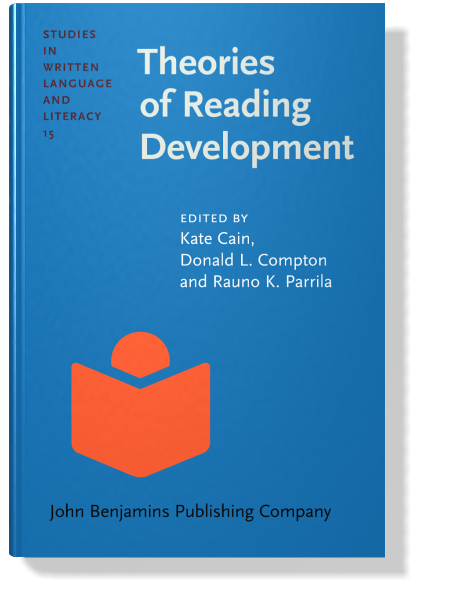
In:Theories of Reading Development
Edited by Kate Cain, Donald L. Compton and Rauno K. Parrila
[Studies in Written Language and Literacy 15] 2017
► pp. 99–122
Opening the “black box” of learning to read
Inductive learning mechanisms supporting word acquisition development with a focus on children who struggle to read
Published online: 14 August 2017
https://doi.org/10.1075/swll.15.06ste
https://doi.org/10.1075/swll.15.06ste
Article outline
- Introduction
- Statistical learning mechanisms: Structured probabilistic vs. dynamic systems
- Analogical reasoning as an inductive mechanism for transfer
- Adding inductive learning to an individual difference model of reading development
- The role of inductive learning in reading development
- Orthographic learning
- Vocabulary acquisition
- Support for the role of inductive learning supporting reading development
- Orthographic learning
- Experimental statistical learning tasks and reading outcomes
- Relationship between longterm statistical learning and reading outcomes
- Optimizing the statistical learning environment
- Analogical reasoning and basic transfer
- Vocabulary acquisition
- Orthographic learning
- Conclusion
Acknowledgements Note References

References (99)
Altmann, G. T. M. (2010). Why emergentist accounts of cognition are more theoretically constraining than structured probability accounts: Comment on Griffiths et al. and McClelland et al. Trends in Cognitive Sciences, 14, 340.
Anderson, R. C., & Freebody, P. (1981). Vocabulary knowledge. In J. T. Guthrie (Ed.), Comprehension and teaching: Research reviews (pp.77–117). Newark, DE: International Reading Association.
Anglin, J. M. (1993). Vocabulary development: A morphological analysis. Monographs of the Society for Research in Child Development, 58, v–186.
Apfelbaum, K. S., Hazeltine, E., & McMurray, B. (2013). Statistical learning in reading: Variability in irrelevant letters helps children learn phonics skills. Developmental Psychology, 49, 1348–1365.
Arciuli, J., Monaghan, P., & Seva, N. (2010). Learning to assign lexical stress during reading aloud: Corpus, behavioral, and computational investigations. Journal of Memory and Language, 63, 180–196.
Arciuli, J., & Simpson, I. C. (2012). Statistical learning is related to reading ability in children and adults. Cognitive Science, 36, 286–304.
Aslin, R. N., & Newport, E. L. (2012). Statistical learning: From acquiring specific items to forming general rules. Current Directions in Psychological Science, 21, 170–176.
Aslin, R. N., Saffran, J. R., & Newport, E. L. (1998). Computation of conditional probability statistics by 8-month-old infants. Psychological Science, 9, 321–324.
Barnes, M. A., Davis, C., Priebe, S., Arrington, N., Francis, D., & Fletcher, J. (July, 2012). Word-level, text-level and general purpose cognitive skills in struggling adolescent readers: Implications for assessment and intervention. In M. W. Lovett & D. Greenberg (Chairs), Assessment and intervention research with struggling adolescent and adult readers. Symposium conducted at the annual meeting of the Society for the Scientific Study of Reading, Montreal, Canada.
Berninger, V. W. (1994). The varieties of orthographic knowledge I: Theoretical and developmental issues. Dordrecht, The Netherlands: Kluwer Academic Press.
Berninger, V. W., & Abbott, R. D. (2002). Multiple orthographic and phonological codes in literacy acquisition: An evolving research program. In D. L. Molfese & V. J. Molfese (Eds.), Developmental variations in learning: Applications to social, executive function, language, and reading skills. (pp. 275–308). Mahwah, NJ: Erlbaum.
Biemiller, A. (2003). Vocabulary: Needed if more children are to read well. Reading Psychology, 24, 323–335.
Biemiller, A., & Slonim, N. (2001). Estimating root word vocabulary growth in normative and advantaged populations: Evidence for a common sequence of vocabulary acquisition. Journal of Educational Psychology, 93, 498–520.
Brasseur-Hock, I., Hock, M. F., Kieffer, M. J., Biancarosa, G., & Deshler, D. D. (2011). Adolescent struggling readers in urban schools: Results of a latent class analysis. Learning and Individual Differences, 21, 438–452.
Brown, A. L. (1989). Analogical reasoning and transfer: What develops? In S. Vosniadou & A. Ortony (Eds.), Similarity and analogical reasoning (pp. 369–412). Cambridge: Cambridge University Press.
(1990). Domain-specific principles affect learning and transfer in children. Cognitive Science, 14, 107–133.
Bruck, M. (1992). Persistence of dyslexics’ phonological awareness deficits. Developmental Psychology, 28, 874–886.
Cain, K., Oakhill, J., & Lemmon, K. (2004). Individual differences in the inference of word meanings from context: The influence of reading comprehension, vocabulary knowledge, and memory capacity. Journal of Educational Psychology, 96, 671–681.
Carlisle, J. F. (2007). Fostering morphological processing, vocabulary development, and reading comprehension. In R. Wagner, A. Muse, & K. Tannenbaum (Eds.), Vocabulary acquisition: Implications for reading comprehension (pp. 78–103). New York: Guilford Press.
Chen, V., & S Savage, R. (2014). Evidence for a simplicity principle: teaching common complex grapheme‐to‐phonemes improves reading and motivation in at‐risk readers. Journal of Research in Reading, 37, 196–214.
Compton, D. L., Miller, A. C., Elleman, A. M., & Steacy, L. M. (2014). Have we forsaken reading theory in the name of “quick fix” interventions for children with reading disability? Scientific Studies of Reading, 18, 55–73.
Cunningham, A. E., & Stanovich, K. E. (1997). Early reading acquisition and its relation to reading experience and ability 10 years later. Developmental Psychology, 33, 934–945.
Currie, N. K., & Cain, K. (2015). Children’s inference generation: The role of vocabulary and working memory. Journal of Experimental Child Psychology, 137, 57–75.
Deacon, S. H., Conrad, N., & Pacton, S. (2008). A statistical learning perspective on children’s learning about graphotactic and morphological regularities in spelling. Canadian Psychology/Psychologie Canadienne, 49, 118–124.
Durso, F. T., & Shore, W. J. (1991). Partial knowledge of word meanings. Journal of Experimental Psychology: General, 120, 190–202.
Ehri, L. C. (2005). Learning to read words: Theory, findings, and issues. Scientific Studies of Reading, 9, 167–188.
(2014). Orthographic mapping in the acquisition of sight word reading, spelling memory, and vocabulary learning. Scientific Studies of Reading, 18, 5–21.
Ehri, L. C., & Saltmarsh, J. (1995). Beginning readers outperform older disabled readers in learning to read words by sight. Reading and Writing, 7, 295–326.
Elleman, A. M., Lindo, E. J., Morphy, P., & Compton, D. L. (2009). The impact of vocabulary instruction on passage-level comprehension of school-age children: A meta-analysis. Journal of Research on Educational Effectiveness, 2, 1–44.
Evans, J. L., Saffran, J. R., & Robe-Torres, K. (2009). Statistical learning in children with specific language impairment. Journal of Speech, Language, and Hearing Research, 52, 321–335.
Farrington‐Flint, L., Wood, C., Canobi, K. H., & Faulkner, D. (2004). Patterns of analogical reasoning among beginning readers. Journal of Research in Reading, 27, 226–247.
Fletcher, J. M., Lyon, G. R., Fuch, L. S., & Barnes, M. A. (2006). Learning disabilities: From identification to intervention. New York: Guilford Press.
Fuchs, D., & Fuchs, L. S. (2015). Rethinking service delivery for students with significant learning problems: Developing and implementing intensive instruction. Remedial and Special Education, 36, 105–111.
Fukkink, R. G., & de Glopper, K. (1998). Effects of instruction in deriving word meaning from context: A meta-analysis. Review of Educational Research, 68, 450–469.
Goswami, U. (1986). Children’s use of analogy in learning to read: A developmental study. Journal of Experimental Child Psychology, 42, 73–83.
Gough, P. B., Juel, C., & Griffith, P. L. (1992). Reading, spelling, and the orthographic cipher. In P. B. Gough, L. C. Ehri, & R. Treiman (Eds.), Reading acquisition (pp. 35–48). Hillsdale, NJ: Erlbaum.
Griffiths, T. L., Chater, N., Kemp, C., Perfors, A., & Tenenbaum, J. B. (2010). Probabilistic models of cognition: Exploring representations and inductive biases. Trends in Cognitive Sciences, 14, 357–364.
Griffiths, T. L., Steyvers, M., & Tenenbaum, J. B. (2007). Topics in semantic representation. Psychological Review, 114, 211–244.
Harm, M. W., & Seidenberg, M. S. (1999). Phonology, reading acquisition, and dyslexia: Insights from connectionist models. Psychological Review, 106, 491–528.
Holyoak, K. J. (2012). Analogy and relational reasoning. In K. J. Holyoak & R. G. Morrison (Eds.), The Oxford handbook of thinking and reasoning (pp. 234–259). New York: Oxford University Press.
Jenkins, J. R., Stein, M. L., & Wysocki, K. (1984). Learning vocabulary through reading. American Educational Research Journal, 21, 767–787.
Kintsch W., & Rawson, K. A. (2005). Comprehension. In M. J. Snowling & C. Hulme (Eds.), The science of reading: A handbook (pp. 209–226). Oxford: Blackwell.
Landauer, T. K., & Dumais, S. T. (1997). A solution to Plato’s problem: The latent semantic analysis theory of acquisition, induction, and representation of knowledge. Psychological Review, 104, 211–240.
Landauer, T. K., Foltz, P. W., & Laham, D. (1998). An introduction to latent semantic analysis. Discourse Processes, 25, 259–284.
Lawrence, J. F., Crosson, A. C., Paré-Blagoev, E. J., & Snow, C. E. (2015). Word generation randomized trial: Discussion mediates the impact of program treatment on academic word learning. American Educational Research Journal, 52, 750–786.
Loftus, S. M., Coyne, M. D., McCoach, D. B., Zipoli, R., & Pullen, P. C. (2010). Effects of a supplemental vocabulary intervention on the word knowledge of kindergarten students at risk for language and literacy difficulties. Learning Disabilities Research & Practice, 25, 124–136.
Marcus, G. F., & Davis, E. (2013). How robust are probabilistic models of higher-level cognition? Psychological Science, 24, 2351–2360.
McClelland, J. L., Botvinick, M. M., Noelle, D. C., Plaut, D. C., Rogers, T. T., Seidenberg, M. S., & Smith, L. B. (2010). Letting structure emerge: Connectionist and dynamical systems approaches to cognition. Trends in Cognitive Sciences, 14, 348–356.
McKeown, M. G., & Beck, I. L. (2014). Effects of vocabulary instruction on measures of language processing: Comparing two approaches. Early Childhood Research Quarterly, 29, 520–530.
Movellan, J. R., & McClelland, J. L. (1993). Learning continuous probability distributions with symmetric diffusion networks. Cognitive Science, 17, 463–496.
Nagy, W., Anderson, R., & Herman, P. (1987). Learning word meanings from context during normal reading. American Educational Research Journal, 24, 237–270.
Nagy, W. E., Herman, P. A., & Anderson, R. C. (1985). Learning words from context. Reading Research Quarterly, 20, 233–253.
Nation, K., & Snowling, M. J. (1998). Semantic processing and the development of word-recognition skills: Evidence from children with reading comprehension difficulties. Journal of Memory and Language, 39, 85–101.
National Institutes of Children’s Health and Development. (2000). Report of the national reading panel: Teaching students to read: An evidenced-based assessment of the scientific research literature on reading and its implications for reading instruction: Reports of the subgroups. Bethesda, MD: National Institutes of Health.
O’Connor, R., & Fuchs, L. S. (2013). Responsiveness to intervention in the elementary grades: Implications for early childhood education. In V. Buysse, E. Peisner-Feinberg, & J. Cantler (Eds.), Handbook of response to intervention (RTI) in early childhood education (pp. 41–56). Baltimore, MD: Brookes.
Pacton, S., Fayol, M., & Perruchet, P. (2005). Children’s implicit learning of graphotactic and morphological regularities. Child Development, 76, 324–339.
Pacton, S., Perruchet, P., Fayol, M., & Cleeremans, A. (2001). Implicit learning out of the lab: the case of orthographic regularities. Journal of Experimental Psychology: General, 130, 401.
Pearson, P. D., Valencia, S. W., & Wixson, K. (2014). Complicating the world of reading assessment: Toward better assessments for better teaching. Theory Into Practice, 53, 236–246.
Perfetti, C. A. (1992). The representation problems in reading acquisition. In P. B. Gough, L. C. Ehri, & R. Treiman (Eds.), Reading acquisition (pp. 145–174). Hillsdale, NJ: Erlbaum.
(2007). Reading ability: Lexical quality to comprehension. Scientific Studies of Reading, 11, 357–384.
Perfetti, C. A., Landi, N., & Oakhill, J. (2005). The acquisition of reading comprehension skill. In Snowling M. J. & Hulme C. (Eds.), The science of reading: A handbook (227–247). Malden, MA: Blackwell Publishing.
Perruchet, P., & Pacton, S. (2006). Implicit learning and statistical learning: One phenomenon, two approaches. Trends in Cognitive Sciences, 10, 233–238.
Perry, C., Ziegler, J. C., Braun, M., & Zorzi, M. (2010). Rules versus statistics in reading aloud: New evidence on an old debate. European Journal of Cognitive Psychology, 22, 798–812.
Perry, C., Ziegler, J. C., & Zorzi, M. (2010). Beyond single syllables: Large-scale modeling of reading aloud with the connectionist dual process (CDP++) model. Cognitive Psychology, 61, 106–151.
Plaut, D. C., McClelland, J. L., Seidenberg, M. S., & Patterson, K. (1996). Understanding normal and impaired word reading: Computational principles in quasi-regular domains. Psychological Review, 103, 56–115.
Proctor, C. P., Carlo, M., August, D., & Snow, C. (2005). Native Spanish-Speaking children reading in English: Toward a model of comprehension. Journal of Educational Psychology, 97, 246–256.
Pullen, P. C., Tuckwiller, E. D., Ashworth, K., Lovelace, S. P., & Cash, D. (2011). Implementing intensive vocabulary instruction for students at risk for reading disability. Learning Disabilities Research & Practice, 26, 145–157.
Rayner, K, Foorman, B., Perfetti, C. A., Pesetsky, D., & Seidenberg, M. S. (2001). How psychological science informs the teaching of reading. Psychological Science in the Public Interest, 2, 31–74.
Reitsma, P. (1983). Printed word learning in beginning readers. Journal of Experimental Child Psychology, 36, 321–339.
Seidenberg, M. S. (1997). Language acquisition and use: Learning and applying probabilistic constraints. Science, 275, 1599–1603.
Sénéchal, M., Gingras, M., and L’Heureux, L. (2016). Modeling spelling acquisition: The effect of orthographic regularities on silent-letter representations. Scientific Studies of Reading, 20, 155–162.
Ševa, N., Monaghan, P., & Arciuli, J. (2009). Stressing what is important: Orthographic cues and lexical stress assignment. Journal of Neurolinguistics, 22, 237–249.
Share, D. L. (1995). Phonological recoding and self-teaching: sine qua non of reading acquisition. Cognition, 55, 151–218.
Shefelbine, J. L. (1990). Student factors related to variability in learning word meanings from context. Journal of Literacy Research, 22, 71–97.
Snow, C. E., Burns, M. S., & Griffin, P. (1998). Preventing reading difficulties in young children. Washington, D.C.: National Academic Press.
Sparks, E., & Deacon, S. H. (2015). Morphological awareness and vocabulary acquisition: A longitudinal examination of their relationship in English-speaking children. Applied Psycholinguistics, 36, 299–321.
Spencer, M., Kaschak, M. P., Jones, J. L., & Lonigan, C. J. (2015). Statistical learning is related to early literacy-related skills. Reading and Writing, 28, 467–490.
Swanborn, M. S. L., & de Glopper, K. (1999). Incidental word learning while reading: A meta-analysis. Review of Educational Research, 69, 261–285.
Tenenbaum, J. B., Griffiths, T. L., & Kemp, C. (2006). Theory-based bayesian models of inductive learning and reasoning. Trends in Cognitive Sciences, 10, 309–318.
Torgesen, J. K. (1998). Catch them before they fall: Identification and assessment to prevent reading failure in young children. American Educator, 22, 32–40.
(2000). Individual differences in response to early interventions in reading: The lingering problem of treatment resisters. Learning Disabilities Research & Practice, 15, 55–64.
Treiman, R., Gordon, J., Boada, R., Peterson, R. L., & Pennington, B. F. (2014). Statistical learning, letter reversals, and reading. Scientific Studies of Reading, 18, 383–394.
Treiman, R., & Kessler, B. (2006). Spelling as statistical learning: Using consonantal context to spell vowels. Journal of Educational Psychology, 98, 642–652.
Treiman, R., Kessler, B., & Bick, S. (2003). Influence of consonantal context on the pronunciation of vowels: A comparison of human readers and computational models. Cognition, 88, 49–78.
Treiman, R., Kessler, B., Zevin, J. D., Bick, S., & Davis, M. (2006). Influence of consonantal context on the reading of vowels: Evidence from children. Journal of Experimental Child Psychology, 93, 1–24.
Treiman, R., Mullennix, J., Bijeljac-Babic, R., & Richmond-Welty, E. D. (1995). The special role of rimes in the description, use, and acquisition of English orthography. Journal of Experimental Psychology: General, 124, 107–136.
(1999). The American way of spelling: The structure and origins of American English Orthography. New York, NY: Guilford Press.
Vousden, J. I., Ellefson, M. R., Solity, J., & Chater, N. (2011). Simplifying reading: Applying the simplicity principle to reading. Cognitive Science, 35, 34–78.
Whitehurst, G. J., & Lonigan, C. J. (1998). Child development and emergent literacy. Child Development, 69, 848–872.
Yoshida, H., & Smith, L. (2003). Shifting ontological boundaries: How Japanese-and English-speaking children generalize names for animals and artifacts. Developmental Science, 6, 1–36.
Yu, C. (2008). A statistical associative account of vocabulary growth in early word learning. Language Learning and Development, 4, 32–62.
Yu, C., & Smith, L. B. (2007). Rapid word learning under uncertainty via cross-situational statistics. Psychological Science, 18, 414–420.
Cited by (8)
Cited by eight other publications
Conrad, Nicole J. & S. Hélène Deacon
Edwards, Ashley A., Laura M. Steacy, Valeria M. Rigobon, Yaacov Petscher & Donald L. Compton
Steacy, Laura M., Ashley A. Edwards, Jay G. Rueckl, Yaacov Petscher & Donald L. Compton
Savage, Robert, George Georgiou, Rauno Parrila, Kristina Maiorino, Kristy Dunn & Giovani Burgos
Tibi, Sana, Ashley A. Edwards, Christopher Schatschneider & John R. Kirby
Elleman, Amy M., Laura M. Steacy & Donald L. Compton
O’Brien, Beth A., Malikka Habib & Luca Onnis
This list is based on CrossRef data as of 4 december 2025. Please note that it may not be complete. Sources presented here have been supplied by the respective publishers. Any errors therein should be reported to them.