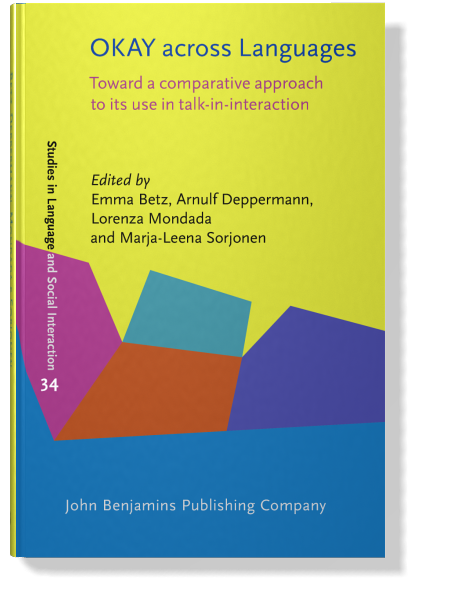
In:OKAY across Languages: Toward a comparative approach to its use in talk-in-interaction
Edited by Emma Betz, Arnulf Deppermann, Lorenza Mondada and Marja-Leena Sorjonen
[Studies in Language and Social Interaction 34] 2021
► pp. 55–92
Chapter 3OKAY in responding and claiming understanding
Published online: 17 March 2021
https://doi.org/10.1075/slsi.34.03bet
https://doi.org/10.1075/slsi.34.03bet
Abstract
OKAY originates from English, but it is
increasingly used across languages. This chapter presents data from
13 languages, illustrating the spectrum of possible uses of OKAY in
responding and claiming understanding in contexts of informings.
Drawing on a wide range of interaction types from both informal and
institutional contexts, including those crucially involving embodied
practices, we show how OKAY can be used to (i) claim sufficient
understanding, (ii) mark understanding of the prior informing as
preliminary or not complete, and (iii) index discrepancy of
expectation.
Article outline
- 1.Introduction
- 2.OKAY claims (sufficient) understanding
- 3.OKAY marks understanding of prior informing as preliminary or not complete
- 4.OKAY marks discrepancy of expectation
- 5.Summary and conclusion
Acknowledgements Notes

Cited by (7)
Cited by seven other publications
Afshari Saleh, Reihaneh, Carmen Taleghani-Nikazm, Elham Monfaredi & Parvaneh Rezaee
Betz, Emma & Alexandra Gubina
Sabbah‐Taylor, Angela & Christopher J. Jenks
Deppermann, Arnulf
2024. What do you understand by X?. In New Perspectives in Interactional Linguistic Research [Studies in Language and Social Interaction, 36], ► pp. 103 ff.
Sahlbach, Veronika
Lee, Yeji & Jakub Mlynář
Piccoli, Vanessa & Rosa Pugliese
This list is based on CrossRef data as of 4 december 2025. Please note that it may not be complete. Sources presented here have been supplied by the respective publishers. Any errors therein should be reported to them.