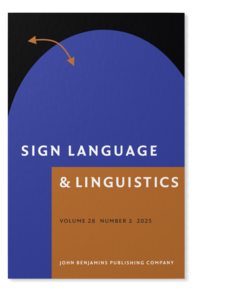
Sign Language & Linguistics
Main information
Journal metrics
Impact Factor: 0.4 (5-year: 0.4)Journal Citation Indicator: 0.36
CiteScore: 1.3
SNIP: 0.456 SJR: 0.238
This journal is peer reviewed and indexed in: ANVUR Riviste scientifiche (ANVUR ) ; CNKI Scholar ; Dimensions ; ERIH PLUS ; Glottolog ; IBR/IBZ ; Linguistic Bibliography/Bibliographie Linguistique ; Linguistics Abstracts Online ; Linguistics and Language Behavior Abstracts (LLBA ) ; MLA International Bibliography ; Scopus ; WoS Emerging Sources Citation Index (ESCI )
Sign Language & Linguistics is a peer-reviewed, international journal which aims to increase our understanding of language by providing an academic forum for researchers to discuss sign languages in the larger context of natural language, crosslinguistically and crossmodally. SLL presents studies that apply existing theoretical insights to sign language in order to further our understanding of SL; it investigates and expands our knowledge of grammar based on the study of SL and it specifically addresses the effect of modality (signed vs. spoken) on the structure of grammar.
SLL publishes its articles Online First.

Latest articles
19 December 2025
16 December 2025
2 December 2025
25 November 2025
18 November 2025
17 November 2025
11 November 2025
21 October 2025
26 September 2025
9 September 2025
8 August 2025
13 June 2025
18 March 2025
11 March 2025
24 January 2025
23 January 2025
18 November 2024
Issues
Online-first articlesVolume 28 (2025)
Volume 27 (2024)
Volume 26 (2023)
Volume 25 (2022)
Volume 24 (2021)
Volume 23 (2020)
Volume 22 (2019)
Volume 21 (2018)
Volume 20 (2017)
Volume 19 (2016)
Volume 18 (2015)
Volume 17 (2014)
Volume 16 (2013)
Volume 15 (2012)
Volume 14 (2011)
Volume 13 (2010)
Volume 12 (2009)
Volume 11 (2008)
Volume 10 (2007)
Volume 9 (2006)
Volume 8 (2005)
Volume 7 (2004)
Volume 6 (2003)
Volume 5 (2002)
Volume 4 (2001)
Volume 3 (2000)
Volume 2 (1999)
Volume 1 (1998)
Editorial info
Subscription Info
General information about our electronic journals.
Subscription rates
All prices for print + online include postage/handling.
| Online-only | Print + online | ||
|---|---|---|---|
| Volume 29 (2026): 2 issues; ca. 300 pp. | EUR | EUR |
Individuals may apply for a special online-only subscription rate of EUR
Private subscriptions are for personal use only, and must be pre-paid and ordered directly from the publisher.
Available back-volumes
| Online-only | Print + online | ||
|---|---|---|---|
| Complete backset (Vols. 1‒28; 1998‒2025) | 56 issues; 7,500 pp. | EUR 6,852.00 | EUR 7,400.00 |
| Volume 28 (2025) | 2 issues; 300 pp. | EUR | EUR |
| Volume 27 (2024) | 2 issues; 300 pp. | EUR | EUR |
| Volume 26 (2023) | 2 issues; 300 pp. | EUR | EUR |
| Volumes 23‒25 (2020‒2022) | 2 issues; avg. 300 pp. | EUR | EUR |
| Volume 22 (2019) | 2 issues; 300 pp. | EUR | EUR |
| Volume 21 (2018) | 2 issues; 300 pp. | EUR | EUR |
| Volume 20 (2017) | 2 issues; 300 pp. | EUR | EUR |
| Volume 19 (2016) | 2 issues; 300 pp. | EUR | EUR |
| Volume 18 (2015) | 2 issues; 250 pp. | EUR | EUR |
| Volumes 16‒17 (2013‒2014) | 2 issues; avg. 250 pp. | EUR | EUR |
| Volumes 1‒15 (1998‒2012) | 2 issues; avg. 250 pp. | EUR | EUR |
Author info
The purpose of Sign Language & Linguistics is to increase understanding of language by providing a forum for researchers to discuss sign languages in the larger context of natural language, crosslinguistically and crossmodally. SLL seeks high quality papers exploring the challenges and contributions that the study of sign languages can offer to theoretical linguistics. Submissions are encouraged which:
a) apply existing theoretical insights to sign languages to further the understanding of SL;
b) investigate, evaluate, and expand our knowledge of grammar based on the study of SL; or
c) specifically address the effect of modality (signed vs. spoken)
on the structure of grammar.
Descriptive studies should offer facts embedded in, and in relation to, a theory against which they can be interpreted. Similarly, theoretical generalizations should be supported with robust evidence; the (in)adequacies of alternative analyses should be considered. The paper should reflect the author's thorough familiarity with the existing literature, its strengths and its weaknesses. To increase the accessibility of manuscripts to the larger linguistic audience, authors are encouraged to include accompanying videorecorded examples.
Areas of linguistics covered include: phonology, morphology, syntax, semantics, pragmatics, phonetics/kinematics, psycholinguistics, neurolinguistics, and typology.
Submission
Sign Language & Linguistics offers online submission.
Before submitting, please consult the guidelines and the Short Guide to EM for Authors.
If you are not able to submit online, or for any other editorial correspondence, please contact the editors
via e-mail: em-sllbenjamins.nl
Dissertation Abstracts and Book Reviews need not be submitted through the Editorial Manager system; they can be sent to the editors via email.
Articles under consideration are double-blind peer-reviewed and decisions on all published content are made by the editors.
Ethics
John Benjamins journals are committed to maintaining the highest standards of publication ethics and to supporting ethical research practices.
Authors and reviewers are kindly requested to read this Ethics Statement.
Please also note the guidance on (the declaration of) the use of Artificial Intelligence.
Rights and Permissions
Authors must ensure that they have permission to use any third-party material in their contribution; the permission should include perpetual (not time-limited) world-wide distribution in print and electronic format.
For information on authors' rights, please consult the rights information page.
Open Access
Articles accepted for this journal can be made Open Access through payment of an Article Publication Charge (APC) of EUR 1800 (excl. tax). To arrange this, please contact openaccessbenjamins.nl as soon as your paper has been accepted for publication. More information can be found on the publisher's Open Access Policy page.
Corresponding authors from institutions with which John Benjamins has a Read & Publish arrangement can publish Open Access without paying a fee. Please consult this list of institutions for up-to-date information on which articles qualify.
For information about permission to post a version of your article online or in an institutional repository ('green' open access or self-archiving), please consult the rights information page.
If the article is not (to be made) Open Access, there is no fee for the author to publish in this journal.
Archiving
John Benjamins Publishing Company has an agreement in place with Portico for the archiving of all its online journals and e-books.