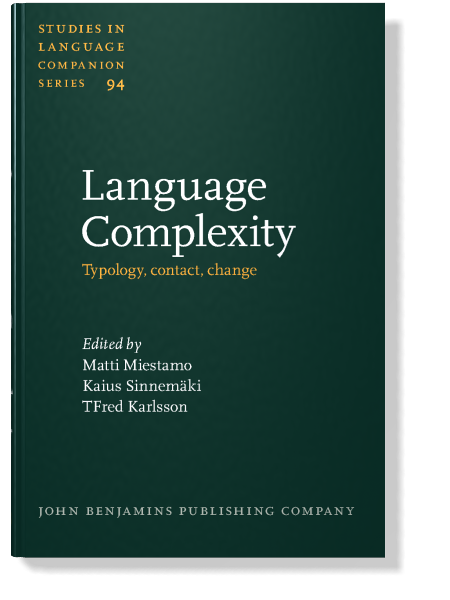
In:Language Complexity: Typology, contact, change
Edited by Matti Miestamo, Kaius Sinnemäki and Fred Karlsson
[Studies in Language Companion Series 94] 2008
► pp. v–vi
Get fulltext
This article is available free of charge.
Published online: 6 February 2008
https://doi.org/10.1075/slcs.94.toc
https://doi.org/10.1075/slcs.94.toc
Table of contents
Introduction: The problem of language complexity
I. Typology and theory1
Complexity in linguistic theory, language learning and language change
Grammatical complexity in cross-linguistic perspective
Complexity trade-offs between the subsystems of language
Complexity trade-offs in core argument marking
Assessing linguistic complexity
How complex are isolating languages?
Complexity in isolating languages: Lexical elaboration versus grammatical economy
Grammatical resources and linguistic complexity: Sirionó as a language without NP coordination
II. Contact and change165
Why does a language undress? Strange cases in Indonesia
Morphological complexity as a parameter of linguistic typology: Hungarian as a contact language
Language complexity and interlinguistic difficulty
Complexity in nominal plural allomorphy: A contrastive survey of ten Germanic languages
III. Creoles and pidgins263
The simplicity of creoles in a cross-linguistic perspective
Complexity in numeral systems with an investigation into pidgins and creoles
Explaining Kabuverdianu nominal plural formation
Complexity and simplicity in minimal lexica: The lexicon of Chinook Jargon
Index of languages
Index of authors
Index of subjects
