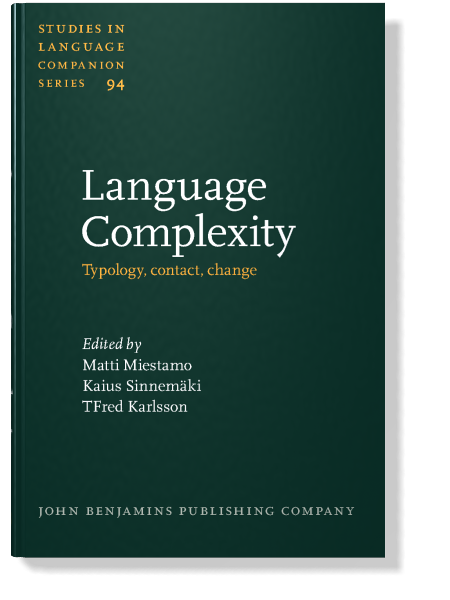
In:Language Complexity: Typology, contact, change
Edited by Matti Miestamo, Kaius Sinnemäki and Fred Karlsson
[Studies in Language Companion Series 94] 2008
► pp. 321–340
Complexity and simplicity in minimal lexica: The lexicon of Chinook Jargon
Published online: 6 February 2008
https://doi.org/10.1075/slcs.94.20juv
https://doi.org/10.1075/slcs.94.20juv
I examine the ways the minimal lexicon of a pidgin language, Chinook Jargon, gains maximal efficiency when put into use in a contemporary fictional text. The paper first describes the lexicon used from a structural point of view. It then examines the use of multifunctional lexical items in comparison to English. The results of these studies show, that 1) there is no bound morphology (neither derivational nor inflectional) in the variety studied and, 2) there is much more multifunctionality in the pidgin text than in the English texts. Finally, it is argued that the results show that the lexicon studied can indeed be described as simple and efficient.

Cited by (3)
Cited by three other publications
Bakker, Peter
2023. Review of Operstein (2021): The Lingua Franca: Contact-Induced Language Change in the Mediterranean. Journal of Pidgin and Creole Languages 38:1 ► pp. 202 ff.
Operstein, Natalie
2020. Lexical diversity and the issue of the basilect/acrolect distinction in Lingua Franca. Language Ecology 4:2 ► pp. 202 ff.
This list is based on CrossRef data as of 4 december 2025. Please note that it may not be complete. Sources presented here have been supplied by the respective publishers. Any errors therein should be reported to them.