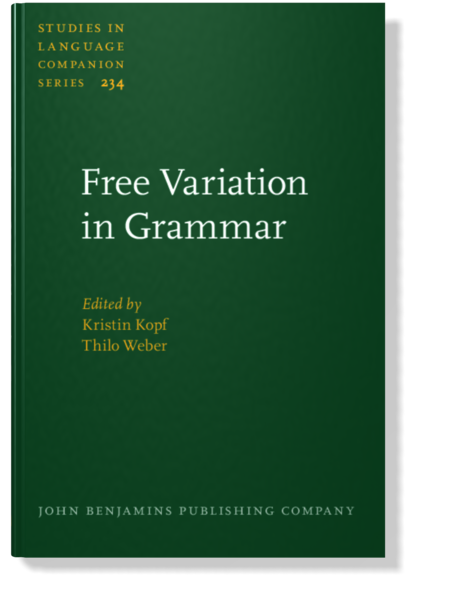
In:Free Variation in Grammar: Empirical and theoretical approaches
Edited by Kristin Kopf and Thilo Weber
[Studies in Language Companion Series 234] 2023
► pp. v–vi
Get fulltext
Available under the Creative Commons Attribution (CC BY) 4.0 license.
For any use beyond this license, please contact the publisher at rights@benjamins.nl.
Published online: 31 October 2023
https://doi.org/10.1075/slcs.234.toc
https://doi.org/10.1075/slcs.234.toc
Table of contents
Chapter 1.Free variation, unexplained variation?1
Thilo Weber
Kristin Kopf
Section 1.Identifying and measuring free variation
Chapter 2.How free is the position of German object pronouns?22
Markus Bader
Chapter 3.Optionality in the syntax of Germanic traditional dialects: On (at least) two types of intra-individual variation48
Ann-Marie Moser
Chapter 4.Non-verbal plural number agreement. Between the distributive plural and singular: Blocking factors and free variation74
Karolina Rudnicka
Aleš Klégr
Chapter 5.‘Optional’ direct objects: Free variation?99
Vilma Symanczyk Joppe
Section 2.Free variation and language change
Chapter 6.Variation and change in the Aanaar Saami conditional perfect168
Merit Niinemägi
Chapter 7.Stability of inflectional variation: The dative of the indefinite article in Zurich German202
Anja Hasse
Chapter 8.Resemanticising ‘free’ variation: The case of V1 conditionals in Dutch229
Julie Nijs
Freek Van de Velde
Section 3.Free variation? Look harder!
Chapter 9.Syntactic priming and individual preferences: A corpus-based analysis260
Malte Rosemeyer
Chapter 10.Optionality, variation and categorial properties: The case of plural marking in Yucatec Maya284
Yidong Yu
Chapter 11.Variation of deontic constructions in spoken Catalan: An exploratory study315
Roser Giménez García
Sheila Queralt
F. Xavier Vila
Index
