In:Micro- and Macro-variation of Causal Clauses: Synchronic and Diachronic Insights
Edited by Łukasz Jędrzejowski and Constanze Fleczoreck
[Studies in Language Companion Series 231] 2023
► pp. 15–48
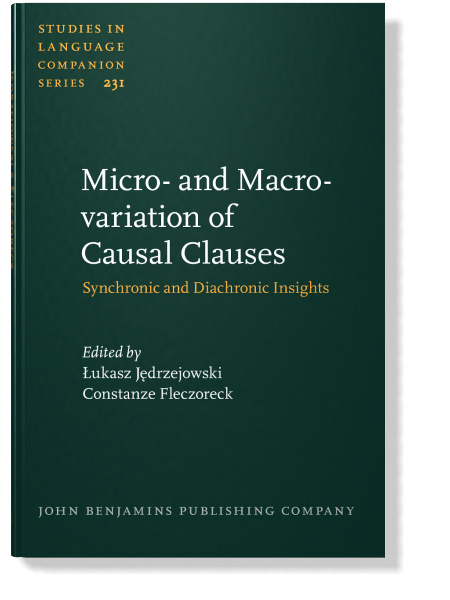
Chapter 2Adverbial clauses and their variation
The case of causal clauses in German
Published online: 1 March 2023
https://doi.org/10.1075/slcs.231.02jed
https://doi.org/10.1075/slcs.231.02jed
Abstract
In this introduction chapter, we depict the variation of adverbial clauses focusing on causal clauses in German. We briefly overview the most important findings both from a synchronic and diachronic point of view, and embed them into a more general discussion on adverbial clause-linkage.
Keywords: causal clause, adverbial clause, German, typology, diachrony
Article outline
- 1.Introduction
- 2.Synchronic variation of causal clauses
- 2.1Semantics
- 2.2Syntax
- 3.Diachronic variation of causal clauses
- 3.1Semantics
- 3.2Syntax
- 4.Concluding remarks
Acknowledgements Notes Abbreviations References

References (129)
Antomo, Mailin & Steinbach, Markus. 2010. Desintegration und Interpretation: Weil-V2-Sätze an der Schnittstelle zwischen Syntax, Semantik und Pragmatik. Zeitschrift für Sprachwissenschaft 29(1): 1–37.
Axel-Tober, Katrin. 2012. (Nicht-)kanonische Nebensätze im Deutschen. Synchrone und diachrone Aspekte [Linguistische Arbeiten 542]. Berlin: De Gruyter Mouton.
Blühdorn, Hardarik. 2006. Kausale Satzverknüpfungen im Deutschen. Pandaemonium Germanicum. Revista de Estudos Germanıś Ticos 10: 253–282.
. 2008. Epistemische Lesarten von Satzkonnektoren – Wie sie zustande kommen und wie man sie erkennt. In Semantik und Pragmatik – Schnittstellen, Inge Pohl (ed.), 217–251. Frankfurt: Peter Lang.
Breindl, Eva. 2015a. Irrelevanzkonditionale Konnektoren. In Handbuch der deutschen Konnektoren 2. Semantik der deutschen Satzverknüpfer [Schriften des Instituts für Deutsche Sprache 13], Eva Breindl, Anna Volodina & Ulrich Hermann Waßner (eds), 963–1009. Berlin: Mouton de Gruyter.
. 2015b. Konzessive Konnektoren. In Handbuch der deutschen Konnektoren 2. Semantik der deutschen Satzverknüpfer [Schriften des Instituts für Deutsche Sprache 13], Eva Breindl, Anna Volodina & Ulrich Hermann Wasner (eds), 903–962. Berlin: Mouton de Gruyter.
Catasso, Nicholas. 2018. Die Janusköpfigkeit des ahd. Konnektors wanta und ihre Relevanz für die korpusbasierte historische Syntaxforschung. Zeitschrift für germanistische Linguistik. Deutsche Sprache in Gegenwart und Geschichte 46(2): 248–281.
Charnavel, Isabelle. 2017. Non-at-issueness of since-clauses. In Proceedings of the 27th Semantics and Linguistic Theory Conference, University of Maryland, College Park, 12–14 May, Dan Burgdorf, Jacob Collard, Sireemas Maspong & Brynhildur Stefánsdóttir (eds), 43–58.
. 2020. French causal puisque-clauses in the light of (not)-at-issueness. In Romance Languages and Linguistic Theory 16: Selected Papers from the 47th Linguistic Symposium on Romance Languages (LSRL47), Newark, Delaware [Romance Languages and Linguistic Theory 16], Irene Vogel (ed.), 50–64. Amsterdam: John Benjamins.
Chomsky, Noam. 1981. Lectures on Government and Binding. The Pisa Lectures [Studies in Generative Grammar 9]. Dordrecht: Foris.
Copley, Bridget & Wolff, Phillip. 2014. Theories of causation should inform linguistic theory and vice versa. In Causation in Grammatical Structures [Oxford Studies in Theoretical Linguistics 52], Bridget Copley & Fabienne Martin (eds), 11–57. Oxford: OUP.
Curme, George O. 1922. A Grammar of the German Language. Designed for a Thorough and Practical Study of the Language as Spoken and Written to Day. New York NY: The MacMillan Company.
van Dam, Johannes. 1957. The Causal Clause and Causal Prepositions in Early Old English Prose. Groningen: Wolters.
Danckaert, Lieven. 2012. Latin Embedded Clauses. The Left Periphery [Linguistik Aktuell/Linguistics Today 184]. Amsterdam: John Benjamins.
van Dijk, Teun A. 1977. Text and Context. Explorations in the Semantics and Pragmatics of Discourse [Longman Linguistics Library 21]. London: Longman.
Dowty, David R. 1979. Word Meaning and Montague Grammar: The Semantics of Verbs and Times in Generative Semantics and in Montague’s PTQ [Synthese Language Library 7]. Dordrecht: Reidel.
Enç, Mürvet. 1989. Pronouns, licensing, and binding. Natural Language and Linguistic Theory 7(1): 51–92.
Eroms, Hans-Werner. 1980. Funktionskonstanz und Systemstabilisierung bei den begründenden Konjunktionen im Deutschen. Sprachwissenschaft 5(1): 73–115.
Fleczoreck, Constanze. 2015. Kausale Beziehungen im mittelhochdeutschen und frühneuhochdeutschen Wilhelm von Österreich. MA thesis, University of Potsdam.
Frey, Werner. 2011. Peripheral adverbial clauses, their licensing and the prefield in German. In Satzverknüpfungen. Zur Interaktion von Form, Bedeutung und Diskursfunktion [Linguistische Arbeiten 534], Eva Breindl, Gisella Ferraresi & Anna Volodina (eds), 41–77. Berlin: Mouton de Gruyter.
. 2012. On two types of adverbial clauses allowing root-phenomena. In Main Clause Phenomena. New Horizons [Linguistik Aktuell/Linguistics Today 190], Lobke Aelbrecht, Liliane Haegeman & Rachel Nye (eds), 405–429. Amsterdam: John Benjamins.
. 2016. About some correlations between formal and interpretative properties of causal clauses. In Co- and Subordination in German and Other Languages [Linguistische Berichte Sonderheft 21], Ingo Reich & Augustin Speyer (eds), 153–179. Hamburg: Buske.
. 2020. German concessives as TPs, JPs and ActPs. Glossa: A Journal of General Linguistics 5(110): 1–31.
Frey, Werner & Masiero, Federica. 2018. Desintegration versus Parordination bei obwohl und weil-Konstruktionen. In Im Mittelpunkt Deutsch [ZAS Papers in Linguistics 59], André Meinunger (ed.), 57–82. Berlin: Zentrum für Allgemeine Sprachwissenschaft.
Gagel, Sebastian. 2017. Frühneuhochdeutsche Konnektoren. Entwicklungslinien kausaler Verknüpfungen auf dem Gebiet der Modalität [Studia Linguistica Germanica 131]. Berlin: De Gruyter.
Gaumann, Ulrike. 1983. Weil die machen jetzt bald zu. Angabe- und Junktivsatz in der deutschen Gegenwartssprache [Göppinger Arbeiten zur Germanistik 384]. Göppingen: Kümmerle.
van Gelderen, Elly. 2011. The Linguistic Cycle. Language Change and the Language Faculty. Oxford: OUP.
Gering, Hugo. 1876. Die Kausalsätze und ihre Partikeln bei den ahd. Übersetzern des 8. und 9. Jahrhunderts. Eine syntaktische Untersuchung. Halle: Buchdruckerei des Waisenhauses.
Gillmann, Melitta. 2018. Causal inference or conventionalized meaning? A corpus study of the German connector nachdem ‘after’ in regional standard varieties. Folia Linguistica 52(2): 483–522.
. 2020. Da eine oder mehrere betroffen …. Eine Korpusuntersuchung zur Konstruktionalisierung und Indexikalisierung der (kausalen) da-Satz-Konstruktion in der standardisierenden Schriftsprache des 17. und 18. Jahrhunderts. Zeitschrift für germanistische Linguistik. Deutsche Sprache in Gegenwart und Geschichte 48(1): 47–100.
Gohl, Christine & Günther, Susanne. 1999. Grammatikalisierung von weil als Diskursmarker in der gesprochenen Sprache. Zeitschrift für Sprachwissenschaft 18(1): 39–75.
Grice, Herbert Paul. 1975. Logic and conversation. In Syntax and Semantics 3: Speech Acts, Peter Cole & Jerry L. Morgan (eds), 41–58. New York NY: Academic Press.
Günthner, Susanne. 1993. ‘‘… weil – man kann es ja wissenschaftlich untersuchen” – Diskurspragmatische Aspekte der Wortstellung in weil-Sätzen. Linguistische Berichte 143: 37–59.
. 2002. Zum kausalen und konzessiven Gebrauch des Konnektors wo im gesprochenen Umgangsdeutsch. Zeitschrift für germanistische Linguistik. Deutsche Sprache in Gegenwart und Geschichte 30(3): 310–341.
Haegeman, Liliane. 2003. Conditional clauses: External and internal syntax. Mind and Language 18(4): 317–339.
Haegeman, Liliane & Wekker, Herman. 1984. The syntax and interpretation of futurate conditionals in English. Journal of Linguistics 20(1): 45–55.
Hartung, Wolf Dietrich. 1964. Die zusammengesetzten Sätze des Deutschen [Studia Grammatica 4]. Berlin: Akademie Verlag.
Heymann, James. 1903. Die Kausalsätze der deutschen Lyriker im XII. Jahrhundert. PhD dissertation, Friedrich Wilhelms-University, Berlin.
Hooper, Joan B. & Thompson, Sandra A. 1973. On the applicability of root transformations. Linguistic Inquiry 4(4): 465–497.
Huldi, Max. 1957. Die Kausal-, Temporal und Konditionalkonjunktionen bei Christian Kuchmeister, Hans Fründ und Nicolas von Wyle. Mit einem Anhang über Herkunft und Ausbreitung von kausalem denn. PhD dissertation, University of Zürich.
Jędrzejowski, Łukasz, Angantýsson, Ásgrímur & Snorrason, Oddur. 2022. On exceptive nema-clauses in Icelandic. Ms, University of Cologne and University of Iceland.
Johnston, Michael James Robert. 1994. The syntax and semantics of adverbial adjuncts. PhD dissertation, University of California Santa Cruz.
Jucker, Andreas H. 1991. Between hypotaxis and parataxis. Clauses of reason in Ancrene Wisse. In Historical English Syntax [Topics in English Linguistics 2], Dieter Kastovsky (ed.), 203–220. Berlin: De Gruyter.
Keller, Rudi. 1993a. Das epistemische weil. Bedeutungswandel einer Konjunktion. In Sprachgeschichte und Sprachkritik. Festschrift für Peter von Polenz zum 65. Geburtstag, Hans Jürgen Heringer & Georg Stötzel (eds), 219–247. Berlin: De Gruyter.
. 1993b. Der Wandel des weil: Verfall oder Fortschritt? Sprache und Literatur in Wissenschaft und Unterricht 24/71: 2–12.
Kempen, Gerard & Harbusch, Karin. 2016. Verb-second word order after German weil ‘because’: Psycholinguistic theory from corpus-linguistic data. Glossa: A Journal of General Linguistics 1(3): 1–32.
Küper, Christoph. 1984. Zum sprechaktbezogenen Gebrauch der Kausalverknüpfer denn und weil: Grammatisch-pragmatische Interrelationen. Linguistische Berichte 92: 15–30.
Kuteva, Tania, Heine, Bernd, Bo Hong, Haiping Long, Narrog, Heiko & Rhee, Seongha (eds). 2019. Word Lexicon of Grammaticalization. Cambridge: CUP.
Larson, Richard. 2004. Sentence-final adverbs and “scope”. In Proceedings of the North Eastern Linguistics Society Annual Meeting 34 (NELS 34) at the Stony Brook University, Keir Moulton & Matthew Wolf (eds), 23–43. Amherst MA: GLSA.
. 2022. What adverbials and adverbial clauses may teach us about quantification. Talk and handout delivered at the conference ‘Adverbial clauses between subordination and coordination’ at the University of Cologne, May.
Larson, Richard K. & Sawada, Miyuki. 2012. Root transformations & quantificational structure. In Main Clause Phenomena. New Horizons [Linguistik Aktuell/Linguistics Today 190], Lobke Aelbrecht, Liliane Haegeman & Rachel Nye (eds), 47–78. Amsterdam: John Benjamins.
Lee, Ji Won. 2007. On the development of because. A corpus-based study. SNU Working Papers in English Linguistics and Language 6: 91–100.
Lenker, Ursula. 2007. Forhwi ‘because’: Shifting deictics in the history of English causal connection. In Connectives in the History of English [Current Issues in Linguistic Theory 283], Ursula Lenker & Anneli Meurman-Solin (eds.), 193–227. Amsterdam: John Benjamins.
Levinson, Stephen C. 2001. Presumptive Meanings. The Theory of Generalized Conversational Implicature. Cambridge MA: The MIT Press.
Liggins, Elizabeth Mary. 1995. The expression of causal relationship in Old English prose. PhD dissertation, University of London.
Lühr, Rosemarie. 2018. Begründete Evidenz bei Otfrid. In Sprachwandel im Deutschen [Lingua Historica Germanica 19], Luise Czajkowski, Sabrina Ulbrich-Bösch & Christina Waldvogel (eds), 103–115. Berlin: Mouton de Gruyter.
Molencki, Rafał. 2003. The etymology and development of the conjunction as in Middle English. Linguistica Silensia 24: 25–39.
. 2007. The evolution of since in medieval English. In Connectives in the History of English [Current Issues in Linguistic Theory 283], Ursula Lenker & Anneli Meurman-Solin (eds), 97–113. Amsterdam: John Benjamins.
. 2008. The rise of because in Middle English. In Historical Englishes in Varieties of Texts and Contexts. The Global COE program, International Conference 2007 [Studies in English Medieval Language and Literature 22], Masachiyo Amano, Michiko Ogura & Masayuki Ohkado (eds), 201–216. Frankfurt: Peter Lang.
. 2012. Causal Conjunctions in Mediaeval English. A Corpus-Based Study of Grammaticalization. Katowice: Uniwersytet Śląski.
Möslein, Kurt. 1974. Einige Entwicklungstendenzen in der Syntax der wissenschaftlichen Literatur seit dem Ende des 18. Jahrhunderts. Beiträge zur Geschichte der deutschen Sprache und Literatur 94: 156–198.
Müller, Sonja. 2017. Kausale/konzessive Verberst- und Wo-Verbletzt-Sätze. Deutsche Sprache 3: 245–276.
Önnerfors, Olaf. 1997. Verb-erst-Deklarativsätze. Grammatik und Pragmatik [Lunder germanistische Forschungen 60]. Stockholm: Almqvist & Wiksell.
Oppenrieder, Wilhelm. 1989. Selbstständige Verb-Letzt-Sätze: Ihr Platz im Satzmodussystem und ihre intonatorische Kennzeichnung. In Zur Intonation von Modus und Fokus im Deutschen [Linguistische Arbeiten 234], Hans Altmann, Anton Batliner & Wilhelm Oppenrieder (eds), 163–244. Tübingen: Niemeyer.
Pasch, Renate. 1982. Untersuchungen zu den Gebrauchsbedingungen der deutschen Kausalkonjunktionen da, denn und weil. Linguistische Studien des ZISW 104: 41–243.
. 1983. Die Kausalkonjunktionen da, denn und weil: Drei Konjunktionen – Drei lexikalische Klassen. Deutsch als Fremdsprache 20(6): 332–337.
Pauly, Dennis. 2014. Grenzfälle der Subordination: Merkmale, Empirie und Theorie abhängiger Nebensätze. PhD dissertation, University of Potsdam.
Pitsch, Stefanie. 2016. Syntax and semantics of causal nachdem-clauses in German. In Co- and Subordination in German and Other Languages [Linguistische Berichte Sonderheft 21], Ingo Reich & Augustin Speyer (eds), 261–284. Hamburg: Buske.
Pittner, Karin. 1999. Adverbiale im Deutschen. Untersuchungen zu ihrer Stellung und Interpretation [Studien zur deutschen Grammatik 60]. Tübingen: Stauffenburg.
. 2007. Dialog in der Grammatik: Doch in Kausalsätzen mit Verberststellung. In Von der Pragmatik zur Grammatik, Sandra Döring & Jochen Geilfuß-Wolfgang (eds), 39–56. Leipzig: Leipziger Universitätsverlag.
. 2011. Subsidäre Begründungen. In Konnektoren im Deutschen und im Sprachvergleich: Beschreibung und grammatische Analyse [Studien zur deutschen Sprache 53], Gisella Ferraresi (ed.), 157–182. Tübingen: Narr.
Posner, Roland. 1979. Bedeutung und Gebrauch der Satzverknüpfer in den natürlichen Sprachen. In Sprechakttheorie und Semantik [Suhrkamp-Taschenbuch Wissenschaft 276], Günther Grewendorf (ed.), 345–385. Frankfurt: Suhrkamp.
Potts, Christopher. 2005. The Logic of Conventional Implicatures [Oxford Studies in Theoretical Linguistics 7]. Oxford: OUP.
Putzer, Oskar. 1979. Konjunktionale Nebensätze und äquivalente Strukturen in der Heinrich von Langenstein zugeschriebenen Erkenntis der Sünde. Eine syntaktische Studie zur Wiener Übersetzungsliteratur um 1390 [Schriften zur deutschen Sprache in Österreich 2]. Wien: Universitäts-Verlagsbuchhandlung.
Ravetto, Miriam & Blühdorn, Hardarik. 2011. Die Kausalkonjunktionen denn, weil, da im Deutschen und perché, poiché, siccome im Italienischen. In Konnektoren im Deutschen und im Sprachvergleich: Beschreibung und grammatische Analyse [Studien zur deutschen Sprache 53], Gisela Ferraresi (ed.), 207–250. Tübingen: Narr.
Reich, Ingo, Reis, Marga, Ehrich, Veronika & Fortmann, Christian. 2009. Einführung. In Koordinationund Subordination im Deutschen [Linguistische Berichte Sonderheft 16], Veronika Ehrich, Christian Fortmann, Ingo Reich & Marga Reis (eds), 5–20. Hamburg: Buske.
Reinhardt, F. 1884. Die Kausalsätze und ihre Partikeln im Nibelungenliede. Aschersleben dissertation.
Reis, Marga. 2000a. Anmerkungen zu Verb-erst-Satz-Typen im Deutschen. In Deutsche Grammatik in Theorie und Praxis, Rolf Thieroff, Matthias Tamrat, Nanna Fuhrhop & Oliver Teuber (eds), 215–227. Tübingen: Niemeyer.
. 2000b. Review of: Olaf Önnerfors 1997: Verb-erst-Deklarativsätze. Grammatik und Pragmatik. Stockholm: Almqvist & Wiksell. Studia Linguistica 54(1): 90–100.
. 2013. ‘‘Weil-V2”-Sätze und (k)ein Ende? Anmerkungen zur Analyse von Antomo & Steinbach (2010). Zeitschrift für Sprachwissenschaft 32(2): 221–262.
Roemheld, Friedrich. 1911. Die deutschen Konjunktionen wande, denn und weil. Ludwigs-Universität zu Giessen dissertation.
Roetteken, Hubert. 1884. Der zusammengesetzte Satz bei Berthold von Regensburg. Ein Beitrag zur mittelhochdeutschen Syntax [Quellen und Forschungen zur Sprach- und Culturgeschichte der germanischen Völker 53]. Strassburg: Karl J. Trübner.
Ros, Hilke. 2005. Functional Phrase Structure: Integrating functional ideas in generative adverbial syntax. PhD dissertation, Ghent Universiteit.
Rudolph, Elisabeth. 1980. Bemerkungen zur konnektiven Partikel denn. In Perspektive textintern. Akten des 14. Linguistischen Kolloquiums, Bochum 1979 [Linguistische Arbeiten 88], Edda Weigand & Gerhard Tschauder (eds), 249–261. Tübingen: Niemeyer.
Rutherford, William E. 1970. Some observations concerning subordinate clauses in English. Language 46(1): 97–115.
Scheffler, Tatjana. 2005. Syntax and semantics of causal denn in German. In Proceedings of the 15th Amsterdam Colloquium, Paul Dekker & Michael Franke (eds), 215–220. Amsterdam: Grafisch Centrum Amsterdam.
. 2008. Semantic operators in different dimensions. PhD dissertation, University of Pennsylvania.
. 2013. Two-dimensional Semantics. Clausal Adjuncts and Complements [Linguistische Arbeiten 549]. Berlin: Mouton de Gruyter.
Schiffrin, Deborah. 1987. Discourse Markers [Studies in Interactional Sociolinguistics 5]. Cambridge: CUP.
Schmidhauser, Beda. 1995. Kausalität als linguistische Kategorie. Mittel und Möglichkeiten für Begründungen [Reihe Germanistische Linguistik 152]. Tübingen: Niemeyer.
Scholz, Ulrike. 1991. Wunschsätze im Deutschen – Formale und funktionale Beschreibung. Satztypen mit Verberst- und Verbletztstellung [Linguistische Arbeiten 265]. Tübingen: Niemeyer.
Selting, Barbara. 1999. Kontinuität und Wandel der Verbstellung von ahd. wanta bis gwd. weil. Zur historischen und vergleichenden Syntax der weil-Konstruktionen. Zeitschrift für germanistische Linguistik 27(2): 167–204.
Simons, Mandy, Tonhauser, Judith, Beaver, David & Roberts, Craige. 2010. What projects and why. In Proceedings of SALT 20, Vancouver, 29 April-1 May, Nan Li & David Lutz (eds), 309–327.
Sohmiya, Yoshikazu. 1975. Syntax und Semantik der kausalen Konjunktionen denn und weil. Doitsu Bungaku 42: 108–119.
Speyer, Augustin. 2011. Zur Integriertheit kausaler (Neben-)Sätze im Frühneuhochdeutschen. Sprachwissenschaft 36(1): 53–84.
. 2015. Informationsdichte als Faktor für Einbettung. Eine sprachhistorische Studie an Kausalsätzen. Sprachwissenschaft 40(4): 453–485.
Speyer, Augustin & Voigtmann, Sophia. 2021. Informationelle Bedingungen für die Selbständigkeit kausaler Satzaussagen. Eine diachrone Sichtweise. In Neues zur Selbstständigkeit von Sätzen [Linguistische Berichte Sonderheft 30], Robert Külpmann & Rita Finkbeiner (eds), 177–205. Hamburg: Buske.
Stede, Manfred & Walter, Maik. 2011. Zur Rolle der Verknüpfungsebene am Beispiel der Kausalkonnektoren. In Satzverknüpfungen. Zur Interaktion von Form, Bedeutung und Diskursfunktion [Linguistische Arbeiten 534], Eva Breindl, Gisella Ferraresi & Anna Volodina (eds), 149–179. Berlin: De Gruyter.
Sweetser, Eve. 1990. From Etymology to Pragmatics. Metaphorical and Cultural Aspects of Semantic Structure [Cambridge Studies in Linguistics 54]. Cambridge: CUP.
Taigel, Sonja. 2020. On the role of the left periphery in the interpretation of causal Wo-VE-clauses. In Verb Second – Grammar Internal and Grammar External Interfaces [Interface Explorations 34], Horst Lohnstein & Antonios Tsiknakis (eds), 329–370. Berlin: De Gruyter.
Takami, Ken-ichi. 1988. The syntax of if-clauses: Three types of if-clauses and X̄-theory. Lingua 74(4): 263–281.
Thim-Mabrey, Christiane. 1982. Zur Syntax der kausalen Konjunktionen weil, da und denn. Sprachwissenschaft 7: 197–219.
Tonhauser, Judith. 2012. Diagnosing (not-)at-issue content. Semantics of Underrepresented Languages of the Americas 6: 239–254.
Uhmann, Susanne. 1998. Verbstellungsvariation in weil-Sätzen: Lexikalische Differenzierung mit grammatischen Folgen. Zeitschrift für Sprachwissenschaft 17(1): 92–139.
Volodina, Anna. 2009. Sprechaktbezogene Kausalität. In Sprache und Kognition: Traditionelle und neue Ansätze. Akten des 40. Linguistischen Kolloquiums in Moskau 2005 [Linguistik International 23], Olga Souleimanova (ed.), 311–322. Frankfurt: Peter Lang.
. 2011. Sweetsers Drei-Ebenen-Theorie: Theoretische Überlegungen vor dem Hintergrund einer korpuslinguistischen Studie über konditionale und kausale Relationen. In Konnektoren im Deutschen und im Sprachvergleich: Beschreibung und grammatische Analyse [Studien zur deutschen Sprache 55], Gisela Ferraresi (ed.), 127–155. Tübingen: Narr.
Waldmann, Michael R. (ed.). 2017. The Oxford Handbook of Causal Reasoning [Oxford Library of Psychology]. Oxford: OUP.
Wegener, Heide. 1993. weil – das hat schon seinen Grund: Zur Verbstellung in Kausalsätzen mit weil im gegenwärtigen Deutsch. Deutsche Sprache 21: 289–305.
. 1999. Syntaxwandel und Degramatikalisierung im heutigen Deutsch? Nocheinmal zu weil-Verbzweit. Deutsche Sprache 27(1): 3–26.
. 2000. Da, denn und weil – der Kampf der Konjunktionen. Zur Grammatikalisierung im kausalen Bereich. In Deutsche Grammatik in Theorie und Praxis, Rolf Thieroff, Oliver Teuber, Matthias Tamrat & Nanna Fuhrhop (eds), 69–81. Tübingen: Max Niemeyer.
Wei, Yipu. 2018. Causal connectives and perspective markers in Chinese: The enconding and processing of subjectivity in discourse. PhD dissertation, Universiteit Utrecht.
von Wietersheim, Sophie. 2016. Variable binding as evidence for clausal attachment. In Co- and Subordination in German and Other Languages [Linguistische Berichte Sonderheft 21], Ingo Reich & Augustin Speyer (eds), 319–345. Hamburg: Buske.
. 2022. The Syntactic Integration of Adverbial Clauses. Experimental Evidence from Anaphoric Relations [Studien zur deutschen Grammatik 101]. Tübingen: Stauffenburg.
von Wietersheim, Sophie & Featherston, Sam. 2019. Does structural binding correlate with degrees of functional depenence? In Insubordination [Trends in Linguistics. Studies and Monographs 326], Karin Beijering, Gunther Kaltenböck & Marıá Sol Sansiñena (eds), 265–290. Berlin: De Gruyter Mouton.
Willems, Klaas. 1994. weil es hat mit Bedeuetung nicht viel zu tun … Zum Sprachwandel einer Konjunktion. Deutsche Sprache 22(3): 261–279.
Williams, Edwin. 1974. Rule ordering in syntax. PhD dissertation, MIT.
Cited by (1)
Cited by one other publication
This list is based on CrossRef data as of 4 december 2025. Please note that it may not be complete. Sources presented here have been supplied by the respective publishers. Any errors therein should be reported to them.