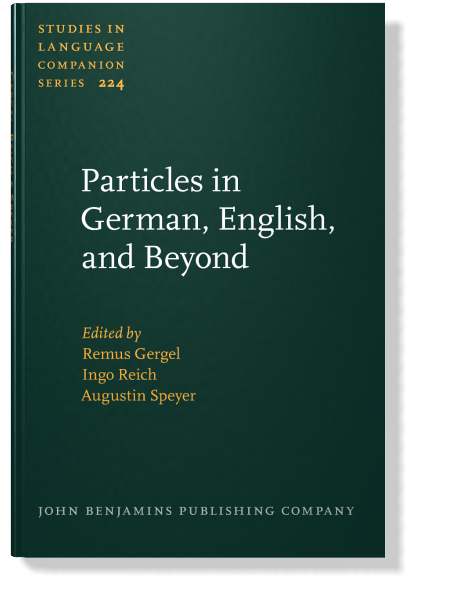
In:Particles in German, English, and Beyond
Edited by Remus Gergel, Ingo Reich and Augustin Speyer
[Studies in Language Companion Series 224] 2022
► pp. 1–24
Chapter 1Particles
A brief synchronic, diachronic and contrastive introduction
Published online: 16 August 2022
https://doi.org/10.1075/slcs.224.01ger
https://doi.org/10.1075/slcs.224.01ger
Abstract
This chapter provides a general background to the field of particles by introducing major classifications and considerations
from synchronic, diachronic, and contrastive perspectives. It builds on earlier literature from the respective fields. In
doing so, it also prepares the ground for the individual chapters, which it previews and puts into perspective with the
general theme of the volume.
Article outline
- 1.Delimiting current scope
- 2.Particles from a synchronic point of view
- 3.Diachronic aspects
- 4.Contrasting and comparing towards explanatory building blocks
- 4.1A contrasting paradigm
- 4.2The contributions of this volume
- 4.2.1Papers with their main focus on German
- 4.2.2Papers with their main focus on English
- 4.2.3Further contrastive studies and papers primarily concerned with particles in other languages
Note References

References (89)
Abraham, Werner. 1991. The grammaticalization of the German modal particles. In: Traugott, Elisabeth & B. Heine (eds.): Approaches to Grammaticalization. Vol. II. Amsterdam & Philadelphia: John Benjamins Publishing Company, 331–380.
. 2010. Diskurspartikel zwischen Modalität, Modus und Fremdbewusstseinsabgleich (Theory of Mind). In Theo Harden & Elke Hentschel (eds.): 40 Jahre Partikelforschung. Tübingen: Stauffenburg, 33–77.
Authenrieth, Tanja. 2002. Heterosemie und Grammatikalisierung bei Modalpartikeln: eine synchrone und diachrone Studie anhand von “eben”,
“halt”, “e(cher)t”, “einfach”, “schlicht” und “glatt”. Tübingen: Niemeyer.
Axel, Katrin. 2007. Studies in Old High German Syntax: Left sentence periphery, verb placement and verb-second. Amsterdam & Philadelphia: John Benjamins Publishing Company.
Axel-Tober, Katrin. 2018. Origins of verb-second in Old High German. In Agnes Jäger, Gisella Ferraresi & Helmut Weiß (eds.): Clause structure and word order in the history of German. Oxford: Oxford University Press, 22–47.
Axel-Tober, Katrin & Remus Gergel. 2016. Modality and mood in generative and other formal linguistic approaches. In The Oxford Handbook of Modality and Mood, Jan Nuyts & Johan van der Auwera (eds), 473–494. Oxford: Oxford University Press.
Beaver, David & Brady Z. Clark. 2008. Sense and Sensitivity: How Focus Determines Meaning. John Wiley & Sons.
Beck, Sigrid. 2016. Temporal noch/still and further-to readings of German noch. In Proceedings of Sinn und Bedeutung 20: 4–25. Universität Tübingen.
. 2020b. Indeterminate pronouns in Old English: a compositional semantic analysis. The Journal of Comparative Germanic Linguistics 23: 203–269.
Beck, Sigrid & Remus Gergel. 2015. The diachronic semantic of English again. Natural Language Semantics 23: 157–203.
Beck, Sigrid, Oda, Toshiko, & Sugisaki, Koji. 2004. Parametric variation in the semantics of comparison: Japanese vs. English. Journal of East Asian Linguistics, 13(4): 289–344.
Beck, Sigrid, Sveta Krasikova, Daniel Fleischer, Remus Gergel, Stefan Hofstetter, Christiane Savelsberg, John Vanderelst & Elisabeth Villalta. 2009. Cross-linguistic variation in comparison constructions. The Linguistic Variation Yearbook 9: 1–66.
Chierchia, Gennaro. 1998. Reference to kinds across language. Natural Language Semantics 64: 339–405.
Chomsky, Noam & Howard Lasnik. 1993. “The theory of principles and parameters.” Syntax: An international handbook of contemporary research, ed. by J. Jacobs et al., 506–569. Vol. 1. Berlin/New York: Walter de Gruyter.
Deo, Ashwini. 2009. Unifying the imperfective and the progressive: partitions as quantificational domains. Linguistics and Philosophy, 32: 475–521.
Detges, Ulrich, and Richard Waltereit. 2009. Diachronic pathways and pragmatic strategies: Different types of pragmatic particles from a diachronic
point of view. In Current Trends in Diachronic Semantics and Pragmatics, Björn Hansen, Maj-Britt Mosegaard, and Jacqueline Visconti (eds.), 43–61. Bingley: Emerald.
Diewald, Gabriele. 2006. Discourse particles and modal particles as grammatical elements. In: Fischer, Kerstin (ed.): Approaches to discourse particles. Amsterdam: Elsevier. 403–425.
. 2011. Pragmaticalization (defined) as grammaticalization of discourse functions. Linguistics 49: 365–390.
Eckardt, Regine. 2006. Meaning Change in Grammaticalization. An Enquiry into Semantic Reanalysis. Oxford University Press.
. 2012. Grammaticalization and Semantic Reanalysis. In Semantics – An International Handbook of Natural Language Meaning [Handbücher zur Sprach- und Kommunikationswissenschaft / Handbooks of Linguistics and Communication
Science (HSK) 33/3], Klaus von Heusinger, Claudia Maienborn & Paul Portner (eds), 2675–2702. Berlin, De Gruyter Mouton.
Eckardt, Regine & Augustin Speyer. 2014. Information structure and language change. In The Oxford Handbook of Information Structure, C. Féry and S. Ishihara (eds), 503–519. Oxford University Press.
Fischer, Kerstin. 2007. Grounding and Common Ground: Modal Particles and Their Translation Equivalents. In Lexical Markers of Common Grounds, Alexandra Fetzer & Kerstin Fischer (eds), 47–66 Amsterdam: Elsevier.
Fretheim, Thorstein. 1991. Formal and functional differences between S-internal and S-external modal particles in
Norwegian. Multilingua 10, 175–200.
Gelderen, Elly van. 2001. The syntax of mood particles in the history of English. Folia Linguistica Historica XXII: 301–330.
Gergel, Remus. 2011. Structure-sensitivity in actuality: Notes from a class of preference expressions. University of Pennsylvania Working Papers in Linguistics 17: 115–124.
. 2016. Modality and gradation: Comparing the sequel of developments in ‘rather’ and ‘eher’. In The linguistic Cycle Continued, Elly van Gelderen (ed). 319–350. Amsterdam/Philadelphia: John Benjamins.
. 2020. Sich ausgehen: Actuality entailments and further notes from the perspective of an Austrian
German motion verb construction. In Proceedings of the Linguistic Society of America, Martín Fuchs & Joshua Phillips (eds). New Orleans: LSA Publications 5: 5–15.
Gergel, Remus and Sigrid Beck. 2015. Early Modern English again: a corpus study and semantic analysis. English Language and Linguistics 19: 27–47.
Gergel, Remus & Martin Kopf-Giammanco. 2021. ‘Sich ausgehen’: On modalizing go constructions in Austrian German. Canadian Journal of Linguistics 66: 141–190.
Gergel, Remus, Martin Kopf-Giammanco & Maike Puhl. 2021. Simulating semantic change: a methodological note. In Proceedings of Experiments in Linguistic Meaning (ELM) 1, Andrea Beltrama, Florian Schwarz & Anna Papafragou (eds.). 184–196. University of Pennsylvania: LSA Publications.
Grice, Paul. 1975. Logic and conversation. In: Syntax and Semantics, Vol. 3: Speech Acts. Peter Cole & Jerry Morgan (eds). New York: Academic Press, 41–58.
Gutzmann, Daniel. 2015. Use-conditional Meaning: Studies in multidimensional semantics. Oxford: Oxford University Press.
Gutzmann, Daniel & Katharina Turgay. 2015. Expressive intensifiers and external degree modification. The Journal of Comparative Germanic Linguistics 17: 185–228.
Haselow, Alexander. 2012. Subjectivity, intersubjectivity and the negotiation of Common Ground in spoken discourse: final particles
in English. Language & Communication 32(3): 182–204.
Hentschel, Elke. 1986. Funktion und Geschichte deutscher Partikeln. Ja, doch, halt und eben. Tübingen: Niemeyer.
Ippolito, Michela. 2007. On the meaning of some focus-sensitive particles. Natural Language Semantics 15: 1–34.
Kaplan, David. 2004. The meaning of ouch and oops. Howison Lecture in Philosophy delivered at UC Berkeley, transcribed by Elizabeth Coppock. Ms., UC Berkeley.
Kaufmann, Magdalena & Kaufmann, Stefan. 2016. Modality and mood in formal semantics. In Jan Nuyts & Johan van der Auwera (eds.): The Oxford Handbook of Modality and Mood. Oxford: Oxford University Press.
König, Ekkehard & Volker Gast. 2012. Understanding English-German Contrasts. (revised). Berlin: Erich Schmidt.
Kopf-Giammanco, Martin. 2020. German noch under reanalysis. In Remus Gergel & Jonathan Watkins (eds.), Quantification and Scales in Change 161–198. Berlin: Language Science Press.
Kratzer, Angelika. 1991. Modality. In Semantik: ein internationales Handbuch der zeitgenössischen Forschung, Arnim von Stechow & Dieter Wunderlich (eds), page numbers? Berlin: de Gruyter.
. 1999. Beyond ouch and oops: How descriptive and expressive meaning interact. In Cornell conference on theories of context dependency (Vol. 26). Ithaca, NY: Cornell University.
Krifka, Manfred. 2008. Basic notions of information structure. Acta Linguistica Hungarica 55: 243–276.
Lenker, Ursula. 2010. Argument & Rhetoric. Adverbial Connectors in the History of English. Berlin: Mouton de Gruyter.
Matthewson, Lisa. 2001. Quantification and the nature of cross-linguistic variation. Natural Language Semantics 9:145–189.
. 2006. Presuppositions and cross-linguistic variation. Proceedings of the North Eastern Conference in Linguistics 26: 63–76.
McCready, Elin. 2012. Formal Approaches to Particle Meaning. Language and Linguistics Compass 6(12): 777–795.
Meibauer, Jörg. 1994. Modaler Kontrast und konzeptionelle Verschiebung: Studien zur Syntax und Semantik deutscher
Modalpartikeln. Tübingen: Niemeyer.
Müller, Sonja. 2018. Distribution und Interpretation von Modalpartikel-Kombinationen. Berlin: Language Science Press.
Nevalainen 1991. But, only, just. Focusing adverbial change in Modern English, 1500–1700. Memoires de la Societe Neophilologique de Helsinki.
Ormelius-Sandblom, Elisabeth. 1997. Die Modalpartikeln ja, doch und schon. Zu ihrer Syntax, Semantik und Pragmatik. Stockholm: Almqvist & Wiksell.
Papafragou, Anna. 2002. Modality and theory of mind. Perspectives from language development and autism. In: Sjef Barbiers, F. Beukema & Wim van der Wurff (eds.) Modality and its Interaction with the Verbal System. Amsterdam & Philadelphia: John Benjamins Publishing Company. 185–204.
Reich, Ingo. 2002. Question/Answer Congruence and the semantics of wh-phrases. Theoretical Linguistics 28: 73–94.
Reis, Marga. 2001. Bilden Modalverben im Deutschen eine syntaktische Klasse? In Modalität und Modalverben im Deutschen, Reimar Müller and Marga Reis (eds.), 287–318. Hamburg: Buske.
Repp, Sophie. 2013. Common Ground Management: Modal particles, Illocutionary Negation and VERUM. In Beyond Expressives, Daniel Gutzmann & Hans-Martin Gärtner, (eds), 231–274. Leiden, Boston: Emerald.
Roberts, Craige. 1996. Information structure in discourse: towards an integrated formal theory of pragmatics. In Ohio State University Working Papers in Linguistics, J. H. Yoon and A. Kathol (eds), 49: 91–136.
Rooth, Mats. 1985. Association with Focus (Montague Grammar, Semantics, Only, Even). Doctoral dissertation, University of Massachusetts Amherst.
Schmerse, Daniel, Elena Lieven & Michael Tomasello. 2014. Discourse Particles and Belief Reasoning: The Case of German doch. Journal of Semantics 31: 115–133.
Smirniova, Elena. 2012. On some problematic aspects of subjectification. Language Dynamics and Change 2: 34–58.
Von Stechow, Arnim. 1996. The different readings of wieder ‘again’: A structural account. Journal of Semantics 13: 87–138.
Traugott, Elizabeth Closs. 2006. The semantic development of scalar focus modifiers. In The Handbook of the History of English Handbooks in Linguistics, Ans van Kemenade & Bettelou Los (eds.), 335–359. Malden et al.: Blackwell.
. 2019. Whither historical pragmatics? A cognitively-oriented perspective. Journal of Pragmatics 145: 25–30.
Traugott, Elizabeth Closs & Richard B. Dasher. 2002. Regulartity in Semantic Change. Cambridge: Cambridge University Press.
Weydt, Harald. 1977. Aspekte der Modalpartikeln: Studien zur deutschen Abtönung. Tübingen: Niemeyer. (= Konzepte der Sprach- und Literaturwissenschaft; 23).
. 1986. Betonungsdubletten bei deutschen Partikeln. In Kontroversen, alte und neue, Vol. 3: Textlinguistik contra Stilistik?, Walter Weiss, Herbert Ernst Wiegand & Marga Reis (eds), 393–403. Tübingen: Niemeyer.
Yu, Jianrong. 2020. Repetitive and Restitutive Presuppositions and the Semantics of English Verbal Roots. Doctoral dissertation, University of Arizona, Tucson, USA.
Zeevat, Henk & Elena Karagjosova. 2009. History and grammaticalisation of “doch”/”toch”. In Papers on Pragmasemantics ZASPiL 51, Benz, Anton & Reinhard Blutner (eds), 135–152. Berlin, ZAS.
Zimmermann, Malte. 2004. Zum „Wohl“: Diskurspartikeln als Satztypmodifikatoren. Linguistische Berichte 199: 253–286.
. 2008. Discourse Particles in the Left Periphery. In Dislocated Elements in Discourse, Philippa Cook, Werner Frey, Claudia Maienborn & Benjamin Shaer (eds), 200–231. Oxford: Routledge.