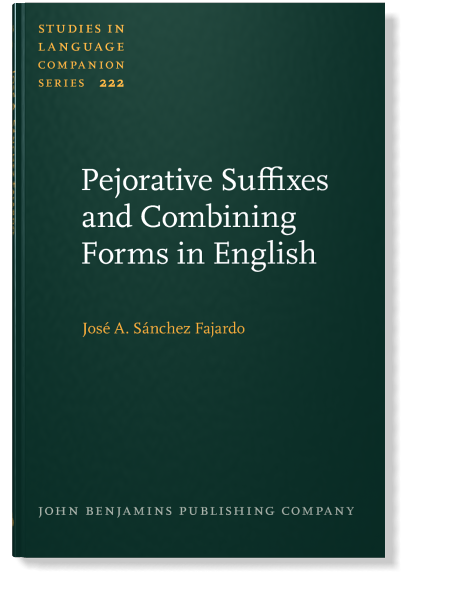
In:Pejorative Suffixes and Combining Forms in English
José A. Sánchez Fajardo
[Studies in Language Companion Series 222] 2022
► pp. vii–x
Get fulltext
This article is available free of charge.
Published online: 9 February 2022
https://doi.org/10.1075/slcs.222.toc
https://doi.org/10.1075/slcs.222.toc
Table of contents
Acknowledgements
Abbreviations and symbols
Figures and tables
Introduction
Chapter 1Pejoration and beyond
1.1What is pejoration?
1.2Pejoration at the interface of semantics and pragmatics
1.3A linguistic interpretation of pejoratives
1.4A two-dimensional analysis of pejorative lexis
1.5Pejoratives: what for?
1.6Pejoration and X-phemisms
1.6.1Euphemisms as neutralizers of pejorative meaning
1.6.2Dysphemisms as enhancers of pejorative meaning
1.7Pejoration and slang
1.8Pejoratives and the conceptualization of taboo
Chapter 2How pejoratives are made
2.1Compounding
2.1.1Blends
2.2Affixation
2.2.1Why ‘semi’ in semi-suffix?
2.2.2Morphological markedness
2.3Conversion
2.4Clipping
2.5Abbreviations
2.6Loanwords
2.7Reduplication
2.8Semantic extensions
Chapter 3From diminution to pejoration
3.1Size definitely (and semantically) does matter
3.2The suffix ‑ie
3.2.1Forms and functions of -ie pejoratives
3.2.2Constructional schemas of -ie pejoratives
3.2.2.aSchemas of -ie DnNs
3.2.2.bSchemas of -ie DaNs
3.2.2.cSchemas of -ie DvNs
3.2.3What schemas tell us about pejoratives ending in -ie
3.3The suffix ‑o
3.3.1Forms and functions of -o pejoratives
3.3.2Constructional schemas of -o pejoratives
3.3.2.aSchemas of -o DnNs
3.3.2.bSchemas of -o DaNs
3.3.2.cSchemas of -o DvNs
3.3.3What schemas tell us about pejoratives ending in -o
Chapter 4From excess to pejoration
4.1Too much can be bad
4.2The suffix ‑ard
4.2.1Forms and functions of -ard pejoratives
4.2.2Constructional schemas of -ard pejoratives
4.3The combining form ‑holic
4.3.1Forms and functions of -holic pejoratives
4.3.2Constructional schemas of -holic pejoratives
4.3.2.aSchemas of -holic DnNs
4.3.2.bSchemas of -holic DaNs
4.3.2.cSchemas of -holic DvNs
4.3.3What schemas tell us about pejoratives ending in -holic
4.4The combining form ‑rrhea and the suffix ‑itis
4.4.1Forms and functions of -itis and -rrhea pejoratives
4.4.2Constructional schemas of -rrhea pejoratives
4.4.3Constructional schemas of -itis pejoratives
4.4.4What schemas tell us about pejoratives ending in -rrhea and -itis
4.5The combining forms ‑later and ‑maniac
4.5.1Forms and functions of -later and -maniac pejoratives
4.5.2Constructional schemas of -later and -maniac pejoratives
4.5.3What schemas tell us about pejoratives ending in -later and -maniac
4.6The combining form ‑porn
4.6.1Forms and functions of -porn pejoratives
4.6.2Constructional schemas of -porn pejoratives
4.6.3What schemas tell us about pejoratives ending in -porn
Chapter 5From resemblance to pejoration
5.1When partial resemblance meets evil
5.2The suffix ‑ish
5.2.1Forms and functions of -ish
5.2.2Constructional schemas of -ish pejoratives
5.2.3What schemas tell us about pejoratives ending in -ish
5.3The suffix ‑oid
5.3.1Forms and functions of -oid pejoratives
5.3.2Constructional schemas of -oid pejoratives
5.3.3What schemas tell us about pejoratives ending in -oid
5.4The suffix ‑aster
5.4.1Forms and functions of -aster pejoratives
5.4.2Constructional schemas of -aster pejoratives
5.4.3What schemas tell us about pejoratives ending in -aster
Chapter 6From metonymization to pejoration
6.1It’s not you, it’s (a part of) me
6.2The combining form ‑head
6.2.1Forms and functions of -head pejoratives
6.2.2Constructional schemas of -head pejoratives
6.2.3What schemas tell us about pejoratives ending in -head
6.3The combining form ‑pants
6.3.1Forms and functions of -pants pejoratives
6.3.2Constructional schemas of -pants pejoratives
6.3.3What schemas tell us about pejoratives ending in -pants
6.4The case of pejoratives ending in ‑ass
Concluding remarks
Appendices
References
