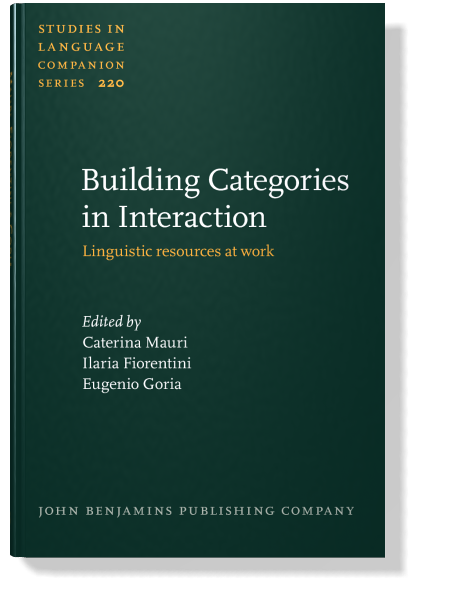
In:Building Categories in Interaction: Linguistic resources at work
Edited by Caterina Mauri, Ilaria Fiorentini and Eugenio Goria
[Studies in Language Companion Series 220] 2021
► pp. 373–414
Chapter 14French type-noun constructions based on
genre
From the creation of ad hoc categories to ad hoc categorization
Published online: 6 December 2021
https://doi.org/10.1075/slcs.220.14mih
https://doi.org/10.1075/slcs.220.14mih
Abstract
Colloquial French genre is highly
polysemous with a variety of functions such as comparison,
approximation and the fully pragmaticalized functions as a mitigator,
a quotative marker, an exemplifier, a marker of narrative progression,
explanation and focussing. So far, the focus has been on the various
discourse functions, however, several studies also point out possible
paths of pragmaticalization. The aim of this paper is to analyse in
greater detail the construction at the root of all these functions,
i.e. “X of the same type as Y”, a construction originally used for
construing ad hoc categories. This rather learned construction became
established in the 19th century for French and transformed into a
backgrounded instruction for sloppy categorization and the other
derived colloquial functions listed above.
Article outline
- 1.Introduction
- 2.Well-established categories and linguistic labels
- 3.Ad hoc categories
- 4.Taxonomies and taxonomic nouns
- 4.1The implicit and explicit reference to subkinds: Taxonomic readings
- 4.2Preposed and postposed taxonomic nouns and the conflation of
type and instance readings
- 4.2.1Conflation of type and instance readings: Taxonomic nouns supporting adjectival modification
- 4.2.2Conflation of type and instance readings: Postdeterminer uses
- 4.2.3From subkind specification to approximative ad hoc categorization
- 5.Constructions with genre building ad hoc
categories
- 5.1Ce genre de choses and related anaphoric constructions
- 5.2‘X of the same type as Y’ creating ad hoc categories
- 6.From ad hoc category to sloppy categorization: 20th and 21st century genre
- 6.1From ad hoc category to ad hoc categorization
- 6.2From comparison marker to approximation
- 6.3From comparison marker to exemplification marker to connecting uses
- 6.4A tentative semantic map for the pragmatic marker genre
- 7.Conclusion
Acknowledgements Notes References

References (63)
Aijmer, Karin. 2002. English Discourse Particles: Evidence from a
Corpus [Studies in Corpus Linguistics 10]. Amsterdam: John Benjamins.
Andersen, Gisle. 2001. Pragmatic Markers and Sociolinguistic Variation. A
Relevance-theoretic Approach to the Language of
Adolescents [Pragmatics & Beyond New Series 84]. Amsterdam: John Benjamins.
Beeching, Kate. 2007. A politeness-theoretic
approach to
pragmatico-semantic
change. Journal of Historical Pragmatics 8(1): 68–108.
Berlin, Brent. 1972. Speculations on the growth of ethnobotanical
nomenclature. Language in Society 1: 51–86.
. 1992. Ethnobiological classification: Principles of
Categorization of Plants and Animals in Traditional
Societies. Princeton NJ: Princeton University Press.
Brems, Lieselotte & Davidse, Kristin. 2010. The grammaticalization of nominal type noun
constructions with kind/sort of: Chronology
and paths of change. English Studies 91(2): 180–202.
Chauveau-Thoumelin, Pierre. 2016. De l’exemplification à la catégorisation
approximative: Étude de la construction [[X]SN genre
[Y]SN]. Congrès Mondial de Linguistique Française (CMLF
2016), Jul 2016, Tours, France. Actes du Congrès Mondial de Linguistique Française. <[URL]> (2 May 2017).
. 2018. Exemplification and ad hoc categorization: The
genre-construction in French. In Linguistic Strategies for the Construction of Ad Hoc
Categories: Synchronic and Diachronic Perspectives, Caterina Mauri & Andrea Sansò (eds). Special issue of Folia Linguistica 52(s39–1):): 177–199.
Cheshire, Jenny & Secova, Maria. 2018. The origins of new quotative expressions: The case
of Paris French. Journal of French Language Studies 28(2): 209–234.
Danon-Boileau, Laurent & Morel, Mary-Annick. 1997. Question, point de vue, genre,
style…: Les noms prépositionnels en français
contemporain. Faits de Langues 9: 193–200.
De Smedt, Liesbeth, Brems, Lieselotte & Davidse, Kristin. 2007. NP-internal functions and extended uses of the
‘type’ nouns kind, sort, and
type: Towards a comprehensive,
corpus-based description. Language & Computers 62(1): 225–255.
Dehé, Nicole & Stathi, Katerina. 2016. Grammaticalization and prosody: The case of
english sort/kind/type of
constructions. Language 92(4): 911–946.
Denison, David. 2002. History of the sort of
construction family. Paper presented at the Second International Conference on Construction
Grammar, Helsinki, 6–8 September 2002.
Dufaye, Lionel. 2016. GENRE ou le scénario d’une
grammaticalisation. LINX: Bulletin de Centre de Recherches Linguistiques de
Paris-X Nanterre 10: 45–59.
FRANTEXT = Base textuelle
FRANTEXT <[URL]>
FrTenTen12 = French Web 2012 <[URL]>
Gelman, Susan A. & Kalish, Chuck W. 2006. Conceptual development. In Handbook of Child Psychology, Vol. 2: Cognition,
Perception and Language, Deanna Kuhn & Robert S. Siegler (eds), 687–733. New York NY: Wiley & Sons.
Gelman, Susan A. & Brandone, Amanda C. 2010. Fast-mapping placeholders: Using words to talk
about kinds. Language Learning and Development 6(3): 223–240.
Godefroy, Frédéric. 1881–1902. Dictionnaire de l’ancienne langue française et de tous
ses dialectes du IXe au XVe
siècle. Paris: F. Vieweg.
Hampton, James A. 1997. Conceptual combination. In Knowledge, Concepts and Categories, Koen Lamberts & David R. Shanks (eds), 133–159. Cambridge MA: The MIT Press.
Haspelmath, Martin. 2003. The geometry of grammatical meaning: Semantic maps
and cross-linguistic comparison. In The New Psychology of Language, Vol. 2, Michael Tomasello (ed.), 211–242. Mahwah NJ: Lawrence Erlbaum Associates.
Haspelmath, Martin & Buchholz, Oda. 1998. Equative and similative constructions in the
languages of Europe. In Adverbial Constructions in the Languages of
Europe, Johan van der Auwera & Dónall Ó Baoill (eds), 277–334. Berlin: De Gruyter.
Heine, Bernd. 2002. On the role of context in
grammaticalization. In New Reflections on Grammaticalization [Typological Studies in Language 49], Ilse Wischer & Gabriele Diewald (eds), 83–101. Amsterdam: John Benjamins.
Isambert, Paul. 2016. Genre: Une mode récente mais qui
vient de loin. Journal of French Language Studies 26(1): 85–96.
Kaltenböck, Gunther, Heine, Bernd & Kuteva, Tania. 2011. On thetical grammar. Studies in Language 35(4): 852–897.
Knittel, Marie-Laurence. 2009. Taxonomic adjectives in French: A syntactic
account. <[URL]> (6 March 2019).
Kolyaseva, Alena F. 2018. The ‘new’ Russian quotative tipa:
Pragmatic scope and functions. Journal of Pragmatics 128: 82–97.
Kornfeld, Laura Malena. 2013. Atenuadores en la lengua coloquial
argentina. Lingüística 29(2): 17–49.
Lo Baido, Maria Cristina. 2018. Categorization via exemplification: Evidence from
Italian. In Linguistic Strategies for the Construction of Ad Hoc
Categories: Synchronic and Diachronic Perspectives, Caterina Mauri & Andrea Sansò (eds). Special issue of Folia Linguistica 52(s39–1): 69–95.
Marques, Aldina. 2015. “Tipo”: Référentiation et modalisation dans des
interactions verbales orales. In Travaux et documents 60, Maria Helena Araújo Carreira (ed.), 249–260. Paris: Université Paris 8.
Mauri, Caterina. 2017. Building and interpreting ad hoc categories: A
linguistic analysis. In Formal Models in the Study of Language: Applications in
Interdisciplinary Contexts, Joanna Blochowiak, Cristina Grisot, Stephanie Durrlemann-Tame & Christopher Laenzlinger (eds), 297–326. Berlin: Springer.
Mihatsch, Wiltrud. 2007. The construction of vagueness: ‘Sort of’
expressions in Romance languages. In Aspects of Meaning Constructing Meaning: From Concepts to
Utterances, Günter Radden, Klaus-Michael Koepcke, Thomas Berg & Peter Siemund (eds), 225–245. Amsterdam: John Benjamins.
. 2009. The approximators French comme,
Italian come, Portuguese
como and Spanish como
from a grammaticalization perspective. In Grammaticalization and Pragmatics: Facts, Approaches,
Theoretical Issues, Corinne Rossari, Claudia Ricci & Adriana Spiridon (eds), 65–91. Bingley: Emerald.
. 2010. „Wird man von Hustensaft wie so ne art bekifft?“
Approximationsmarker in romanischen Sprachen. Frankfurt: Klostermann.
. 2016b. Collectives, object mass nouns and individual
count nouns: nouns between lexical and inflectional plural
marking. In Lexical Plurals and Beyond, Peter Lauwers & Marie Lammert (eds). Special issue of Lingvisticæ Investigationes 39(2): 289–308.
. 2018. From ad hoc category to ad hoc categorization: The
proceduralization of Argentinian Spanish
tipo. In Linguistic Strategies for the Construction of Ad Hoc
Categories: Synchronic and Diachronic Perspectives, Caterina Mauri & Andrea Sansò (eds). Special issue of Folia Linguistica 52(s39–1): 147–176.
Hennecke, Inga & Mihatsch, Wiltrud (to appear). From taxonomic to pragmatic uses of French genre: Degrees of prosodic prominence as indicators of pragmaticalization. To appear in: Clear versus approximate categorisation: A crosslinguistic perspective, Hélène Vassiliadou & Marie Lammert (eds.) Cambridge Scholars.
Mihatsch, Wiltrud (to appear a). Germanic, Romance and Slavic taxonomic nouns and their functions: An overview. To appear in Type Noun Constructions in Slavic, Germanic and Romance Languages – Semantics and pragmatics on the move. Lieselotte Brems, Kristin Davidse, Inga Hennecke, Anna Kisiel, Alena Kolyaseva & Wiltrud Mihatsch (eds.) De Gruyter Series Trends in Linguistics. Studies and Monographs [TiLSM], 352. De Gruyter Mouton, URL: [URL]
(to appear b). A panoramic view of Romance taxonomic nouns and their derivatives. To appear in Type Noun Constructions in Slavic, Germanic and Romance Languages – Semantics and pragmatics on the move. Lieselotte Brems, Kristin Davidse, Inga Hennecke, Anna Kisiel, Alena Kolyaseva & Wiltrud Mihatsch (eds.) De Gruyter Series Trends in Linguistics. Studies and Monographs [TiLSM], 352. De Gruyter Mouton, URL: [URL]
OED = Murray, James. 1884. Oxford English Dictionary Online. Oxford: OUP. <[URL]> (2 May 2017).
Pereira Lima-Hernandes, Maria Célia. 2005. A interface sociolingüística / gramaticalização:
Estratificação de usos de tipo, feito, igual e
como. Sincronia e diacronia. PhD dissertation, University of Campinas.
Rosch, Eleanor, Mervis, Carolyn, Gray, Wayne, Johnson, David W. & Braem Penny Boyes. 1976. Basic objects in natural
categories. Cognitive Psychology 8: 382–439.
Rosenkvist, Henrik & Skärlund, Sanna. 2013. Grammaticalization in the present – The changes of
modern Swedish typ. In Synchrony and Diachrony: A Dynamic Interface [Studies in Language Companion Series 133], Anna Giacalone Ramat, Caterina Mauri & Piera Molinelli (eds), 313–338. Amsterdam: John Benjamins.
Rosier, Laurence. 2002. Genre: Le nuancier de la
grammaticalisation. Travaux de Linguistique 44(1): 79–88.
Rouget, Christine. 1997. Espèce de, genre de, sorte de: Approximatifs ou
sous-catégorisateurs? In Psychomécanique du langage. Problèmes et perspectives.
Actes du 7e Colloque International de
Psychomécanique du langage (Cordoue, 2–4 June 1994), Paulo de Carvalho & Olivier Soutet (eds), 289–298. Paris: Honoré Champion.
Sloutsky, Vladimir M. 2010. From perceptual categories to concepts: What
develops? Cognitive Science 34: 1244–1286.
Smith, Edward E. 1995. Concepts and categorization. In Thinking. An Invitation to Cognitive Science, Vol. 3, Edward E. Smith & D. N. Osherson (eds), 3–33. Cambridge MA: The MIT Press.
TLFi = Trésor de la Langue Française
informatisé <[URL]>
Ullman, Michael T. 2004. Contributions of memory circuits to language: The
declarative / procedural model. Cognition 92(1–2): 231–270.
van der Auwera, Johan. 2013. Semantic maps, for synchronic and diachronic
typology. In Synchrony and Diachrony: A Dynamic Interface [Studies in Language Companion Series 133], Anna Giacalone Ramat, Caterina Mauri & Piera Molinelli (eds), 153–176. Amsterdam: John Benjamins.
Vladimirska, Elena. 2016. Entre le dire et le monde: Le cas du marqueur
discursif genre. In Nouveaux regards sur l’approximation et la
précision, Silvia Adler, Hava Bat-Zeev Shyldkrot & Maria Asnes (eds), 195–209. Paris: Honoré Champion.
Voghera, Miriam. 2013. A case study on the relationship between
grammatical change and synchronic variation: The emergence
of tipo[-N] in Italian. In In Synchrony and Diachrony: A Dynamic Interface [Studies in Language Companion Series 133], Anna Giacalone Ramat, Caterina Mauri & Piera Molinelli (eds), 283–312. Amsterdam: John Benjamins.
Ward, Gregory & Birner, Betty. 1995. Definiteness and the English
existential. Language 71(4): 722–742.
Waxman, Sandra R. & Gelman, Susan A. 2010. Different kinds of concepts and different kinds of
words: What words do for human cognition. In The Making of Human Concepts [Oxford Series in Developmental Cognitive
Neuroscience], Denis Mareschal, Paul C. Quinn & Stephen E. G. Lea (eds), 99–129. Oxford: OUP.
Cited by (1)
Cited by one other publication
Mihatsch, Wiltrud & Ana Vazeilles
2024. Diatopic variation as evidence for diachronic changes in the 20th and 21st centuries. In Language Change in the 20th Century [Pragmatics & Beyond New Series, 340], ► pp. 120 ff.
This list is based on CrossRef data as of 3 december 2025. Please note that it may not be complete. Sources presented here have been supplied by the respective publishers. Any errors therein should be reported to them.