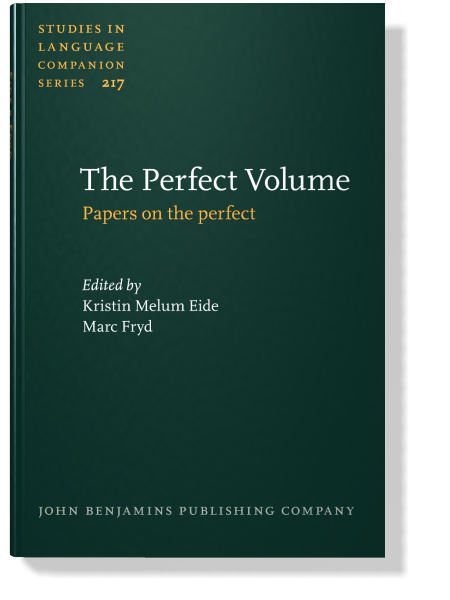
In:The Perfect Volume: Papers on the perfect
Edited by Kristin Melum Eide and Marc Fryd
[Studies in Language Companion Series 217] 2021
► pp. v–vii
Get fulltext
This article is available free of charge.
Published online: 9 July 2021
https://doi.org/10.1075/slcs.217.toc
https://doi.org/10.1075/slcs.217.toc
Table of contents
Chapter 1.The perfect volume: Papers on the perfect1
Kristin Melum Eide
Marc Fryd
Part I.Perfects and their relatives: Typology, diachrony, and variation
Chapter 2.“Universal” readings of perfects and iamitives in typological
perspective43
Östen Dahl
Chapter 3.Perfect and its relatives in Atayal65
Irene Gorbunova
Chapter 4.Structural and functional variations of the perfect in the Lezgic
languages87
Timur Maisak
Chapter 5.Cross-linguistic parallels and contrasts in a contact language perfect
construction117
Peter Slomanson
Chapter 6.Perfect and negation: Evidence from Lithuanian and sundry languages137
Peter Arkadiev
Chapter 7.The diachrony of the perfect in Zapotec163
George Aaron Broadwell
Part II.Perfect extensions, hodiernality and aoristic drift
Chapter 8.More on hodiernality181
Teresa Maria Xiqués
Chapter 9.The impact of the simultaneity vector on the temporal-aspectual
development of the perfect tense in Romance languages213
Susana Azpiazu Torres
Chapter 10.Gauging expansion in synchrony: The periphrastic perfect in nineteenth-century Rioplatense
Spanish241
Celeste Rodriguez Louro
Guro Fløgstad
Part III.Morphology of perfects: Development, selection and omission
Chapter 11.The rise of the periphrastic perfect tense in the continental West
Germanic languages261
Hans Broekhuis
Chapter 12.On the emergence of auxiliary selection in Germanic291
Ida Larsson
Chapter 13.Language contact and competition in the periphrastic perfect in Early
English319
Tamás Eitler
Gábor Vadász
Chapter 14.The Swedish perfect and periphrasis343
Fredrik Heinat
Chapter 15.“Have-less perfects” in Norwegian: An Old Norse heritage365
Kristin Melum Eide
Chapter 16.From have-omission to supercompounds: A wealth of English perfects397
Marc Fryd
Chapter 17.Auxiliary reduction in secondary grammaticalization: Evidence from the Spanish periphrastic past439
Chad Howe
Chapter 18.The functions of the auxiliary ‘have’ in Australian English vivid
narratives461
Marie-Eve Ritz
Sophie Richard
Index479
