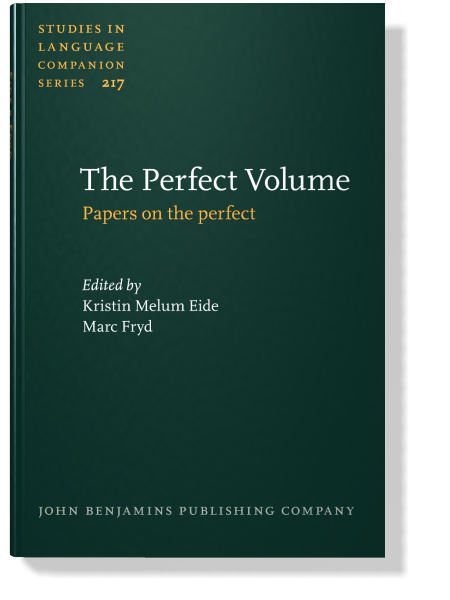
In:The Perfect Volume: Papers on the perfect
Edited by Kristin Melum Eide and Marc Fryd
[Studies in Language Companion Series 217] 2021
► pp. 365–396
Chapter 15“Have-less perfects” in Norwegian
An Old Norse heritage
Published online: 9 July 2021
https://doi.org/10.1075/slcs.217.15eid
https://doi.org/10.1075/slcs.217.15eid
Abstract
The constructions I investigate in this paper
can all be subsumed under the heading ‘have-omission’. This is also
the traditional analysis, to assume an omission of a semantically
superfluous auxiliary in these structures. A different perspective
however, and one that I will advocate here, is that there was never
an auxiliary there in the first place. From this perspective, the
constructions thus do not lack a perfect auxiliary (as the term
‘have-omission’ dictates), but instead these constructions employ
what only morphologically looks like a supine, i.e. an uninflected
past participle, in a syntactic function where you would expect a
different form (i.e. a preterit or an infinitive). Semantically
these constructions display a modal reading; counterfactuality or
irrealis, which I argue is conveyed by the supine-looking from
itself, and a linguistic heritage from Old Norse. Their
morphological, semantic, and syntactic traits suggest a common
underlying explanation for these constructions, and instead of
attributing these features to an invisible auxiliary, my explanation
puts the emphasis on the contribution of the visible element, the
“supine”.
Article outline
- 1.Introduction
- 2.The preterit subjunctive
- 2.1Preterit subjunctive in Old Norse
- 2.2Preterit subjunctive in Norwegian dialects
- 3.The supine form as a non-finite subjunctive marker
- 3.1The modal functions of past tense forms
- 4.Supine-for-infinitive constructions
- 4.1Preterit modal+ supine
- 4.2Perfect modal + supine
- 4.3Infinitival marker + supine
- 5.Conclusion
Acknowledgements Notes Abbreviations References

References (67)
Aa, Leiv Inge, Eide, Kristin Melum & Åfarli, Tor Anders. 2014. Somme mytar er fort avkledde: Perfektum partisipp
i dialektkorpuset. In Språk i Norge og nabolanda, Jane Bondi Johannessen & Kristin Hagen (eds), 217–240. Oslo: Novus.
Askedal, John Ole. 1994. Norwegian. In The Germanic Languages, Ekkehard König & & Johan van der Auwera (eds), 219–270. London: Routledge.
Barbiers, Sjef. 1995. The Syntax of Interpretation. PhD dissertation, University of Leiden.
Boogart, Ronny. 2007. The past and perfect of epistemic
modals. In Recent Advances in the Syntax and Semantics of Tense,
Mood and Aspect, Louis de Saussure, Jacques Moeschler & Genoveva Puskas (eds). Berlin: Mouton de Gruyter.
Carrasco Gutiérrez, Ana. 2018. On perfect(ive) morphology above and below
modals. The H-ident hypothesis. Catalan Journal of Linguistics 17: 77–116.
Davidsen-Nielsen, Niels. 1988. On tense and mood in English and Danish. Ms, Copenhagen School of Economics, Business Administration, and Modern Languages.
Dyvik, Helge. 1999. The universality of f-structure: Discovery or
stipulation? The case of modals. In Proceedings of the LFG99 Conference, Miriam Butt & Tracy Holloway King (eds). Stanford CA: CSLI.
Dørum, Hallvard. 2000. Preteritum konjunktiv i norske (og diverse andre)
målføre. Norsk Lingvistisk Tidsskrift 18, 143–182.
Eide, Kristin Melum. 2002. Norwegian Modals. PhD dissertation, NTNU.
. 2009a. Finiteness: The haves and the
have-nots. In Advances in Comparative Germanic Syntax [Linguistik Aktuell/Linguistics Today 141], Artemis Alexiadou, Jorge Hankamer, Thomas McFadden, Justin Nuger & Florian Schäfer (eds), 357–390. Philadelphia: John Benjamins.
. 2009b. Tense, finiteness and the survive principle:
Temporal chains in a crash-proof grammar. In Towards a Derivational Syntax:
Survive-minimalism [Linguistik Aktuell/Linguistic Today 144], Michael Putnam (ed.), 91–132. Amsterdam: John Benjamins.
. 2010. Mood in Norwegian. In Mood in European Languages [Studies in Language Companion Series 120], Björn Rothstein & Rolf Thieroff (eds), 56–70. Amsterdam: John Benjamins.
. 2011a. Modals and the present perfect. In Proceedings from Chronos 7, Walter De Mulder (ed.). Amsterdam: Rodopi.
. 2011b. The ghost of the Old Norse subjunctive: The
Norwegian subjunctive participle. Groninger Arbeiten zur germanistischen
Linguistik 53 (2): 1–28.
. 2017. Counterfactual present perfects. In Aorists and Perfects. Synchronic and Diachronic
Perspectives [Cahiers Chronos 29], Marc Fryd & Pierre-Don Giancarli (eds), 245–288. Leiden: Brill.
Fagan, Sarah. 2001. Epistemic modality and tense in
German. Journal of Germanic Linguistics 13(3): 197–230.
Falk, Cecilia. 2010. The interaction of temporal and modal auxiliaries
in counterfactual contexts in Swedish. Tampa Papers in Linguistics 1: 1–12.
Falk, Hjalmar & Torp, Alf. 1900. Dansk-norskens syntax i historisk fremstilling. Kristania: Aschehoug.
Fryd, Marc. 2017. Some remarks on have-less perfect constructions
in English. In Aorists and Perfects: Synchronic and Diachronic
Perspectives [Cahiers Chronos 29], Marc Fryd & Pierre-Don Giancarli (eds), 203–244. Amsterdam: Brill.
Garbacz, Piotr & Larsson, Ida. 2014. Omission of auxiliary
have
. Nordic Atlas of Language Structures (NALS)
Journal 1: 396–405
Hinterhölzl, Roland. 2008. The IPP-effect, phrasal affixes and repair
strategies in the syntax. <[URL]> (2 November 2020).
Johannessen, Janne Bondi, Priestley, Joel, Hagen, Kristin, Åfarli, Tor Anders & Vangsnes, Øystein Alexander. 2009. The Nordic Dialect Corpus – An advanced research
tool.
Joos, Martin. 1964. The English Verb: Form and Meanings. Madison WI: The University of Wisconsin Press.
Julien, Marit. 2000. Optional ha in Swedish and
Norwegian. Working Papers in Scandinavian Syntax 66: 33–74. Lund: University of Lund.
. 2002. Optional ha in Swedish and
Norwegian. The Journal of Comparative Germanic Linguistics 5(1–3): 67–95.
Laca, Brenda. 2016. Epistemic modality and perfect morphology in
Spanish and French. <[URL]> (2 November 2020).
Lindstad, Arne Martinus, Nøklestad, Anders, Johannessen, Janne Bondi, Vangsnes, Øystein Alexander. 2009: The Nordic Dialect Database: Mapping
microsyntactic variation in the Scandinavian
languages. In Proceedings of the 17th Nordic Conference of
Computational Linguistics NODALIDA 2009 [NEALT Proceedings Series; Vol. 4], Kristiina Jokinen & Eckhard Bick (eds). <[URL]> (2 November 2020).
Martin, Fabienne. 2011. Epistemic modals in the past. In Romance Languages and Linguistic Theory 3, Janine Berns, Haike Jacobs & Tobias Scheer (eds), 185–202. Amsterdam: John Benjamins.
Moore Smith, G. C. 1910. The omission of ‘have’ before a past
participle. The Modern Language Review 5(3): 346–347.
Nygård, Mari. 2010. Licensing of discourse ellipses in spoken
Norwegian. Talk at the Conference Language Contact and Change. Grammatical
Structure Encounters the Fluidity of Language, Trondheim,
Norwegian University of Science and Technology, 22 September.
. 2013. Discourse Ellipsis in Spontaneously Spoken
Norwegian. Clausal Architecture and Licensing
Conditions. PhD dissertation, NTNU.
Ommeren, Rikke van. 2011. “Ja, jæi la an på å tålå oppdaling,
ja”. En sosiolingvistisk studie av språklige praksisformer blant
voksne innvandrere i Oppdal. MA thesis, Norwegian University of Science and Technlology.
Plank, Frans. 1984. The modals story retold. Studies in Language 8: 305–364.
. 2008. Norske syntaktiske “avvik” i
norsk (Norwegian “deviations” in
Norwegian.] In Banebryter og brobygger i andrespråksfeltet. En Samling
artikler i anledning Jon Erik Hagens 60-årsdag, Cecilie Hamnes Carlsen, Eli Moe, Reidun Oanæs Andersen & Karl Tenfjord (eds), 179–190. Olso: Novus Forlag.
Spurkland, Terje. 2002 [1987]. Språkutviklingen før 1814. In Vårt eget språk I, 2nd edn, Egil Børre Johnsen (ed.), 20–65. Oslo: Aschehoug & Co.
Stowell, Tim. 1996. The phrase structure of tense. In Phrase Structure and the Lexicon [Studies in Natural Language and Linguistic Theory
33], Johan Rooryck & Laurie Zaring (eds), 277–291. Dordrecht: Kluwer.
. 2004. Tense and modals. In The Syntax of Time, Jacqueline Guéron & Jacqueline Lecarme (eds), 621–635. Cambridge MA: The MIT Press.
Sæbø, Kjell Johan. 2009. A Scandinavian mood recovered: The semantics of the surreal supine. Talk/Handout at NORMS Workshop: Counterfactuality and auxiliaries in Nordic Languages. Dec 7–8, 2009.
Taraldsen, Knut Tarald. 1984. Some phrase structure dependent differences
between Swedish and Norwegian. Working Papers in Scandinavian Syntax 9.
Thieroff, Rolf. 2004. The subjunctive mood in German and the Germanic
languages. In Focus on Germanic Typology [Studia Typlogica 6], Werner Abraham (ed.). Berlin: Akademie Verlag.
Vikner, Sten. 1988. Modals in Danish and event
expressions. Working Papers in Scandinavian Syntax 39: 1–33. Lund: Dept. of Scandinavian Linguistics, Lund University.
Weerman, Fred. 1989. The V2 Conspiracy. A Synchronic and Diachronic Analysis
of Verbal Positions in Germanic Languages. Dordrecht: Foris.
Wiklund, Anna-Lena. 1998. Morphosyntactic Parasites as Underspecified
Heads: On the Double Supine Construction, unpublished licentiate thesis, Umeå University.
. 2005. The Syntax of Tenselessness. On Copying
Constructions in Swedish. PhD dissertation, University of Umeå.
. 2007. The Syntax of Tenselessness: Tense/Mood/Aspect-agreeing
Infinitivals [Studies in Generative Grammar 92]. Berlin: Mouton de Gruyter.
Wurmbrand, Susi. 2015. Verb clusters, verb raising and
restructuring. <[URL]> (2 November 2020).