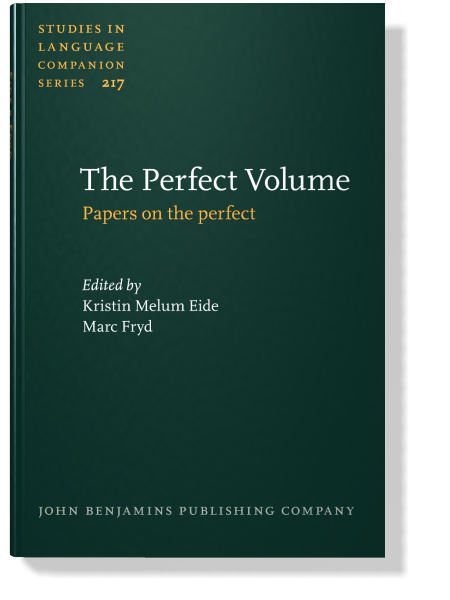
In:The Perfect Volume: Papers on the perfect
Edited by Kristin Melum Eide and Marc Fryd
[Studies in Language Companion Series 217] 2021
► pp. 163–178
Chapter 7The diachrony of the perfect in Zapotec
Published online: 9 July 2021
https://doi.org/10.1075/slcs.217.07bro
https://doi.org/10.1075/slcs.217.07bro
Abstract
Colonial Valley Zapotec (CVZ) is the form of
Zapotec spoken in the Valley of Oaxaca during the Spanish colonial
period (ca 1550–1810 C.E.). CVZ is known to us from written
documents only. CVZ had a distinct perfect morpheme, which has
largely disappeared in modern Zapotec languages. This chapter
surveys descriptions of the perfect in colonial grammars, as well as
corpus evidence to describe the range of uses of perfect morphology.
It contrasts the colonial system with the aspectual system of modern
Zapotec to trace the diachronic development of aspectual morphology
in these languages.
Keywords: Zapotec, historical, overlap, evaluative, progressive
Article outline
- 1.Introduction
- 1.1Modern Zapotec languages and Colonial Valley Zapotec
- 1.2Zapotec verb morphology
- 1.3Aspect systems in modern Central Zapotec
- 1.3.1Guevea de Humboldt Zapotec
- 1.4The aspect system of Isthmus Zapotec
- 2.The aspectual system of Colonial Valley Zapotec
- 3.The wa- morpheme in Colonial Valley
Zapotec
- 3.1Two colonial grammars: Cordova (1578) and Levanto (1732)
- 3.2Cordova’s description
- 3.3Perfects in Levanto (1732)
- 3.4Textual evidence
- 3.4.1Evaluative or evidential
- 3.4.2Durative
- 3.4.3Perfect senses
- 4.Historical development and semantic shift of wa–
- 5.Conclusions
Notes Abbreviations References

References (15)
Briggs, Elinor. 1961. Mitla Zapotec Grammar. Mexico City: Instituto Lingüístico de Verano and Centro de Investigaciones Antropológicas de México.
Broadwell, George A. 2015. The historical development of the progressive
aspect in Central Zapotec. International Journal of American Linguistics 81:151–185.
Cordova, Juan de. 1578. Arte en lengva zapoteca. Mexico: Casa de Pedro Balli. Republished by Nicolás León as Arte del idioma zapoteco de Juan de
Córdova (Imprenta del Gobierno en la Escuela de Artes, Morelia, Michoacán, 1886). A facsimile edition of León’s edition was published as
Arte del idioma zapoteco (Ediciones Toledo and INAH, Mexico City, 1987).
Lee, Felicia A. 1997. Evidence for tense in a ‘tenseless’
language. In Proceedings of NELS 29, P. Tamagi, M. Hirotani & N. Hall (eds). Amherst MA: GLSA.
2006. Remnant Raising and VSO Clausal Architecture: A Case
Study from San Lucas Quiaviní Zapotec. New York NY: Springer.
Levanto, Leonardo. 1732. Arte de la lengua zapoteca. John Carter Brown
Library Manuscript. <[URL]> (29 October 2020).
Mock, Carol C. 1990. Temporal orientation without tenses: The deixis
of time in Isthmus Zapotec. In Beatriz Garza and Paulette Levy, eds. Homenaje a Jorge A. Suárez: Lingüística indoamericana e
hispánica. 367–79. México: Colegio de México.
Munro, Pamela & Felipe H. Lopez et al. 1999. X:tèe’n Dìi’zh Sah Sann Lu’uc: San Lucas Quiaviní
Zapotec dictionary: Diccionario zapoteco de San Lucas
Quiaviní. Los Angeles CA: Chicano Studies Research Center.
Pickett, Velma B. 1989. Aspect in Isthmus Zapotec. In General and Amerindian Ethnolinguistics: In Remembrance
of Stanley Newman, Mary Ritchie Key & Henry M. Hoenigswald (eds), 229–243. Berlin: Mouton de Gruyter.
Pickett, Velma B., Black, Cheryl & Marcial Cerqueda, Vicente. 2001. Gramática popular del zapoteco del Istmo, 2nd edn. Juchitán, Oaxaca: Centro de Investigación y Desarrollo Binnizá and Instituto Lingüístico de Verano. <[URL]>
Ritz, Marie-Eve. 2012. Perfect tense and aspect. In Oxford Handbook of Tense and Aspect, Robert I. Binnick (ed.). Oxford: OUP.
Smith Stark, Thomas C. 2004. El progresivo en zapoteco. Ponencia para el VII congreso nacional de
lingüística. Ms, Universidad de Guadalajara.
2008. La flexion de tiempo, aspecto y modo en el verbo
del zapoteco colonial del valle. In Coloquio Francisco Belmar: Las lenguas otomangues
oaxaqueñas ante el siglo xxi, Ausencia López Cruz & Michael Swanton (eds), 377–419. Oaxaca: Biblioteca Francisco de Burgoa, UABJO and Fundación Alfredo HarpHelú Oaxaca.