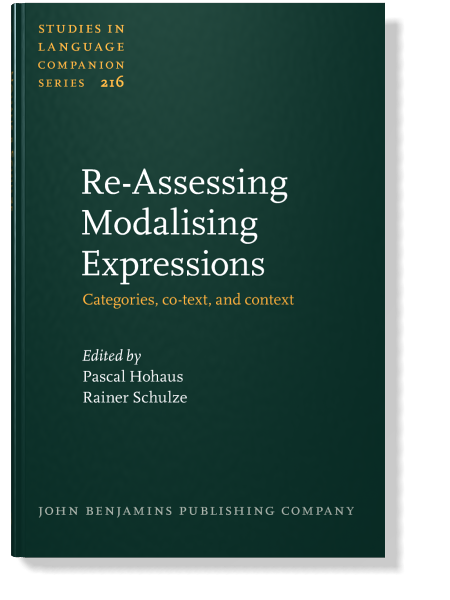
In:Re-Assessing Modalising Expressions: Categories, co-text, and context
Edited by Pascal Hohaus and Rainer Schulze
[Studies in Language Companion Series 216] 2020
► pp. 281–310
Chapter 11
On the (con)textual properties of must, have
to and shall
An integrative account
Published online: 12 November 2020
https://doi.org/10.1075/slcs.216.11fur
https://doi.org/10.1075/slcs.216.11fur
Abstract
This paper focuses on the (con)textual properties of root
must, shall and have to. It is
conducted within an evolving framework, Integrative Grammar. The account of the
three modal forms that is given here is integrative in two senses. First, it shows
that traditional semantic descriptions fail to account for how these forms are used
in discourse and that a comprehensive characterisation of their conditions of use
requires that (con)textual factors be taken into consideration. Two contextual
levels are considered: the distribution of the modal forms according to discourse
modes and their propensity to be used within specific discourse sequences. Second,
this study shows that these (con)textual features and the forms’ semantic, pragmatic
and even syntactic properties are interconnected and throw light upon one
another.
Article outline
- 1.Introduction
- 2.Discourse modes
- 3. Modality: Basic concepts
- 4.Method
- 5.Results and discussion
- 5.1Root must
- 5.2Deontic shall
- 5.3Root have to
- 6.Conclusion
Acknowledgments Notes References Appendix

References (35)
Adam, Jean-Michel. 1992. Les
textes: Types et prototypes: Récit, description, argumentation, explication et
dialogue. Paris: Armand Colin.
Biber, Douglas, Johansson, Stig, Leech, Geoffrey, Conrad, Susan & Finegan, Edward. 1999. Longman
Grammar of Spoken and Written
English. London: Longman.
British
National Corpus, version 2 (BNC
World). 2001. Distributed
by Oxford University Computing Services on behalf of the BNC Consortium. <[URL]> (3 June
2020).
Cibois, Philipe. 2013. TrideuxOri (Version
5.2) [Software]. <[URL]> (3 June
2020).
Fraser, Bruce. 1975. Hedged
performatives. In Syntax
and Semantics, Vol. 3, Peter Cole & Jerry L. Morgan (eds), 187–210. New York NY: Academic Press.
Furmaniak, Grégory. 2010. A
frame-based approach to modality: The case of
obligation. The Belgian Journal of
Linguistics 24: 17–35.
. 2017. La
modalité dans les textes. Essai de caractérisation des propriétés textuelles des
expressions du nécessaire en anglais
contemporain. Habilitation
dissertation, Université Paris-Sorbonne.
. 2019. Les
propriétés textuelles des formes modales anglaises: Vers une Grammaire
Intégrative. Paper given at the Conference on
‘Le possible et le nécessaire. Domaines conceptuels et expressions de la
modalité’, Pau, October
2019.
. 2020. Sur les spécificités discursives de (be) likely
. Lexis 15 <[URL]> (25 July 2020).
Hermerén, Lars. 1978. On
Modality in English: A Study of the Semantics of the
Modals. Lund: Gleerup.
Huddleston, Rodney D. & Pullum, Geoffrey K. 2002. The
Cambridge Grammar of the English
Language. Cambridge: CUP.
Krazem, Mustapha. 2011. Présentation:
Du genre vers la
grammaire. Linx 64–65. <[URL]> (3 June
2020).
Krug, Manfred G. 2000. Emerging
English Modals: A Corpus-Based Study of
Grammaticalization. Berlin: Mouton de Gruyter.
Leech, Geoffrey. 2000. Grammars
of spoken English: New outcomes of corpus-oriented
research. Language
Learning 50(4): 675–724.
Martínez, Iliana A. 2005. Native
and non-native writers’ use of first person pronouns in the different sections
of biology research articles in English. Journal
of Second Language
Writing 14(3): 174–190.
Meurer, José Luiz. 2002. Genre
as diversity, and rhetorical mode as unity in language
use. Ilha do
Desterro 43: 61–82.
Michaelis, Laura A. 2005. Entity
and event coercion in a symbolic theory of
syntax. In Construction
Grammar(s): Cognitive Grounding and Theoretical
Extensions [Constructional Approaches to Language
3], Jan-Ola Östman & Mirjam Fried (eds), 45–88. Amsterdam: John Benjamins.
Myhill, John. 1995. Change
and continuity in the functions of the American English
modals. Linguistics 33: 157–211.
Nuyts, Jan. 2001. Epistemic
Modality, Language, and Conceptualization [Human
Cognitive Processing
5]. Amsterdam: John Benjamins.
Pic, Elsa & Furmaniak, Grégory. 2012. Les
modes de discours, interface entre texte et grammaire dans les langues de
spécialité. ASp 62: 25–44.
Simon-Vandenbergen, Anne-Marie & Aijmer, Karin. 2007. The
Semantic Field of Modal Certainty: A Corpus-based Study of English
Adverbs. Berlin: Mouton de Gruyter.
Cited by (2)
Cited by two other publications
Furmaniak, Grégory
2025. On the semantics of English modal expressions. In Possibility and Necessity [Studies in Language Companion Series, 237], ► pp. 166 ff.
This list is based on CrossRef data as of 3 december 2025. Please note that it may not be complete. Sources presented here have been supplied by the respective publishers. Any errors therein should be reported to them.