In:Re-Assessing Modalising Expressions: Categories, co-text, and context
Edited by Pascal Hohaus and Rainer Schulze
[Studies in Language Companion Series 216] 2020
► pp. 225–252
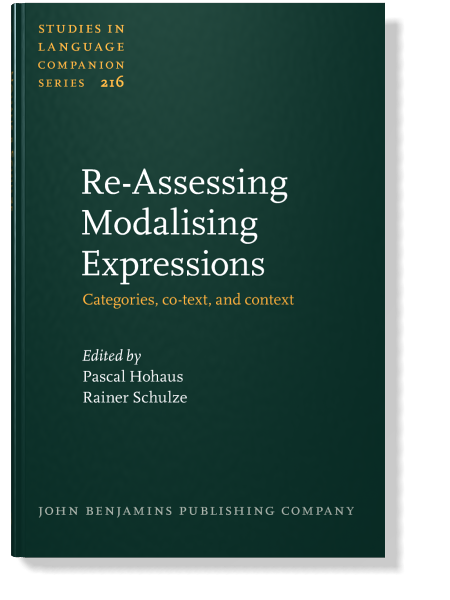
Chapter 9
A genre-based analysis of evaluative modality in multi-verb sequences in
English
Published online: 12 November 2020
https://doi.org/10.1075/slcs.216.09mat
https://doi.org/10.1075/slcs.216.09mat
Abstract
This paper explores the nature of evaluative modality in
multi-verb sequences with the deictic verb go as the first verb in
English. It deals with four types of multi-verb sequences: go-and-V,
go-to-V, go-V, and go-Ving. First, the paper proposes a
general classification of multi-verb sequences. Second, by using the concepts of
cotext and context, it shows the characteristics
of each type of multi-verb sequence from the viewpoints of inflection of the first
verb, the second verb selection, and genres of language use. Consequently, one
conclusion can be drawn: while the go-to-V, go-V, and
go-Ving sequences allow for a cotext-based interpretation, the
go-and-V sequence can allow for both cotext-based and
context-based interpretations.
Keywords: multi-verb sequence, evaluative modality, deixis, genre, frequency
Article outline
- 1.Introduction
- 2.Descriptive and methodological background
- 2.1Working definitions of cotext and context
- 2.2The deictic motion verb go
- 2.3General classification of multi-verb sequences with the first verb go
- 2.4Relation between cotext and context
- 3.Four types of multi-verb sequences with the attenuated
go
- 3.1The go-to-V sequence
- 3.2The go-Ving sequence
- 3.3The go-and-V sequence
- 3.4 The go-V sequence
- 4.Quantitative data of the go-and-V sequence
- 5.Concluding remarks
Acknowledgments Notes References

References (28)
Biber, Douglas, Johansson, Stig, Leech, Geoffrey, Conrad, Susan & Finegan, Edward. 1999. Longman
Grammar of Spoken and Written English. New York NY: Longman.
Bolinger, Dwight. 1983. The
go-progressive and
auxiliary-formation. In Essays
in Honor of Charles F. Hockett, Frederick B. Agard, Gerold Kelley, Adam Makkai & Valerie Becker Makkai (eds), 153–167. Leiden: E.J. Brill.
Bourdin, Philippe. 2003. On
two distinct uses of go as a conjoined marker of evaluative
modality. In Modality
in Contemporary English [Topics in English Series
44], Roberta Facchinetti, Manfred Krug & Frank Palmer (eds), 349–373. Berlin: Mouton de Gruyter.
Carden, Guy & Pesetsky, David. 1977. Double-verb
constructions, markedness, and a fake
co-coordination. CLS 13: 82–92.
Fillmore, Charles J. 1971. Santa
Cruz Lectures on Deixis. Bloomington IN: Indiana University Linguistics Club.
Gesuato, Sara. 2009.
Go
to V: Literal meaning and metaphorical
extensions. In Corpora:
Pragmatics and Discourse, Papers form the 29th International Conference on
English Language Research on Computerized Corpora (ICAME
29), Andreas H. Jucker, Daniel Schreier & Marianne Hundt (eds), 343–360. Amsterdam: Rodopi.
Goffman, Erving. 1974. Frame
Analysis: An Essay on the Organization of
Experience. New York NY: Harper and Row.
Goldberg, Adele E. 2006. Constructions
at Work: The Nature of Generalization in
Language. Oxford: OUP.
Goodwin, Charles & Duranti, Alessandro. 1992. Rethinking
context introduction: An
. In Rethinking
Context: Language as an Interactive Phenomenon, Alessandro Duranti & Charles Goodwin (eds), 1–42. Cambridge: CUP.
Halliday, Michael A. K., McIntosh, Angus & Strevens, Peter. 1964. The
Linguistic Sciences and Language
Teaching. London: Longman.
Halliday, Michael A. K. 1978. Language
as Social Semiotic: The Social Interpretation of Language and
Meaning. London: Edward Arnold.
Huddleston, Rodney & Pullum, Geoffrey K. 2002. The
Cambridge Grammar of the English
Language. Cambridge: CUP.
Jaeggli, Osvald A. & Hyams, Mina M. 1993. On
the independence and interdependence of syntactic and morphological properties:
English aspectual come and
go
. Natural Language and
Linguistic
Theory 11: 313–346.
Matsumoto, Noriko. 2015. Multi-Verb
Sequences in English: Their Classification and
Functions. PhD
dissertation, Kobe University.
Newman, John & Rice, Sally. 2008. Asymmetry
in English multi-verb sequences: A corpus-based
approach. In Asymmetric
Events [Converging Evidence in Language and
Communication Research 11], Barbara Lewandowska-Tomaszczyk (ed.), 3–24. Amsterdam: John Benjamins.
Pullum, Geoffrey K. 1990. Constraints
on intransitive quasi-serial verb constructions in modern colloquial
English. Ohio State University Working Papers in
Linguistics 218–239.
Quirk, Randolph, Greenbaum, Sidney, Leech, Geoffrey & Svartvik, Jan. 1985. A
Comprehensive Grammar of the English
Language. London: Longman.
Salkie, Raphael. 2010. On
going
. In Distinction
in English Grammar: Offered to Renaat Declerck, Bert Cappelle & Naoki Wada (eds), 169–190. Tokyo: Kaitakusha.
Schönefeld, Doris. 2013.
It
is … quite common for theoretical predictions to go untested
(BNC_CMH). A register-specific analysis of the English go
un-V-ed construction. Journal of
Pragmatics 52: 17–33.
Stefanowitsch, Anatol. 1999. The
go-and-verb construction in a cross-linguistic perspective:
Image-schema blending and the construal of
events. Proceedings of the Second Annual High
Desert Linguistic Society
Conference, 123–134.
Visser, Frederik Theodoor. 1969. An
Historical Syntax of the English Language, Part Three, First Half, Syntactical
Units with Two
Verbs. Leiden: E. J. Brill.